Rossini Opera Festival 2026 Review: L’occasione fa il ladro
By Bernardo Gaitan(Photo: Rossini Opera Festival)
Written in just fifteen days in 1812 for Venice’s Teatro San Moisè, this one-act burletta per musica belongs to the extraordinary period of the composer’s youth when, at just 20 years old, Rossini seemed capable of turning even the most seemingly minor plot into a theatrical mechanism of breathtaking precision, sustained by music of the highest caliber.
The simplicity of the plot should not be mistaken for dramatic poverty. The story begins with a mix-up involving a suitcase: Count Alberto and Don Parmenione accidentally exchange their luggage, leading everyone to believe that Don Parmenione is Alberto. This triggers romantic misunderstandings, lies, and comic situations, until the truth is finally revealed and everything is summed up in the phrase: the opportunity makes a thief.
The ability to transform a classic comedy of mistaken identities into a metaphysical theatrical universe explains the extraordinary success of the production that Jean-Pierre Ponnelle created for the ROF back in 1987. Conceived when the French regista was already in the final stretch of his career and premiered just one year before his death, the production constitutes a sort of Rossinian artistic testament, with strong echoes of his celebrated staging of “Cenerentola”.
This production was revived in Pesaro in 1989, 1996, and 2013, thus acquiring an emblematic status within the history of the ROF with each passing decade. Some productions grow old; Ponnelle’s, by contrast, continues to work. The revival, taken up again in 2026 by Sonja Frisell, confirms that traditional old-school productions can prove far more resistant to the passage of time than any technological sophistication. An immense number of rehearsals must have been required to keep the pace as lively and entertaining as it is; the interaction between the performers and the stage elements is essential for the comedy to flow as it did.
On the bare stage appears Martino, Parmenione’s servant, carrying the aforementioned suitcase. The large piece of luggage he brings with him becomes the true symbolic and dramaturgical center of the production: first, wooden structures, ropes, and supports emerge from it, used to construct, before the audience’s eyes, the different settings of the comedy during the overture. The stagehands literally build the set with whatever comes out of the suitcase. Then the characters and other objects begin to emerge from it as well. The costumes, also originally designed by Ponnelle, make use of a range of discreet pastel colors that reinforce the production’s elegant, eighties-inspired, and fairy-tale-like character. Fabio Rossi’s lighting completes the deliberately warm visual universe, although at certain moments, such as during the storm in the opening scene and the tense passages, the lighting plays a fundamental role. At the end of the performance, the sets disappear and everything returns to the suitcase, as if what had happened were nothing more than a fairy tale. Ponnelle’s idea thus becomes a metaphor for the farce itself: a stroke of genius that continues to work.
In the pit, the particularly effective baton of Alessandro Bonato, who makes his ROF debut with this title, offered an especially distinguished musical performance. His Rossinian reading combines precision, agility, and control with transparency, elegance, and a rich variety of colors. His choices were dynamic and purposeful; his knowledge of the belcanto style is evident, as the famous final strette -although not yet fully developed in this period- possess all their energy, as they should. The Orchestra Sinfonica G. Rossini responded with a clean, flexible, and gentle sound, always at the service of the singers and Bonato. The Veronese conductor thus demonstrated a remarkable command of the buffo genre, and his debut proved a success. The recitatives, accompanied on fortepiano and cello by Giulio Zappa and Jacopo Muratori, respectively, were effective and dynamic.
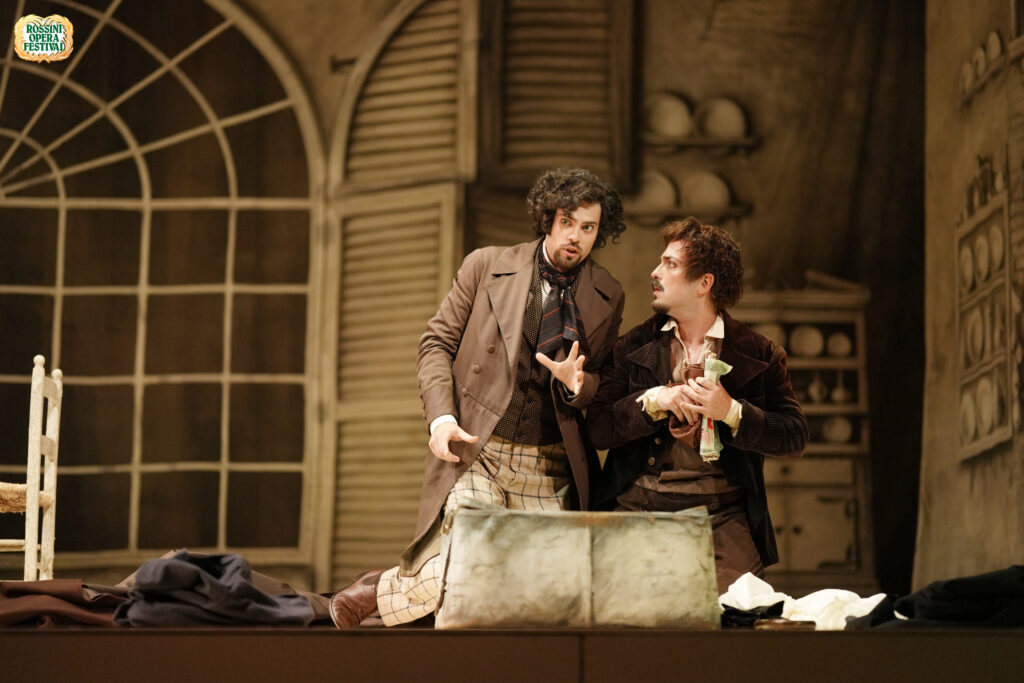
Photo: Rossini Opera Festival
The cast, made up of young performers, works with remarkable balance and, above all, a very clear awareness of the Rossinian style. Without a doubt, the triumph of the evening was Damiana Mizzi, who tackled the role of Berenice with an instrument ideally suited to the part, particularly comfortable in the upper register, allowing her to shine in the virtuosic demands of the score. Her cavatina, “Vicino è il momento,” stands out for the cleanliness of her legato and a well-supported vocal line, while in the duet “Voi la sposa pretendete” she confirms the security of her high notes, as well as her vis comica, clean coloratura, and correct pronunciation. The Italian soprano gave a correct and musically polished performance, although she could bring greater personality to the role in order to make the character a perfect one.
Matteo Mancini brings Don Parmenione an ideal physical presence for the role, as well as an interesting comic quality. Vocally, his bright and powerful voice is well on its way toward the Rossinian style, with a clear emission and a sufficiently secure vocal line. The Pesaro-born baritone was convincing and extremely funny in “Che sorte, che accidente,” as well as in the duet with Berenice, where he demonstrated confidence and a strong command of both the vocal and stage style.
Count Alberto, sung by Dave Monaco, is functional. His instrument possesses the agility and precision necessary to tackle the belcanto writing. He gave a good performance in his aria, “D’ogni più sacro impegno,” where he succeeds in displaying his stylistic abilities and ornamentation. This is why he is one of the voices regularly invited by the festival. For her part, Martiniana Antonie completes the comic pairing as Ernestina with grace and a good stage presence. The Romanian mezzo-soprano’s interpretation works particularly well and contributes to maintaining the balance of the ensembles.
The Sicilian baritone Giuseppe Toia is Martino, the servant who practically sets the entire machinery of the work in motion and who, significantly, opens and closes Ponnelle’s stage universe. His performance reveals an appreciable presence: he possesses a well-timbred voice, musicality, and, above all, a great sense of humor. His stage presence is fundamental in connecting the audience with the artifice of the production.
A pleasant surprise was Manuel Amati as Don Eusebio. The tenor takes considerable advantage of the character’s almost caricatural nature, filled with nervousness and buffoonery, while also demonstrating a notable aptitude for the demands of the vocal writing. Despite the few lines Rossini gives this character, the Italian singer more than demonstrated that secondary characters can be decisive in maintaining theatrical tension and can even steal applause from the leading characters.
One suitcase, six singers, and an immortal regia demonstrate that Rossini’s farces are timeless. Proof of this came in the enormous ovations from the audience at the end of the performance, applauding all the characters equally.