Opéra Grand Avignon 2026-27 Review: Aida
By Andréas Rey(Photo: Thomas O’Brien)
Opéra Grand Avignon presented Verdi’s “Aida,” directed by Frédéric Roels and conducted by Débora Waldman in October. Opera lovers who are aware of the size of the Avignon stage, might have had some concerns given the large number of principal roles and the size of the orchestra in this opera. The production will likely have put their minds at rest on this matter during the premiere.
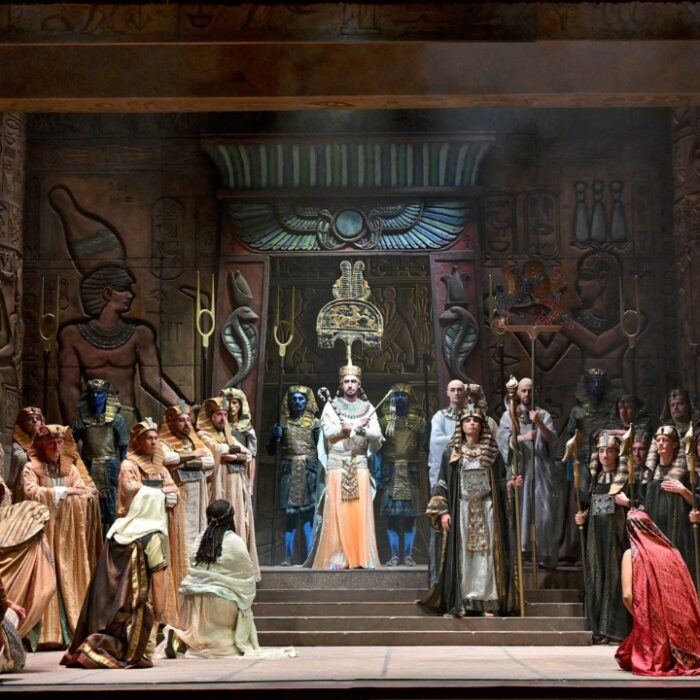
If there were any concerns about this production, it was certainly not the size of the stage, although during the crowd scenes – which, fortunately, are not too large, but substantial enough nonetheless – even then it became apparent that the actors had little room to move during the choral scenes. If there was anything jarring about this production, then it might have been Bruno De Lavenère’s set design, Lionel Lesire’s costumes and Laurent Castaingt’s lighting, ordered by the stage director Frédéric Roels. It made the drama resemble B or even Z-grade science-fiction films from the 60s, 70s and even the 80s, with Aida and Amneris wearing heavily veiled costumes in psychedelic colors. The Egyptian priests resembled Lovecraftian secret cults, and Amonasro in a draped costume with garish necklaces. The bright and varied lighting, ranging from orange-yellow to grey, was always dazzling – whether in the form of neon lights cutting across the space around the central menhir, reminiscent of a spaceship – and at times evoked the deserts of Dune, or the infinite universe of Flash Gordon.
Once this slight sense of unease – bordering on laughter – passed, I was first struck by the quality of the Avignon-Provence National Orchestra, conducted by Débora Waldman. She achieved a superb balance between the string and brass sections – a task that is always delicate in Verdi’s works. She brought to light, in this voluminous, precise and explicit orchestral score, a resemblance to Handel’s oratorios or certain of Rossini’s opera seria on the one hand and, on the other, the orchestral narrative, which Verdi would develop to the point of making it a character in his future operas. The duet between Radamès and Aida and the one between Aida and Amonasro, will remain in my memory, for this very reason.
I was also struck by the vocal performances, which were, as a whole, very impressive. The exception was the Radamès sung by the Spanish tenor Eduardo Aladrén, who, during the first Act aria “Se quel guerrier io fossi!,” struggled to find breath control and tone color in the high notes. His middle register was clear and almost velvety. In the subsequent Acts, he found better breath control but still failed to convince in the upper register.
The other voices of the male cast retained beautiful colors and textures and brought nobility, distinction and the embodiment of the institutions. The Georgian bass-baritone Nika Guliashvili displayed a low register that was nuanced but not overly deep, with clear articulation of the highest calibre. His “Vieni d’Iside al tempio” demonstrated these qualities.
Cameroonian bass Jacques-Greg Belobo as the King consistently maintained a certain nobility in both his expression and his acting, as demonstrated in his “Al tuo consiglio io cedo.”
Equally memorable was the restrained yet explosive power directed at Aida by King Amonasro, portrayed by baritone David Vardan.
Meanwhile, the female roles brought drama and tension to the opera and undoubtedly captivated and truly brought the opera to life. The titular role was sung by French soprano Claire de Monteil, whose voice captured the timbre of both a teenager and a young woman. The duet with her father Amonasro, preceded the one with her lover Radamès, and perfectly illustrated the maturity forced upon her – a quality she conveyed well. But her solos left the greatest lasting impression, such as “Ah pietà! Che più mi resta?” or the “Qui Radamès verrà!… Che vorrà dirmi?,” in which her youthful freshness trembled from within.
Perhaps even more so than that of Claire de Monteil’s Aida, the voice of the French mezzo-soprano Marie Gautrot, whose timbre retained a sharpness, a bite, an incisiveness that was perfectly suited to her role – yet this in no way prevented her from evoking pity in her solo “L’aborrita rivale a me sfuggia…”
And we mustn’t forget the chorus, which, was as often the case in Verdi’s great operas – such as “Simon Boccanegra,” “Don Carlos,” or even, in a certain sense, “La Traviata” – was a distinct and significant character in its own right. Here, they fulfilled their role as the Egyptians and Ethiopians very well, whether singing together – that is, men and women in unison, as in the second and first Act – or just the women gathered around Amneris in the second. The work of the chorus masters, Alan Woodbridge and Noëlle Gény, was very well executed here.
While one may have to overlook the stage design, the musical qualities of this production more than make up for it.