Los Angeles Opera 2026-27 Review: Carmen
By Nathaniel Ronning(Credit: Cory Weaver)
Operagoers dressed to the nines for the opening night of LA Opera’s 2026-2027 season. Though the opera company’s website insists that there is no wrong way to dress, excluding “meat dresses and swim trunks,” attendees erred strongly toward opulence on Saturday night. Even Jennifer Lopez got in on the action, wearing a sheer Dolce and Gabbana coat that she showed off to her 240 million Instagram followers. Joyful feelings pervaded The Music Center’s outdoor plaza. Excited patrons took red carpet pictures and watched flamenco dancing before the show.
The debut of Domingo Hindoyan as Music Director was especially crucial to an elevated air of excitement. His appointment felt appropriate and in line with LA Opera’s commitment to fresh perspectives. That freshness was further highlighted by opening with a brand new Spanish Gothic production of “Carmen.” Audience members could only predict, but not know, what to expect. It was clear from the program notes that director Thaddius Strassberger’s interpretation would take its historical influence seriously. This “Carmen” would evidently consider the eerier aspects of Spanish history.
Unfortunately, the promise of newness resulted in a production lacking on several levels.
A New Music Director
Few opening notes in opera are more famous than those in “Carmen.” The theme, which repeats as a bullfighters procession, invites spectators into the topsy turvy world of Carmen’s fatal allure. On this particular evening, the prelude played more like background music than a psychological welcome. The orchestra got off to a soft, muffled start and lacked bounce. That muted tendency continued through the evening. Hindoyan refused to lean into Bizet’s more showy inclinations that lift the material into wondrous heights. Sequences in which Hindoyan’s orchestra was left on its own, such as the entr’actes between each act, were especially pale.
The orchestra did prove to be competent accompanists. Whereas Hindoyan’s restrained approach dampened crowd pleasing moments, it was successful in giving singers a chance to make clear their interpretations. Musically, the highlight came at the end of Act one, when Carmen convinces Don José to release her from jail. The orchestra played with a thoughtful intensity that mirrored the characters’ uneasy passion. Punchy accents on each singer registered as an apt cross section between infatuation and manipulation. Any negative dissonance between the orchestra and singers was more so due to weak singing. Hindoyan left enough room for each singer to shine even if the voices didn’t always illuminate.
There did exist a fittingness between Hindoyan’s subdued approach to the material and Strassberger’s dour production. The fittingness came at the expense of any musical catharsis. Though not a satisfying debut, the opening invoked optimism that Hindoyan is a conductor who truly considers all aspects of a production. It will be exciting to see how he manages when paired with different singers and material.
More Misfiring
The weak start to Hindoyan’s debut was not helped by the production’s direction. Strassberger invites audiences to the material through thin, flowing projections during its prelude. We see projections continue throughout the performance, often accenting the scenery. None of the projections were overtly ugly, but they did cheapen an otherwise elaborate set. There existed a lack of connection between the projected patterns and libretto. The chosen imagery, such as smoke, was detailed enough to grab attention but distracting as an aid for sinking into the music.
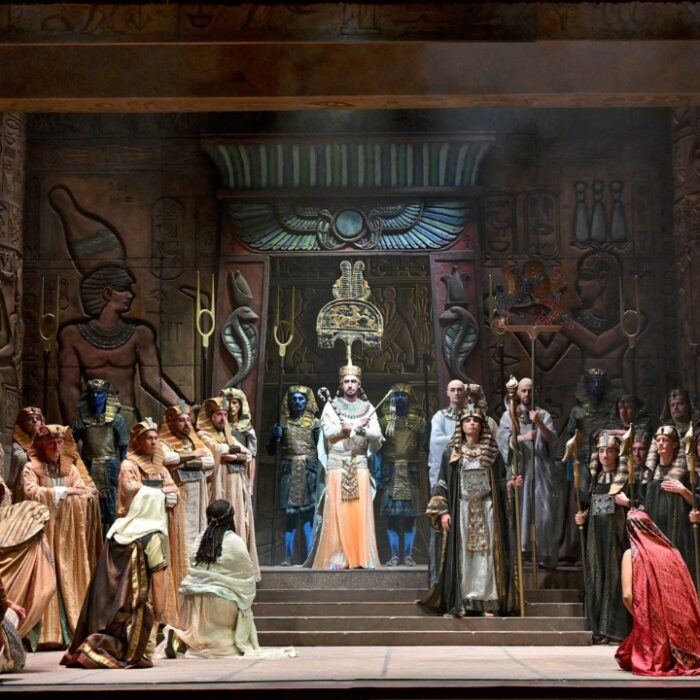
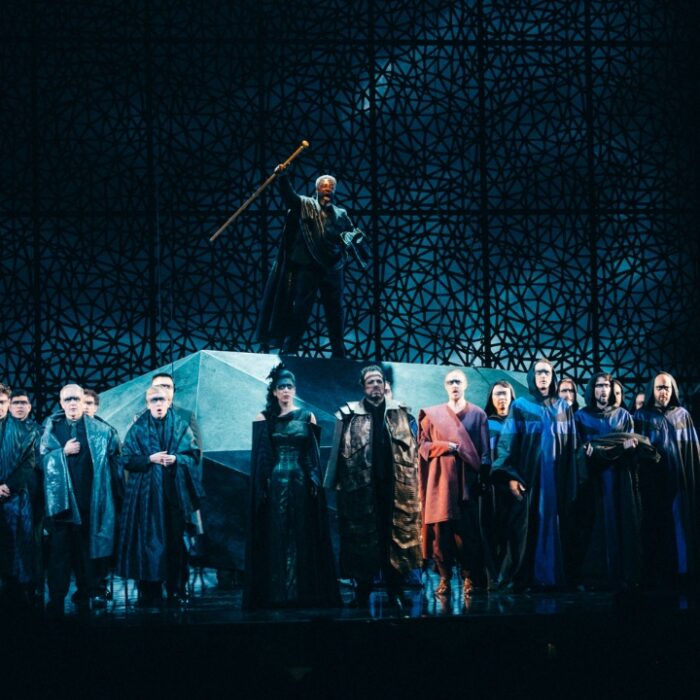
Sets were marred by inconsistencies in the level of detail. There was an impressive sense of depth in the construction of the Spanish Gothic architecture. The layout extended well into the reaches of the LA Opera’s sizable stage. What held the robust setup back was a lack of any “lived in” quality. Decorations and ornaments were placed in over-aligned symmetry that didn’t match the opera’s inherent verve. In addition, those same adornments lacked specificity. The overall set came across as functional without being informative.
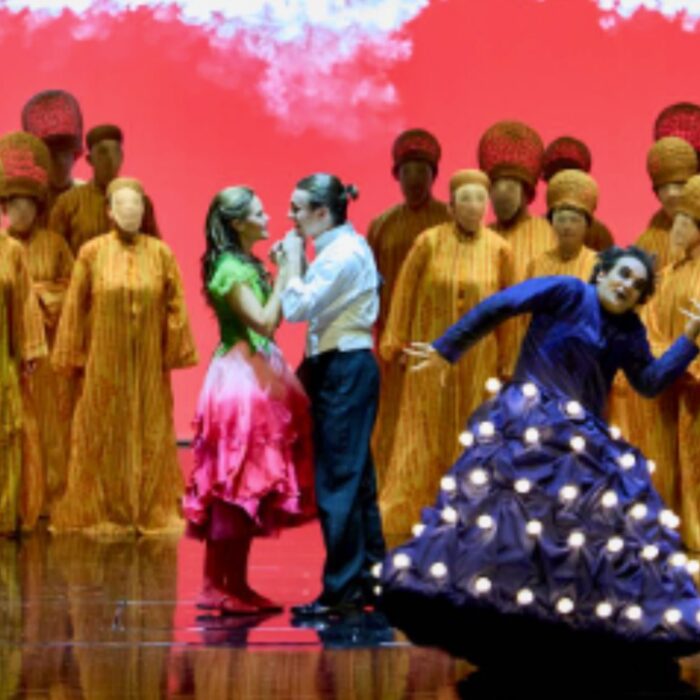
Strassberger’s decision to set the production in a “Seville suspended between centuries” came across as overly vague rather than mysterious. There were hints of historical commentary but without conveying enough information to have any bite. The costumes stick out as a highlight of the entire evening. There was palpable intentionality in the color schematics that blended uniformity and thoughtful continuity. Don José’s arc was especially aided by his wardrobe changes through evolving circumstances. Chorus members were dressed in complementary, often similar, attire that effectively conveyed unease. Costume Designer Mattie Ulrich and her team stand out as MVPs of the night.
A Tale of Two Leads
As Carmen, Rihab Chaieb came across more as a soothing authority figure. The townspeople looked to Carmen as a matriarch upon her entering the scene rather than personified volatility. Chaieb’s approach resulted in an overall lack of energy that plagued the production. It was not evident in her performance why Carmen caused such a stir. The performance came across as lackadaisical and overly comfortable.
Chaieb’s singing did not help in adding vitality to the production. She sang in a polished manner, without any blatant mistakes. Similar to Hindoyan’s conducting, Chaieb’s big moments didn’t punch hard enough. Her “L’amour est un oiseau rebelle” contained no surprises nor dynamism. Carmen’s unpredictability was never convincing. An oversteadiness persisted through the entire performance. Chaieb has a beautiful midrange that soared during moments of vulnerability. She felt most comfortable when Carmen was at her most vulnerable, effectively expressing emotional confusion toward Don José. But, her high notes seldom projected enough to properly exhibit vocal contrast.
Joshua Guerrero deserves props for grounding the production with a soft, humane approach. His Don José comes across more as a puppy-eyed nincompoop than a verbose buffoon. It remains plausible that he could snap out of his feelings for Carmen until the very end. Guerrero is also a strong comedic performer, his crazed determination had a fun drunken quality. The portrayal emphasized hopelessness through a clean-cut nature that devolves with passing time. It was a Don José that worked as a traditional main character, giving audience members somebody to follow on a journey.
Guerrero’s singing came across as milquetoast and wholesome, tet, the singing felt appropriate to his more vulnerable interpretation of Don José. The best moments for Guerrero came toward the opera’s beginning, especially his duet with Micaëla, “Parle-moi de ma mére!” He sings with a sweetness that makes Don José’s bad decisions all the more heartbreaking. The duets with Chaieb were also strong. The pair’s subdued vocal performances were convincing as viable romantic discourse, not just explosive infatuation. Guerrero’s Don José isn’t thrilling but operates well as an emotional foundation.
Strongest Showings
Kathleen O’Mara gives the strongest lead performance as Micaëla. Her voice convincingly filled the auditorium, a unique attribute in this production. Micaëla’s duet with Don José articulated innocent love while balancing true vocal power, creating real anticipation for her return in Act three. The major problem with Micaëla was created by stage direction. Strassberger makes a perplexing choice to heavily invoke the Virgin Mary during the opera’s final moments.
Escamillo is performed with an emphasis on humor by Liam James Karai. He paints with shades of Will Ferrell, relishing in the ridiculousness of his character. His vocal timbre is largely forgettable but strong enough to nicely hit the high F4 in “Votre toast, je peux vous le rendre.“ Karie Trigg was a particular standout as Mercédès, both in voice and comedy, with her line about wanting to be a rich widow garnering memorable laughter.
The new production of “Carmen” may not be the home run that LA Opera was hoping for. Like the Los Angeles Dodgers, exceptional components couldn’t make up for a lack of sustainable pep. Thoughtful decisions were made in all aspects of this “Carmen.” It’s clear that Hindoyan and company are being given some freedom to interpret material instead of recreating norms. There wasn’t enough embracing that freedom, the production felt timid in presenting its uniqueness. Choosing “Carmen” as the season opener might be part of the problem. The opera comes with certain expectations that are hard to separate from. Here’s to hoping Hindoyan’s tenure grows into form with each passing production.