Rossini Opera Festival 2026 Review: Le siège de Corinthe
By Bernardo Gaitan(Credits: Rossini Opera Festival ©)
Gioachino Rossini’s “Le siège de Corinthe” occupies a fundamental place both in the evolution of the composer born in Pesaro and in the history of the modern revival of his works. Premiered at the Théâtre de l’Académie Royale de Musique in Paris on October 9, 1826, this tragédie lyrique represents Rossini’s first major foray into French theater and, at the same time, a profound transformation of “Maometto II,” premiered in Naples in 1820. In adapting it to the tastes and conventions of the Parisian stage, Rossini did not limit himself to translating or superficially modifying the original score: he expanded, replaced, and reworked numerous passages, incorporating the spectacular, choral, and declamatory demands of the French tradition. The result clearly anticipates the language of the grand opéra.
The plot of ‘The Siege of Corinth’ recounts the fall of Corinth to the Ottoman troops, with a strong sentimental dimension. In the midst of the war, Pamyra, daughter of the Greek governor, discovers that Maometto, the leader of the Turks, is the man she loves. He attempts to persuade her to leave the city and go away with him, but Pamyra decides to remain with her people and defend her homeland. When the Turks finally conquer Corinth, the Greeks refuse to surrender and choose death rather than life under enemy rule. Pamyra joins them, and her love story ends in tragedy.
The opera’s relationship with the ROF is particularly significant. It was staged there in 2000 using the edition employed for the Paris premiere. A critical edition by Damien Colas Gallet was presented in 2017. In 2026, coinciding with the bicentenary of its Paris premiere, “Le siège de Corinthe” returned as the opening title of the festival’s 47th edition and as its only new production in this edition.
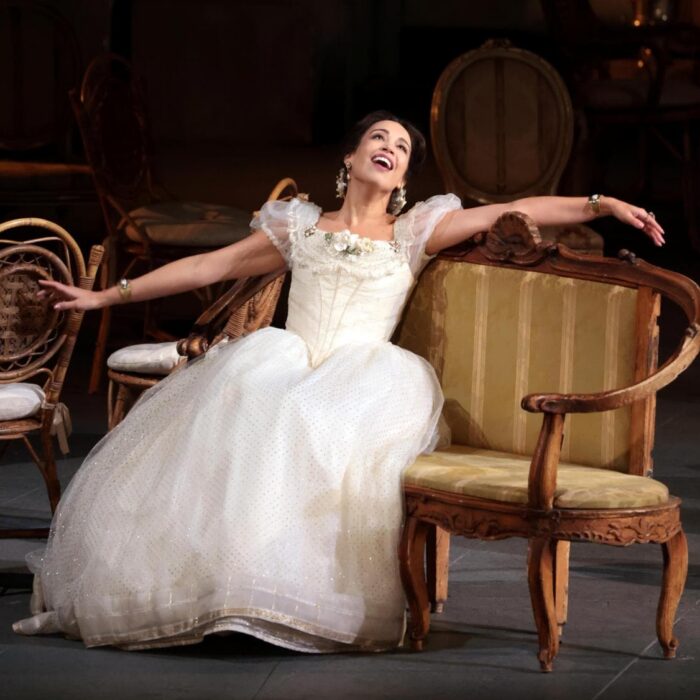
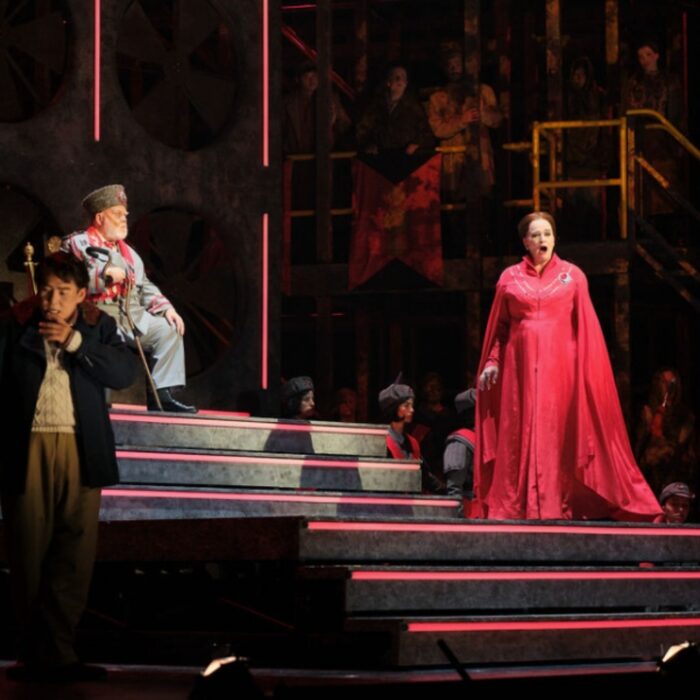
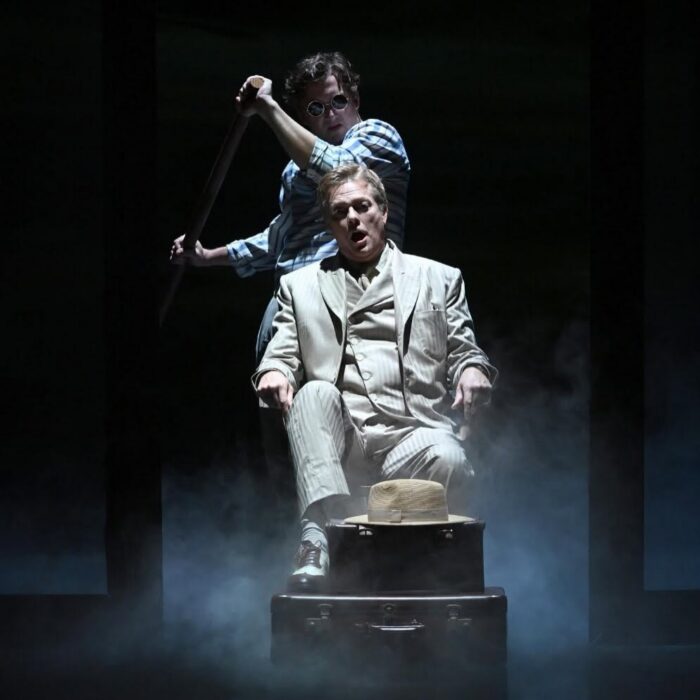
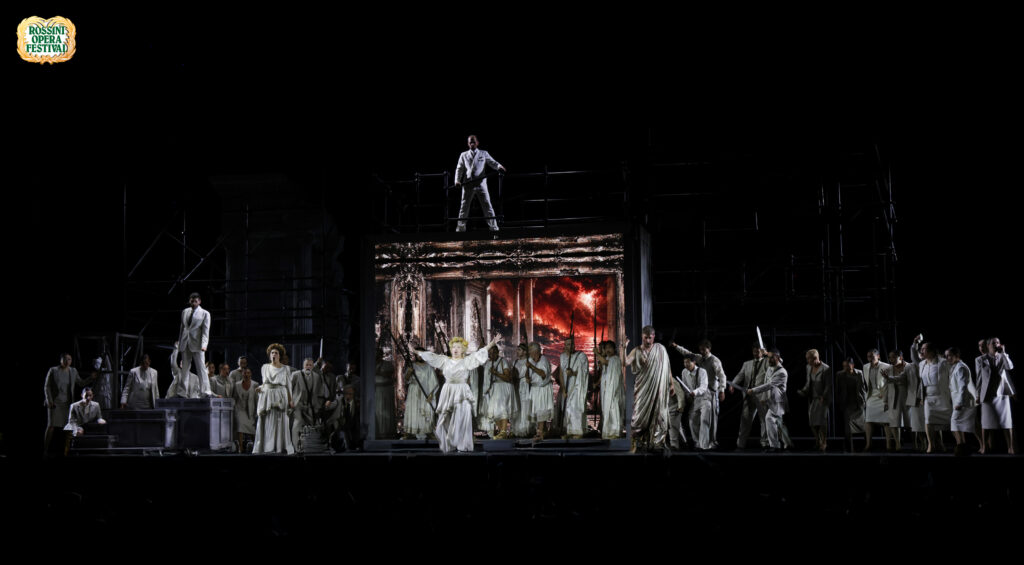
The ingenious staging by Davide Livermore transposes the conflict between Greeks and Ottomans into a modern era, filled with contemporary elements and technology. Corinth appears as a present-day museum filled with remains of ancient Greece, while the Turkish invaders are portrayed as contemporary tourists who photograph, consume, and trivialize the culture surrounding them. As the opera progresses, the set designed by Livermore together with Eleonora Peronetti and Paolo Gep Cucco deteriorates, filling with garbage and everyday objects and symbolizing the destruction of Greek culture. A major visual contribution comes from the digital projections by D-Wok -a classic feature of Livermore’s productions- which progressively transform the landscape into a succession of visions and complete the scenic context superbly on an ultra-high-definition screen inside a box. The costumes by Gianluca Falaschi actively contribute to this contrast: the Greeks are presented through the visual cliché of antiquity, in white tunics, while the Turks appear dressed as dandies, but vulgar and uncouth.
The experienced baton of Carlo Rizzi approached the complex score with assurance, sound choices, and precise conducting, always maintaining control and dramatic tension. His handling of dynamics was superb, as were the tempi, consistently precise, while the volume demonstrated the Milanese conductor’s experience. His impressive command of the belcanto style is also worth emphasizing, evident from the overture to the fall of the curtain. The Orchestra of the Teatro Comunale di Bologna responded with remarkable precision and assurance to an especially demanding score. The Coro del Teatro Ventidio Basso, prepared by Pasquale Veleno, also stood out for its power, homogeneity, and stage presence. Its members made a decisive contribution to creating the opera’s large-scale ensemble scenes.
Credits: Rossini Opera Festival ©
Vasilisa Berzhanskaya was the great protagonist as the confused yet heroic Pamyra, distinguished by a broad, powerful, dark voice, particularly rich in the middle and upper registers. The Russian soprano’s high notes, also beautifully sung and securely placed, stood out from the rest of the cast in the ensemble passages. Her clean and well-pitched coloratura also deserves mention. In her aria “Du séjour de la lumière,” she excelled with delicate sounds and assured, compelling virtuosity.
As Mahomet, Adrian Sâmpetrean, with sufficient vocal authority, displayed a broad voice and elegant emission, although the timbre was somewhat veiled. The Romanian bass’s invading character seeks less to display vocal power than to offer a more human and restrained characterization. His finest moment came in the duet with Pamyra in Act two. His performance was good and, overall, more than fulfilled its requirements.
For Maxim Mironov, Néoclès represented a particularly interesting challenge. The role is not intended for a light tenor with conventional coloratura, but rather requires a vocality closely linked to the French tradition, in which elegance of line, declamation, and nobility are of fundamental importance. The Russian tenor more than fulfilled the development of the character, with excellent French diction and a beautiful voice. Unfortunately, his volume is limited and he gets lost in the ensemble passages. Mironov sings with elegance and understanding, but at certain moments greater vocal expansion would have been desirable.
The opera’s other tenor, Cléomène, was performed with considerable solidity by Matteo Roma. His contribution relies especially on the declamatory character of the role and on a resonant tenor voice, with an increasingly robust and darkened middle register. Roma possesses a vocal quality that seems particularly well suited to declamatory roles. His acting was equally noteworthy: despite his youth, he convincingly portrayed the role of an older man.
Simón Orfila confirmed his authority as Hiéros. The Spanish bass, a veteran of the Rossinian world, had to wait until the end of Act three to perform his heroic scene, a genuine display of virtuosity. The scene allowed him to showcase the nobility and power of his vocal instrument, as well as his acting abilities. His exhortation to the Greek warriors to embrace martyrdom acquired a patriotic and combative dimension, delivered with firmness and clarity thanks to his evident experience in the bel canto repertoire.
For her part, Anna-Doris Capitelli offered a first-rate Ismène. Although secondary in dramaturgical terms, her contribution stood out for its vocal quality and stylistic assurance. With a beautiful, elegant, and supple voice, Capitelli demonstrated that she was fully integrated into a notably homogeneous cast.
Giuseppe De Luca and Tianxuefei Sun completed the cast as Omar and Adraste, respectively, fulfilling their assignments with professionalism. In any case, both contributed to maintaining the solidity of the ensemble.
After three hours and forty minutes of performance, the audience at the Auditorium Scavolini -which, despite appearing not to have particularly good acoustics, is surprising in that this is not immediately perceptible, even though it is not a traditional theater- responded with ovations for the entire cast, especially warm ones for Berzhanskaya, Mironov, and Rizzi.