Rossini Opera Festival 2026: La scala di seta
By Bernardo GaitanThis title occupies a singular place within Gioachino Rossini’s early output. Composed in 1812 for Venice’s Teatro San Moisè, it belongs to the small group of one-act farces that the young composer, just 20 years old, wrote during one of the most frenetic periods of his career. It follows the tradition of the eighteenth-century opera buffa: a romantic entanglement built around misunderstandings, concealment, mistaken identities, and unexpected situations.
The revival of “La scala di seta” also occupies an important place in the philological research and restoration work carried out by the Rossini Opera Festival in Pesaro throughout its more than three decades of activity. Following the earlier productions by Jean-Pierre Ponnelle and Luca De Filippo, the festival now brings back Damiano Michieletto’s 2009 production. For this revival, the critical edition prepared by Swedish musicologist Anders Wiklund was used, based on the autograph source preserved in Stockholm. The history of this manuscript adds a particularly curious chapter to the work’s revival. The document was preserved by Rudolf Nydahl, a former naval commander who later became a liquor merchant. After amassing a considerable fortune, he left business to devote himself to his passion for music. During the interwar period, Nydahl became an important collector of original scores, including several Rossini autographs. The manuscript is now part of the holdings of the Stiftelsen Musikkulturens Främjande, an institution that has made it possible to preserve a fundamental source for our knowledge of the score.
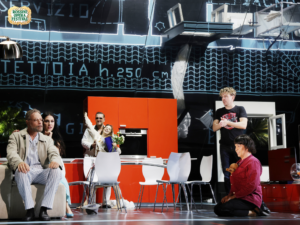
Michieletto’s production, conceived together with Paolo Fantin, who designed both the sets and costumes, is based on an idea that is as simple as it is effective: transforming the living space into a kind of visible theatrical mechanism. The stage is occupied by a full-scale architectural plan of Giulia’s hypothetical apartment, located in Pesaro, specifically at Via Gioachino Rossini, 2. The layout of the various rooms is drawn directly on the floor, together with the intended placement of the furniture, while a large tilted mirror stretches across the stage, allowing the space to be viewed from an elevated perspective. The production is inspired by Lars von Trier’s “Dogville”. As in that distinctive film, the walls disappear and the boundaries between spaces are reduced to lines drawn on the floor. The apartment becomes a game machine, perfectly suited to a dramaturgy that depends on movement, hiding places, and misunderstandings that work through the spectator’s imagination.
The costumes, also designed by Fantin, contribute to the production’s visual personality: they are modern and coherent with the staging. We see Giulia wearing sweatpants while exercising, or Germano in his butler’s uniform. The lighting by Alessandro Carletti completes the creative brilliance of the production. Its purpose is to define, isolate, and transform the light, allowing the different areas of the house/architectural plan to acquire their own identity according to the demands of the action.
From the pit, Iván López-Reynoso delivered a solid performance, leading a brilliant and responsive orchestra from the Teatro Comunale di Bologna. Although he managed to maintain the energy and dynamism of the action, his interpretation at times felt overly cautious and academic, with rigid and poorly contrasted dynamics. The overall result was correct and functional; however, the ensemble occasionally felt disconnected, particularly in the delightful quartet “Sì che unito a cara sposa” -which requires surgical precision- and which here lacked the necessary brilliance. Similarly, the Finale felt somewhat improvised.
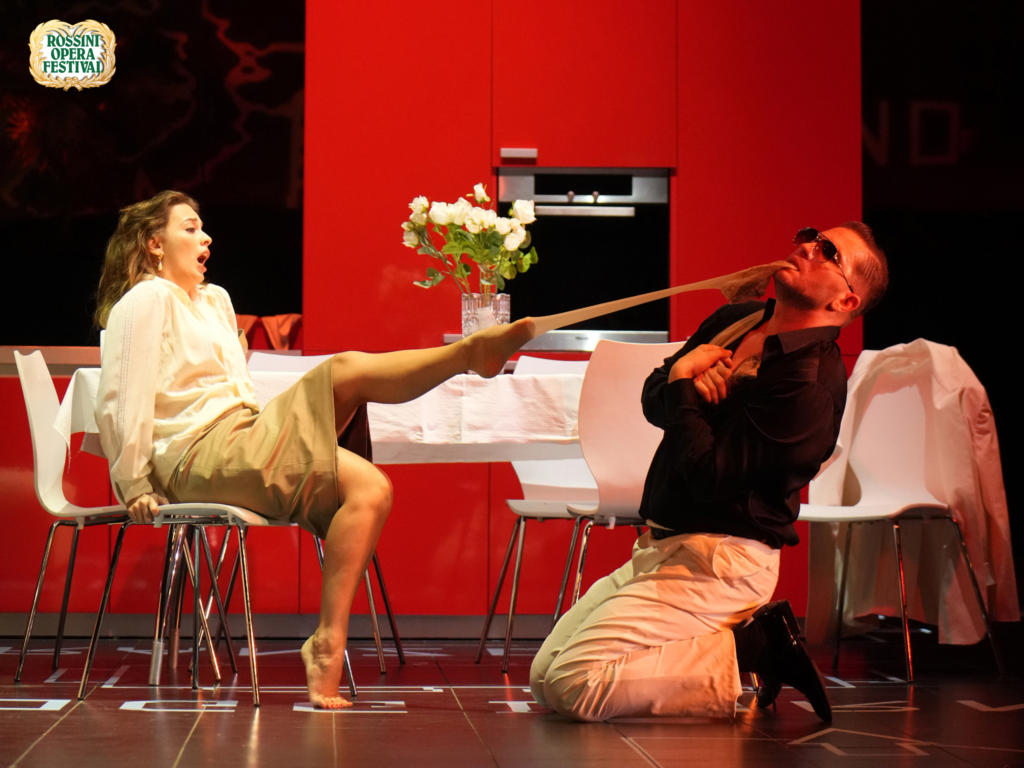
Credits: Rossini Opera Festival ©
Among the cast, Paolo Bordogna stood out particularly as Germano, the true protagonist of the evening. His experience with Rossini, stage command, and extraordinary expressive range allowed him to create an irresistible comic character without falling into vulgarity or overacting, despite portraying Germano as a Filipino butler who does not master the language. The Milanese baritone excelled through his command of syllabic singing and a characterization rich in nuance.
Hasmik Torosyan was a Giulia with a fresh, clear, and pleasant voice, displaying secure coloratura technique and sensitivity in more nuanced passages. In “Il mio ben sospiro e chiamo,” the Armenian soprano demonstrated excellent musicality, physical condition, and technical command.
Alasdair Kent offered a musically refined Dorvil, with a clear and pleasant timbre, good diction, and an excellent sense of style. His limited volume in the upper register caused him some tension, but he compensated for these difficulties with musicality, accurate intonation, beautiful cadenzas, and a particularly successful interpretation of “Vedrò qual sommo incanto.” Meanwhile, the Ukrainian baritone Iurii Samoilov, as Blansac, stood out for his comic flair and for a vigorous and effective stage presence. Possessing a powerful, velvety voice, he created an amusing and sufficiently well-defined character, avoiding an excessive emphasis on the more vulgar traits of this depraved figure.
Mara Gaudenzi was a particularly outstanding Lucilla, with a beautiful, effervescent timbre and an intelligent sensuality. Her performance of “Sento talor nel core” demonstrated both her vocal qualities and remarkable stage ease. Enrico Iviglia, for his part, offered a correct and sympathetic interpretation of Dormont, particularly effective in conveying his qualities as an intrusive and comically awkward old man.
The Pesaro audience warmly welcomed the entire cast, showing particular enthusiasm for Bordogna, while also recognizing the work of the creative team and the orchestra. The production, on stage since 2009, continues to demonstrate remarkable theatrical effectiveness.