Ravenna Festival 2025 Review: Orlando
Pizzi’s Staging Sidesteps the Dramatic Potential of Capece’s Libretto
By Alan Neilson(Photo: Zani-Casadi)
For the November installment of the Ravenna Festival, it was decided to present a Händel trilogy, comprising two fully staged operas, “Orlando” and “Alcina,” and a concert performance of his oratorio “The Messiah.”
First up was the composer’s 1733 composition, “Orlando,” written to a libretto by Carlo Sigismondo Capece, which premiered at London’s King’s Theatre and ran for ten performances. Like many of Händel’s operas, it then disappeared from the stage until revived in the 20th century, since which time it has received frequent productions across Europe and America and is now considered to be one of the composer’s masterpieces.
The story is an action-packed thriller in which Orlando’s obsessive love for Angelica, a pagan princess, sends him into a state of madness, which leads him to kill both her and the man she loves, a Moorish warrior called Medoro. It is a fantastical tale, populated by mythological characters, including Cupid, Proserpina, numerous genii and the magician Zoroastro, who, at one point, carries off Orlando in his flying chariot and rescues Angelica by whisking her away on a cloud. While in his delirious state, Orlando is beset by visions, in which he descends into Hades and sees Prosepina and Medoro in an embrace, after which he emerges in an even more desperate state and burns down Dorinda’s hut, where Medoro had sought refuge. Eventually, Zorastro reappears to save the day by sprinkling magic dust, brought by a magical bird, onto Orlando’s face and restores his reason. Fortunately, Medoro and Angelica are not dead but had been saved by Zoroastro, much to Orlando’s relief, who is now pleased to see them together.
If the narrative reads as a wondrous and wild journey of the poet’s imagination, its message is a simple one: virtuous behavior is founded on reason and certainly not on emotional excess.
Pizzi Downplays the Spectacle to Promote His Aesthetic Vision
There are, therefore, plenty of angles to explore, both in its presentation and interpretation. The director and stage and costume designer, Pier Luigi Pizzi, charged with the production, opted for a simple approach that aimed essentially at creating a series of aesthetically pleasing static stage pictures, often to the detriment of the drama. There was absolutely no attempt to take advantage of the spectacular effects that the narrative has to offer.
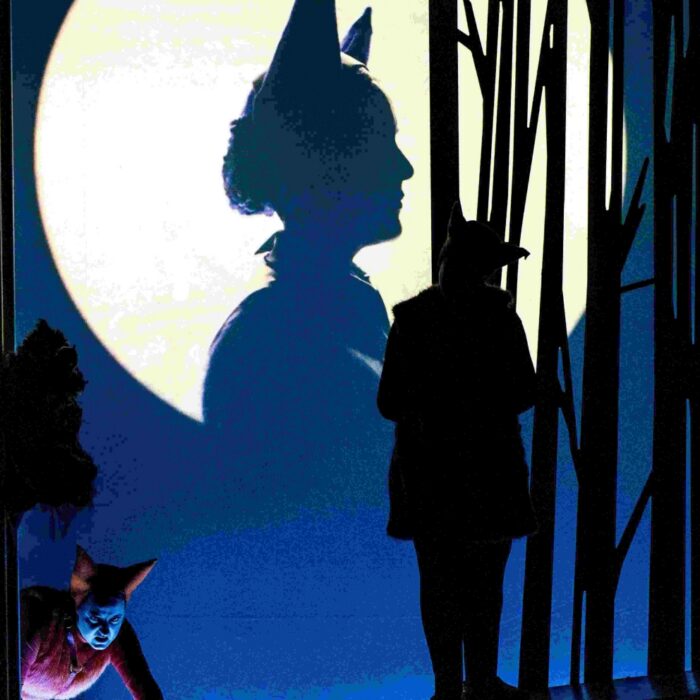
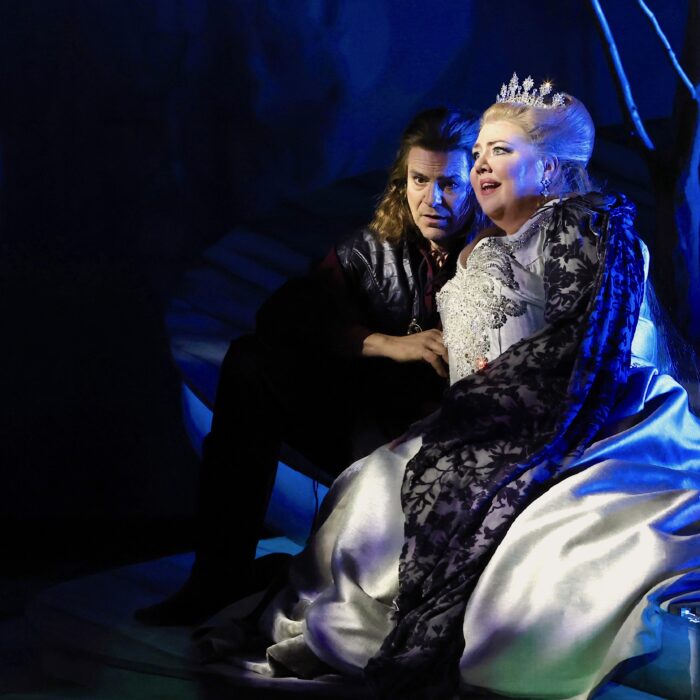
Pizzi opted for a fixed set consisting of mirrored walls, ceiling and a back wall upon which were projected images of trees. At times, they were used to create a pleasing pastoral scene. If the mood darkened, the images of the trees would alter, changing into twisted and gnarled shapes against a grey, black sky. The forest scene was cleverly created by having the trees grow larger and larger, which, accentuated by their reflections in the mirrors, made them appear closer and created an oppressive, claustrophobic atmosphere. The classically inspired, colorful costumes were sympathetically designed so that the characters blended with the scenery, creating a unified and harmonious mise-en-scène.
However, that was as far as it went. There were no flying chariots, no appearances by Proserpina, genii or a magic bird, and even the grotto into which Angelica flees and Dorinda’s hut that Orlando burns to the ground were never physically depicted. The set remained fixed; only the lighting and projected images of trees altered. Moreover, Pizzi does not particularly care for onstage movement; rather, the characters were encouraged to take up static poses. It was all very picturesque but did little to sustain the attention of the audience.
It was a staging that lay easily on the eye, which was sensitively used to reflect and promote the changing emotions of the characters and the scenes, but the dynamics of the drama itself were largely sidestepped.
Surprisingly, however, Pizzi did introduce an idea that went beyond the purely descriptive confines of the libretto by giving a significant role to Cupid. He appeared in almost every scene, to the extent he was rarely absent. The idea is built upon the influence he undoubtedly exerts on all the characters except Zoarastro, to whom he stands in opposition. Yet, this Cupid was no playful, pre-pubescent child. He was a fully developed male whose motivations were cynical and vicious; he knew what he was doing and what the effects would be, which gave a different, even malicious, slant to the drama.
The actor, Giacomo Decol, playing the role of Cupid, created an erotically charged reading, who, when not standing in the background in a statuesque fashion, admiring his handiwork with an inane smile on his face, was writhing around the stage, crudely flirting suggestively with his arrow. As the evening progressed, his presence became somewhat tiring, as he added very little to the drama, having established the full significance of his role within the first few minutes of his appearance on stage.
Dantone’s Delicate and Sensitive Reading Cannot Escape the Undramatic Staging
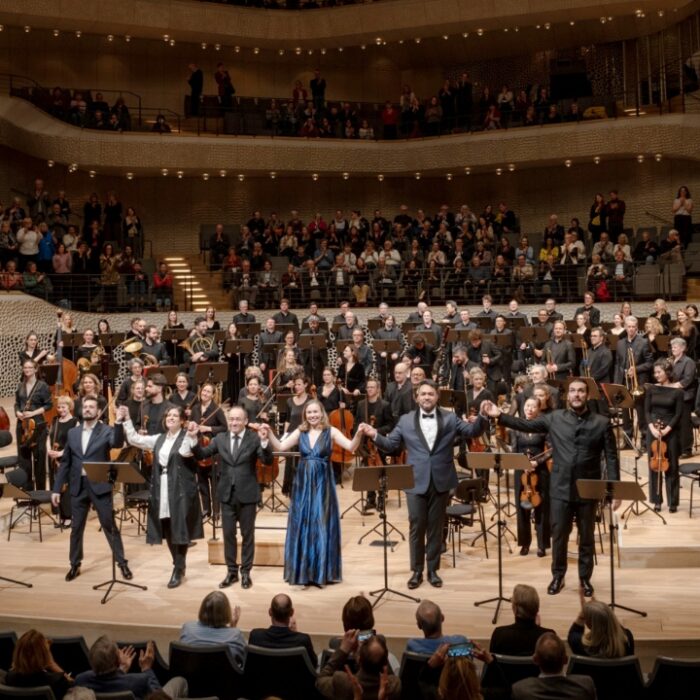
Handel’s score possesses an understated quality requiring a delicately fashioned interpretation, which Ottavio Dantone, directing the Accademia Bizantina, brought beautifully alive with an elegant and sensitively refined reading that successfully captured the nuance of the characters’ emotional states. However, the reading did not appear to exploit the full dramatic impact of the work; whether this is a wholly valid criticism or a result of Pizzi’s static staging is difficult to determine given the intricate relationship that exists between the visual and the aural senses.
Countertenor Filippo Mineccia, cast in the title role, was suitably aggressive, determined and egotistical, capable of voicing his rapidly changing and wild emotions brought about by Cupid’s arrows. In his opening aria, “Non fu già men forte Alcide,” however, we find a calm, reflective Orlando, asserting that his love will not affect his sense of duty, for which Mineccia provided a sensitive rendition that captured his balanced yet firm determination, but in which his light embellishments also hinted at his rising passion for Angelica. It was a state that did not last; in his following aria, “Fammi combattere,” his sense of outrage and madness started to increase, which he illustrated expertly through his violent coloratura and the angry curl in his voice.
Orlando eventually loses his faculties and descends into a state of madness. Pizzi’s lack of direction could not have been better illustrated than in Mineccia’s acting, which, normally so effective, appeared haphazard and unconvincing; at one point, he was walking across the stage in a silly robotic fashion that bore no relation whatsoever to the tenor of the production. It was an exceptionally awkward moment.
Licari’s Beautifully Crafted Portrait of Dorinda
Soprano Martina Licari caught the attention with a beautifully crafted vocal portrait of the shepherdess Dorinda, in which her vocal control, the detail with which she furnished the vocal line and the beauty of her singing impressed. She presented herself with a confident, easygoing stage manner that she used effectively to endear the charming Dorinda to the audience. Her Act one aria, “O care paroletta, o dolci sguardi,” allowed her to show off her lyrically engaging, bright and free-flowing singing, which she infused with a happy, joyful and contagious enthusiasm as she delighted in her love for Medoro. In complete contrast, her aria “Se mi rivolgo al prato” finds her lamenting the fact that Medoro does not return her love, but she cannot rid him from her mind. It was one of the high points of the performance, in which Licari, crafting delicately pained lines, beautifully captured the depths of Dorinda’s despair. In her final aria, “Amor è qual vento,” she displayed her virtuosity with beautifully embellished lines, pleasing passages of coloratura and colorful and emotional inflections.
Soprano Francesca Pia Vitale produced an emotionally animated performance in the role of Angelica and, at times, albeit with good cause, came across as the most unstable character on stage. She possesses a bright, flexible voice with a fresh-sounding upper register, which she used expertly to produce an expressively gripping portrait of her character. Recitatives were clear, articulate and delivered with meaning, while her arias were beautifully crafted, dramatically vivid and emotionally nuanced–qualities that were perfectly illustrated by her rendition of the aria “Non portrà dirmi ingrata,” in which she reflects on her complex attitude towards Orlando. In contrast, the aria “Verdi piante, erbette liete,” in which she bids farewell to the glades, skies and trees before departing with Medoro, allowed her to show off her clear, excellent phrasing and soft, long lines of delicate beauty. The vocal relationships she was able to build with the other characters were carefully and convincingly developed, particularly with her lover, Medoro, and Orlando.
Countertenor Elmar Hauser has a very attractive voice that moves smoothly without any signs of stress or anxiety. His singing is secure and precise, and his phrasing is beautifully fashioned. It is a voice ideally suited for singing arias that express feelings of love, devotion or reflective sadness. Singing the role of Angelica’s lover, he has three arias to sing, all of which he sang with captivating elegance and a refined sense of style, which he often supported with historically informed baroque gestures. It was impossible not to be absorbed by his performance. The only question that arose concerned the degree to which he was able to differentiate between or add depth to emotional states; everything sounded so beautiful; it was as if the emotions were being idealized.
Bass Christian Senn produced a solid interpretation of the magician Zoroastro, whose presence added a degree of rationality to the proceedings and successfully brought the characters to their senses, free from Cupid’s malicious maneuverings. He possesses a resonant voice with a pleasing timbre, which he used to deliver clear, articulate and authoritative lines.
Ultimately, this production of “Orlando” proved to be a very mixed experience. While musically it contained much to enjoy, including a number of excellent singing performances, it failed to exploit the dramatic potential of the libretto and instead focused on the visually aesthetic.