Q & A: Victoria Frances Young on Her Fixed-Media Operatic Work ‘Breaking News’
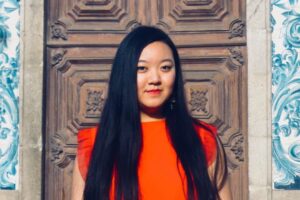
By Jennifer E. Pyron(Photo: © Victoria Frances Young)
Pianist, composer, and electroacoustic and multimedia artist Victoria Frances Young’s contemporary operatic work, “Breaking News,” won the International Alliance for Women in Music (IAWM) Search for New Music Competition’s Leah Reid Electroacoustic and Music in Technology Prize and will receive its wider streaming release on October 6, ahead of the world premiere of its fixed-media version at Knob Detox, October 14–17, in Curitiba, Brazil.
OperaWire visits more with Young to learn about her creative process and how her work is actively evolving opera as an art form today.
OperaWire: What inspired you to create “Breaking News?”
Victoria Frances Young: The inspiration for “Breaking News” came largely from a desire to bridge the gap between my love for science—particularly astrophysics and quantum physics—and my ability (or lack thereof) to understand its more complex and perplexing concepts as a mere layperson. Mindbending and headache-inducing as these can be, I find that states of wonder and confusion can also be fertile grounds for my artistic inspiration as a composer. After all, music is a universal language—and sometimes, I take that to mean that music is something that reaches toward something all of us are universally NOT able to understand: the metaphysical, mysterious, intangible, and existential—things that cannot be grasped by human hands, but are deeply moving to our hearts and minds all the same. I wanted to see if I could transform a scientific concept so confounding that even the world’s most brilliant minds struggle to explain it and, in my humble hands, transform it into something fun, energetic, a bit camp, theatrical, sonically immersive, and easily digestible—all without betraying its complex origins.
I found my golden scientific concept for “Breaking News” during a visit to CERN in Geneva when I was fifteen. Whilst perusing exhibits filled with advanced equations I could barely understand, I suddenly encountered a single sentence that spoke to me on an existential level:
“Matter and antimatter particles are always produced as a pair and, if they come in contact, annihilate one another, leaving behind pure energy.”
How awe-inspiring and terrifying, I thought, to imagine that all of us are made of the stuff whose creation was conditional upon the birth of a twin that could destroy us! And for the result of annihilation to be not nothing, but “pure energy,” felt as beautiful as it was scary, and the basis for limitless potential—or, perhaps, the potential to try again. In “Breaking News,” the dramatic narrative reaches a climactic high point representing annihilation, after which the piece could theoretically end. However, because annihilation leaves behind pure energy rather than nothing, I did not want the finality of nothingness to be what audiences would walk away with. Instead, the music takes a purely speculative turn, with ghostly echoes of human civilization slowly returning from the cosmic ashes.
For the overall framework of “Breaking News,” I took popular elements from modern science fiction media, such as multiple parallel dimensions, cosmic threats, and interstellar sociopolitical constructs, in order to build a wider futuristic world inside which I imagined “Breaking News” existing. My biggest inspiration was Orson Welles’s infamous War of the Worlds broadcast, in which many radio listeners were tricked into believing that aliens were invading the Earth, and the way a sonic piece of art could blur the lines between media fiction and everyday realism. In that sense, “Breaking News” is a spiritual successor to War of the Worlds: a piece of media fiction being broadcast to us in the 21st century from somewhere in the 26th century, blurring the lines between opera and journalism, particle physics and fiction, imagination and reality, coexistence and annihilation.
OW: How is your musical language shaped by classical virtuosity, Chinese operatic and musical idioms from your cultural background, and the energetic influences of electronic music, music theater, and rock-and-roll?
VFY: My musical career started out as a classical concert pianist, with a special interest in the music of Johann Sebastian Bach. The propulsive perpetual motion, keyboard virtuosity, and tonal counterpoint of Baroque music became synthesized into my identity as both composer and performer very early on. With Bach in particular, I always admired the way his music often presents a flawless balance between humor and gravitas, or humanity and divinity. I find myself layering emotional juxtapositions—“Breaking News,” for example, presents a delicate balance between excitement and fear—alongside melodic counterpoint and tightly interwoven rhythmic locomotion.
As I continued developing my compositional voice, I began looking toward my own cultural background and family history. My family’s ancestral homeland is in the Teochew-speaking Chaoshan region of southern China, and my grandmother has always loved traditional Teochew opera, so its sounds and aesthetics were present throughout my childhood. Later on, I began to study the art form deliberately, taking online singing and acting lessons with my grandmother’s Teochew opera master. Studying Teochew opera greatly expanded my musical vocabulary and understanding of music theory, introducing me to pitch inflections and microtonal nuance outside my Western classical training, ornamentation and pitch bends shaped by the tonal contours of the Teochew language, and a highly stylized sense of theatrical presentation centered on aesthetic beauty. These influences are especially prominent in works such as my Piano Concerto. I also became interested in the expressive tension between more direct emotional expression and the heightened stylization of Teochew opera.
Rock, electronic music, and music theater came later. Originally, they were genres I began listening to for fun, but I began to realize that their musical languages were uniquely positioned to bring together the contrasting influences of my Western classical background and Chinese heritage, while also giving me the flexibility to create something that felt truly mine. I find that modal elements I encountered in Chinese music can interact naturally with the modality often present in rock music. The repetitive grooves, amplification, rhythmic drive, and extremity of rock allow me to completely recontextualize simple motifs. Incorporating electronics has opened me up to an extended palette of timbres and techniques that expand my existing material into the realm of imagination. Music theater, meanwhile, informs the dramatic side of my writing through character, pacing, spoken and sung text, and the relationship between sound and theatrical action. I am ultimately interested in the chemical reaction of all these traditions coming into contact with one another at full speed.
OW: Describe your process when composing for voice and electronics. Which one comes first?
VFY: It depends! I treat writing electronics much like orchestration—the only difference is that, with electronics, sometimes I am writing for a sparkly shimmer or a gnarly drone rather than a flute or trombone. Sometimes the text and vocal delivery are so important that the vocal writing absolutely comes first, and I then begin filling out the space around it with acoustic instruments and electronic sound. Other times, however, I start with a much stronger sonic environment or visual image, in which case I begin with the instruments and electronics, building up the world that the voice will eventually inhabit.
OW: What did you learn most about yourself as an artist when working on this project?
VFY: Working on this project helped me discover the courage I had as an artist to push the boundaries of musical genres and opera as an art form without losing sight of my roots. My background as a classical pianist meant that my practice was strongly grounded in concert traditions; similarly, my experiences with Chinese opera taught me the importance of preserving cultural aesthetics and traditions. In my compositional practice, I strongly believe in using recognizable frameworks to give audiences something familiar to orient themselves around.
For every experimental technique, avant-garde sound, or speculative science fiction plot point I wanted to use in “Breaking News,” I needed to anchor it in something historically recognizable. I needed a way for the work to remain tethered to Earth while exploring the expanses of outer space. I really wanted to explore as far as I could, but at times it was a pleasant surprise to discover how far I dared to reach while ensuring that “Breaking News” remained coherent as an opera in news broadcast format. I have always had what felt like an excess of musical ideas competing for attention in my head, but because of the vast distance I had created between recognizable musical traditions and astronomical boundary-pushing, I was able to discover the perfect place where they could fit together.
OW: Were there any challenges that you had to overcome?
VFY: There were two primary challenges when it came to creating “Breaking News.” The first was the integration of many extremely busy and equally chaotic parts while ensuring that the text remained absolutely intelligible despite the quick tempo. The soprano alternates rapidly between speaking and singing against six or more fast-paced instrumental and electronic layers, so I had to make sure that every part interlocked with absolute rhythmic precision.
The second challenge was building a convincing dramaturgy without visual reinforcement. I utilized techniques from modern broadcast media to create a clear dramatic trajectory: outlandish headlines and a rapid succession of sensationalist news stories build momentum and capture the listener’s attention before the breaking-news interruption brings the entire machine to a screeching halt. The challenge was making listeners care about this world quickly enough that, when it begins to collapse, the collapse actually feels like it matters.
OW: How did you feel when you won the International Alliance for Women in Music (IAWM) Search for New Music Competition’s Leah Reid Electroacoustic and Music in Technology Prize for “Breaking News?” And how does this support your creative work?
VFY: It was an incredible honor and delight to receive this prize! I do not take for granted the opportunity to receive recognition as a woman composer. The field of music composition has historically been overwhelmingly male-dominated. Women could be appreciated as performers, entertaining the masses and bringing to life the masterpieces written by men, but were deliberately inhibited from exercising our craft and denied the freedom of using our own voices and creativity as composers. Nowadays, women still face challenges in receiving equal opportunities and visibility within this field despite working at an equally high level. Therefore, platforms like IAWM that deliberately amplify women’s voices remain deeply valuable. I am especially thrilled to have earned this prize for an opera featuring my own synopsis and text.
I feel energized to continue building expansive and immersive sonic worlds and creating unconventional new operas. I hope that other women composers and artists feel encouraged to trust the full extent of their imaginations, take artistic risks, and create the work they genuinely want to make. Ideally, my own future work can contribute to that ecosystem by creating exciting new opportunities for contemporary performers and singers as well.
OW: What do you hope audience members and listeners carry forward with them after experiencing your opera?
VFY: First and foremost, I want audiences to have a good time! I hope they can step inside the universe of “Breaking News” and have a fun ride, whether through its humor, sound, or exploration of the future and outer space.
On a broader level, I hope that “Breaking News” is able to invite some conversation about opera as a living, contemporary art form. I find opera’s dramatic capabilities perfect for telling modern stories in our crazy modern world. The dynamic range and expressive power of opera make it an excellent medium with which to integrate technology and electronics to paint vivid settings, even if that means unconventional staging or, as in the case of “Breaking News,” no staging at all, existing purely as immersive sonic theater. I believe now more than ever is the time to engage with opera as a contemporary art form and to build a distinct 21st-century identity around it.