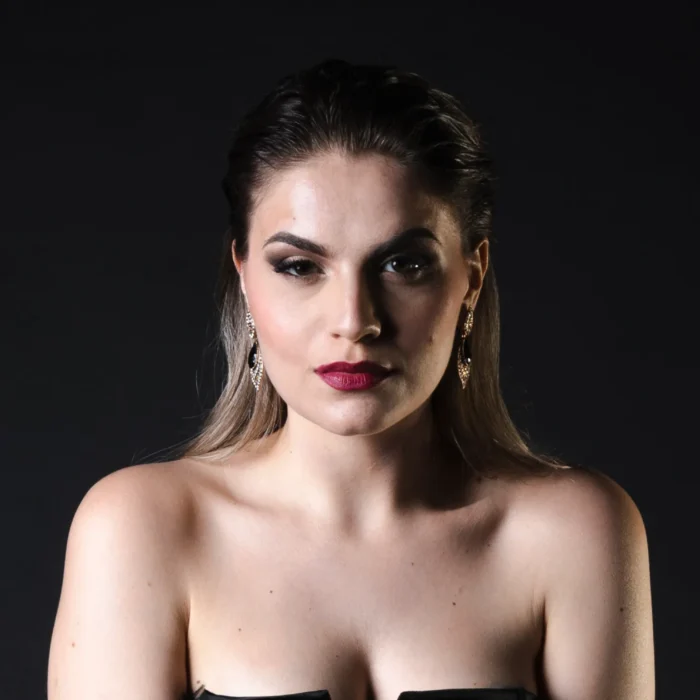
Q & A: Swedish Mezzo-Soprano Alexandra Olsson Andersen on Building a Versatile Career
By Jennifer Pyron(Photo: Tomas Kullström)
Swedish mezzo-soprano Alexandra Olsson Andersen’s work spans opera, concert, theater, and film, with a growing reputation for physically demanding roles and a strong presence in the trouser repertoire. She studied at the Royal College of Music in Stockholm, the Norwegian National Academy of Opera in Oslo, and the Manhattan School of Music in New York, where she held a full scholarship. During her years in New York, she appeared extensively in operatic and concert performances, singing at venues including Carnegie Hall, Merkin Hall, and Town Hall, and collaborating with organizations such as Classic Lyric Arts.
She received Third Prize at the Alan M. and Joan Taub Ades Vocal Competition, along with the support of the Sweden-America Foundation, the Anders Sandrew Foundation, and the Gålö Foundation.
In recent seasons, she has been engaged with Shakespeare Opera Theatre, where her frequent portrayal of trouser roles led to a focused specialization in stage combat and swordplay. Known for her height and strong physical presence onstage, she increasingly gravitates toward roles that combine vocal depth with action-driven storytelling.
Alongside her operatic career, she is active in film, with multiple premieres in 2025 in the United States and Sweden, including screenings in Colorado, New York, and Stockholm. She recently headlined a major solo concert at Maximteatern in Stockholm in August 2025, and this spring she performs the role of Romeo in Bellini’s “I Capuleti e i Montecchi” (“The Capulets and the Montagues”) at the University College of Opera in Stockholm. In the summer of 2026, she will appear in an extensive Scandinavian tour with Skånska Operan, performing one of the leading roles, Flora Bervoix, in Verdi’s “La Traviata.” The tour runs from July 4 through August 13, 2026, with performances at historic venues including Bäckaskog Slott, Bosjökloster, Krapperups Musikhall, Ystad Teater, Jordberga Gods, Öveds Kloster, Kalmar Slott, Hovdala Slott, and Borgebu Slott.
She is the 2025 recipient of the Mona Johansson Cultural Scholarship from SWEA New York.
OperaWire explores more with her in this exclusive interview.
OperaWire: When did you first discover opera and how did you know you wanted to be a singer?
Alexandra Olsson Andersen: It’s actually a funny story. My mother worked at the Royal Swedish Opera in Stockholm as a chiropractor, and one day when I was five, I was home sick with no one to look after me. She had no choice but to bring me to work. She was treating one of the principal singers and couldn’t exactly have a child running around backstage, so she placed me quietly in the main auditorium where they were rehearsing “Swan Lake.” She told me to sit still and promised to pick me up in two hours.
I remember sitting there, completely mesmerized. It wasn’t a dress rehearsal — it was a working rehearsal, with constant stops and adjustments — but I was utterly fascinated. I couldn’t believe that this could be someone’s job. The atmosphere, the artistry, the sense of play and precision all at once — I was completely blown away. I didn’t want to leave.
Soon after, my mother took me to see my first opera, a Swedish children’s opera called “Pelle Svanslös,” about a cat born without a tail. Seeing the performers onstage, dressed as cats and clearly having so much fun, made something click for me. I didn’t know how one got there, but I knew I had to. I joined a children’s chorus shortly after, and at eight years old I auditioned for the children’s chorus at the Royal Opera. I was cast in several productions, and with each one my conviction grew stronger.
Twenty-five years later, I am still just as in love with this artform as I was that day sitting alone in the auditorium.
OW: I love how natural and organic this was for you. Was your mom a singer? How did she get involved with the opera house?
AOA: No, not at all. She’s actually a chiropractor. She has always loved languages and lived in Italy for a period of time when she was younger, so I think she had some exposure to opera through that, but she wasn’t a musician herself. She was much more connected to movement and the body. She began working at the Royal Swedish Opera primarily with the ballet company, and then word spread quickly that there was a chiropractor in-house. Soon singers, dancers, and musicians were all coming to see her. She became very popular, and through her work I was constantly around rehearsals and performances.
Once I had fallen in love with opera, she would take me to productions whenever she could. I was completely obsessed — I would read the program booklets cover to cover and memorize the names of the dancers and singers. After performances, she would sometimes take me backstage and say, “We have a little girl here who would love to meet you.” Thankfully, most artists were incredibly generous and kind.
Speaking of “Pelle Svanslös” — the children’s opera that first captured my heart — that story has come full circle. I was recently awarded the Mona Johnson Cultural Scholarship from SWEA New York to translate the entire libretto into English. My hope is to create a small-scale production at the Swedish Church in New York and introduce this opera to a new audience. It feels very meaningful that the piece which first inspired me as a child is now something I get to bring forward internationally.
OW: Do you have in mind when you will be doing that?
AOA: I am aiming for 2027. I want to give myself enough time to do the translation properly and approach the project thoughtfully. It feels important to introduce it to children in a way that feels natural and accessible — the way opera was introduced to me when I was five. If we can create that same sense of wonder for even a handful of children, then it will be worth it.
OW: Tell me about the Sixten Gemzeus Music Prize by Gålöstiftelsen and how this supports your work as a singer.
AOA: I have actually been honored with the Sixten Gemzeus Music Prize twice. The first time was in 2022, during my master’s studies in opera at the Manhattan School of Music. The award recognized exceptional artistic distinction within the operatic repertoire, affirming my trajectory as an international artist. It enabled me to further consolidate a professional foundation already marked by significant artistic achievement. This prize supported the advancement of a career already operating at a professional international level.
Receiving it again in 2025 was particularly meaningful. The second award was granted in recognition of my artistic growth and professional work, both in Sweden and internationally. It has allowed me to further invest in my career — developing new repertoire, pursuing performance opportunities abroad, and continuing to refine my craft at a high level.
For me, the fact that the foundation chose to support me at two different stages — first in recognition of outstanding artistic distinction, and later as an acknowledgement of sustained and measurable professional achievement — feels like a very special vote of confidence in my long-term development as an artist.
OW: Tell me about your work as an actress in the Husser House Productions’ independent feature “One of the Girls.”
AOA: “One of the Girls” grew out of a musical collaboration rather than a traditional casting process. After completing my master’s degree in opera at the Manhattan School of Music, I became interested in exploring how operatic storytelling — particularly its heightened emotional and physical language — could translate into cinematic form.
Through on-camera training in the United States, I connected with producer and director Taylor Husser of Husser House Productions. Our early conversations centered around music, character development, and dramatic intensity — all elements deeply rooted in opera. That dialogue evolved into “One of the Girls,” a musician-driven independent feature filmed in Colorado in 2024.
While the project marked my first independent feature film, my artistic foundation remained firmly operatic. My screen work continues to draw from musical phrasing, physical embodiment, and emotional precision — principles shaped by decades in opera.
Following that collaboration, Husser began developing a larger television series written specifically with me in mind. In this upcoming production, I am set to portray the leading role of a Swedish opera singer, allowing my professional operatic background to remain central to the storytelling. The project is currently scheduled to enter pre-production toward the end of 2026. While further details remain confidential at this stage, the series represents a significant crossover in which opera is not incidental, but the narrative core.
Opera remains my primary artistic foundation, and any screen work I undertake grows directly from that discipline.
OW: What advice would you give a young singer that is looking to build a versatile career?
AOA: Don’t be afraid to expand beyond what people expect of you. In classical music — especially in opera — there can sometimes be a perception that you must choose one narrow path. But artistry is rarely linear.
For me, building a versatile career has meant allowing creativity to exist in more than one form. I often say that there is “actor Alexandra” and “singer Alexandra” — not as two separate identities, but as two different modes of expression. Both are grounded in storytelling, emotional truth, and discipline, yet they demand different techniques and different kinds of focus.
Learning to switch between those modes has been one of the most valuable parts of my artistic growth. It requires humility and continuous training. You can’t assume that being strong in one discipline automatically makes you strong in the other — they must both be nurtured.
It can feel overwhelming at times, especially when the two careers you monitor simultaneously drags your artistry in two completely different directions at the same time. That’s completely normal. Careers evolve in cycles. The key is to stay curious, stay rigorous, and remain connected to what genuinely moves you.
Versatility should never dilute your identity — it should deepen it.
OW: How do you find that “actor Alexandra” communicates with “singer Alexandra” when you’re preparing for roles?
AOA: That’s a wonderful question. While I think of “actor Alexandra” and “singer Alexandra” as distinct professional modes, they are deeply intertwined in my artistic process. Opera demands extraordinary technical discipline — vocal stamina, linguistic precision, musical intelligence. But technique alone is never the destination. What ultimately moves an audience is emotional truth.
My acting training, particularly my work with the Stella Adler technique, has profoundly shaped how I approach operatic roles. I build characters from the inside out. I ask questions about their psychological history, their formative experiences, and their private motivations — even details that never appear in the libretto. That internal architecture allows the voice to carry something authentic rather than decorative.
I’m currently applying this process to roles such as Romeo in Bellini’s “I Capuleti e i Montecchi” and Flora in “La Traviata.” Romeo demands an intense emotional and physical embodiment — navigating youthful impulsivity, devotion, and tragedy within Bellini’s expansive lyrical lines. Flora is very much a starring role within the dramatic structure of “La Traviata.” She is a central social and psychological catalyst in the story’s turning points. For me, that means she must be treated with the same depth and seriousness as any leading role. Every character onstage carries an inner life, and I believe audiences feel when that life is fully realized.
For me, the goal is always integration: vocal excellence supported by psychological depth. Technique provides the structure — acting gives it breath and pulse.
OW: Tell me about your concert series in Stockholm.
AOA: Over the past year, I presented several curated recital programs in Stockholm, culminating in a large-scale concert at the newly renovated Maxim Theatre in August 2025. Maxim is an iconic venue that recently reopened after extensive restoration, and it was an exciting moment to perform there as part of its renewed artistic life.
The concert brought together a group of singers who had each been developing individual recital projects, and we merged those concepts into a unified evening of opera and art song. I performed Swedish art songs as well as operatic repertoire, and the final portion of the evening expanded into a semi-staged operatic collaboration.
One of the highlights for me was performing the love scene from Bellini’s “I Capuleti e i Montecchi.” That repertoire has stayed close to me, and I am now preparing the full role of Romeo — a role that demands both lyrical flexibility and dramatic intensity, and one that aligns strongly with my specialization in trouser repertoire.
The evening felt like a celebration of both individual artistry and ensemble collaboration, which is something I deeply value in my concert work.
OW: And did I also read that you enjoy studying combat?
AOA: Yes, that interest really developed during my first production with Shakespeare Opera Theatre. Their productions place a strong emphasis on historically-informed stage combat, and I performed in both “Macbeth” and “Anna Bolena,” which required extensive sword work.
We had the privilege of working with renowned fight director Casey Kaleba, who collaborates with Washington National Opera and companies across the US. Training under him completely shifted my understanding of physical storytelling. It wasn’t just about handling a weapon — it was about precision, rhythm, breath, and dramatic intention. In many ways, it felt like choreography or even musical phrasing translated into movement.
For me as a mezzo-soprano frequently performing trouser roles, combat training has become a natural extension of my artistic identity. These roles often demand authority, physical presence, and grounded masculinity, and stage combat deepens that embodiment. It allows me to inhabit characters with a fuller physical vocabulary.
Since returning to Sweden, I’ve continued that training and recently joined a staged combat group in Stockholm focused on sword work. I am also pursuing additional movement training abroad this spring to further develop skills relevant to both stage and screen performance.
Ultimately, I’m interested in roles that combine vocal depth with physical storytelling — where music, movement, and character are fully integrated.
OW: What future operatic roles do you want to perform, especially incorporating all of your interest with trouser roles and combat?
AOA: At the moment, I’m preparing a pocket production of “I Capuleti e i Montecchi,” where I perform the role of Romeo. Romeo is truly one of my dream roles. I have always loved Shakespeare, and this story carries such emotional and physical intensity. Bellini’s writing requires both long lyrical lines and dramatic urgency, which I find incredibly fulfilling as a performer.
Octavian in “Der Rosenkavalier” remains another dream role of mine. He embodies a fascinating duality — noble yet impulsive, romantic yet rebellious. These layered trouser roles align very naturally with my vocal color, height, and physical presence on stage. I’m particularly drawn to roles that combine psychological complexity with physical embodiment. Characters like Sesto in “La Clemenza di Tito” also interest me deeply — figures who carry inner conflict and moral tension. I love exploring that through detailed character work and, when appropriate, staged combat.
While I gravitate toward trouser repertoire, I’m also drawn to powerful female roles such as Amneris in “Aida,” who commands the stage with emotional authority.
Beyond traditional opera, I’m very interested in works that bridge opera and musical theater — especially Scandinavian repertoire. If a cinematic or staged adaptation of “Kristina från Duvemåla” were ever realized, I would be deeply interested in contributing to that world. For me, it’s still rooted in storytelling through music — just in a slightly different format.
Ultimately, I’m drawn to roles that demand both vocal depth and full physical commitment.
Categories
Interviews
Stories you may also like…
Q & A: Lawrence H. Levens on Recovering Will H. Dixon’s Lost Opera, ‘Maid of Chatteaulogne’
Q&A: Librettist/Director Crystal Manich & Composer Laura Kaminsky on Pittsburgh Opera’s World Premiere, Telling Audiences It’s “Time to Act” With School Gun Violence