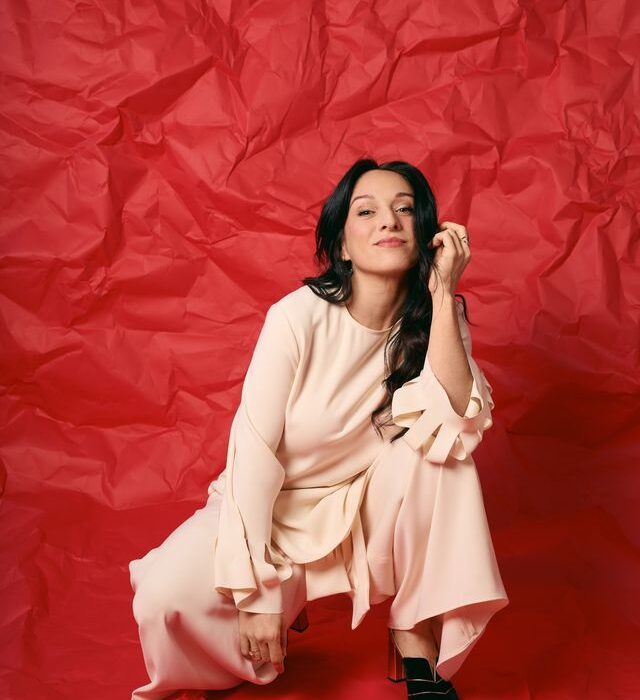
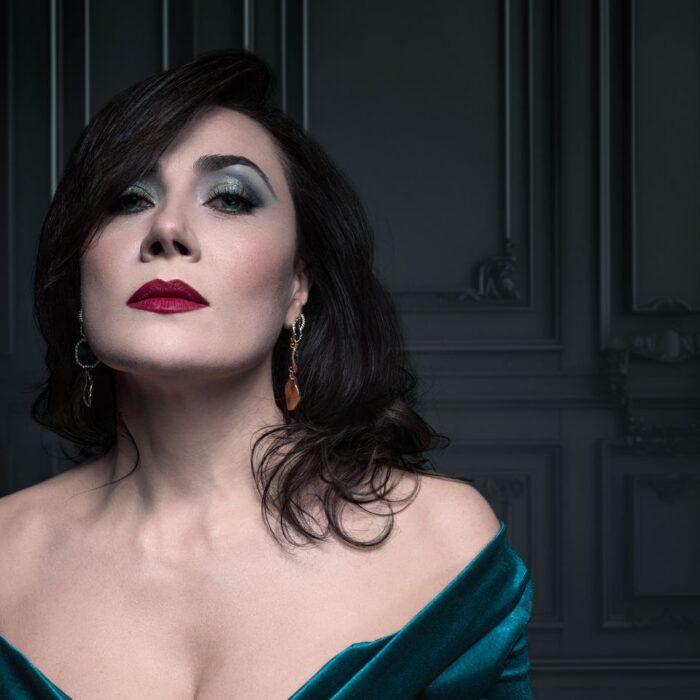
Q & A: Soprano Emily Michiko Jensen Singing Cio-Cio San, the Role ‘That Started it All’
By Lois SilversteinIn childhood soprano Emily Michiko Jensen performed as a “super” for San Diego Opera’s production of “Madama Butterfly,” along with her sister.
Now, she will star as Cio-Cio San in Opera San José’s “Madama Butterfly”, which opens on Nov. 16 and runs through the 30th. Jensen, a Japanese-American San Diego native who draws from her rich heritage as a woman growing up in America with strong family ties to Japan, will have the chance to pay homage to those early moments that first sparked her love of opera in the very role that started it all.
OperaWire spoke to her about the upcoming performance and what this opera means to her.
OperaWire: How might being a Japanese-American affect your interpretation of the role of Cio-Cio San?
Emily Michiko Jensen: I always wanted to sing this role. It has a storied past. So many fine singers have made this role their own. I want to contribute my understanding to these. What is so important is to show her as a real woman and not as a stereotype. Yes, she has Japanese manners and style, yes, she lives in an observant Japanese culture and she respects it. She is willing, however, to open her eyes to something in addition to her Japanese heritage, stirred because she has fallen in love. Whether or not Pinkerton betrays her, Cio-Cio San trusts her own feelings of love and proudly becomes a new American. She believes in her love, and in his: she shows us her strength, whatever happens.
She is also young and has many of the attitudes and perspectives of a young girl of more than Japanese culture. I want to emphasize not only her youth and naiveté, but her humanity. She is warm, honest, caring. While she is innocent, while she is shy, she is not weak. On the contrary, she shows us from the beginning of Act One to the tragic finale in Act Three [that] she is very much her own woman, standing up for what she believes. In fact, she insists on that. She loves Pinkerton and the child they brought to life, and although she is hurt enough to take her own life, she is brave enough to make sure her child will have the the best opportunity to live a good life in America. Even though that life will not include her, she chooses a reality that takes care of him and the dream she shared with his father. This is hardly childlike, but rather mature, sincere, and dedicated.
OW: How does your characterization of Cio-Cio San evolve during the opera?
EMJ: At the outset, the young, shy girl dominates all the action she has onstage. She is eager to express her feelings, and although tastefully reticent, she is not afraid to let herself be seen as who she is. Throughout Act One she is full of joy. She lives the dream of becoming an American wife. She is clear that making the decision to marry Pinkerton, and in loving him, she is becoming stronger, even though it isolates her from her community. She is young but determined and clear. It is contagious too — seeing her so committed to her choice. Love rules, that’s for sure, and however others suspect clouds on the horizon, her conviction rules her actions.
In the second act, her actions convey more tension. She is, as it were, behind closed doors, anxious and waiting and wondering. She wonders how many things she can herself control. She and Suzuki share some of this concern, and although Suzuki might want to protect her from the possible and probable difficulties, Cio-Cio San still moves to her own drummer. In the third and final act, she is much more aware of how things are not under her control, but she discovers what is: her honest commitment to take care of her child. She hands him over to Pinkerton and his wife with strength. She is not a weak victim, however sad it is that she must do this. Rather, she is a hero, a woman who commits herself to her own particular truth.
OW: What facets of Japanese culture did Puccini include in his score, if any?
EMJ: What I know is Puccini likely drew from two Japanese folk song composers, Y. Nagai and K. Kobatake, coming to him through the work of an Austrian musician, Rudolf Dittrich. These aspects are not quotations as I understand it, but qualities of sound that might give a listener more of a Japanese tonality. And this could give a listener somewhat more of a sense of what a Japanese woman could be. One thing is clear to me – Puccini wanted to blend eastern and western culture in this opera, showing its clashes and showing its connections and maybe even how difficult it is to fuse the two, in people and cultural attitudes. This supports the story I think.
OW: What obstacles did you face when you began to prepare for the part?
EMJ: One hurdle was the fact that my husband and I do not have children. I was not sure if I could adequately convey the joy of being a mother and the terrible grief of having to give my child up – that in addition to losing my beloved. I realized, however, that while the story is rooted in Japanese culture and its clash with American culture, it is also an universal story and this tragedy applies more universally. I could relate to that. I just wanted to make sure I could find the balance between the two. The long rehearsal process enabled me to delve into this more and more, and although I did not especially feel comfortable with her decision to [commit] suicide, I see what she was saying by doing it. I hope I have found the balance in my performance between the two perspectives of love and grief. I am aiming for stability in my performance.
OW: Please say a little about your musical training and background.
EMJ: I am originally from San Diego, California. I received a Graduate Diploma and Master of Music in Vocal Performance from the New England Conservatory. I have a Bachelor of Music in Vocal Performance from the Eastman School of Music. Also, I attended Indiana University as a Performance Diploma candidate before beginning my work as a professional artist. Recently, I have been Artist-in-Residence at Opera San José where I sang Fiordiligi in “Cosi fan Tutte” and Mimi in “La Boheme.”
OW: How would you describe your voice?
EMJ: I would say my voice is warm, inviting, honest. I give myself to my roles in-depth. I hope that’s what people think and feel when I sing.
OW: How might you see your opera career in five years’ time? In ten years’ time?
EMJ: I would like to sing Mimi again… I love her character and I would love to give her life again. Also Fiordiligi. Then, I would love to sing Marguerite in Gounod’s “Faust.” It is one of the most beautiful roles.
OW: Who is one of your dream singers to perform with?
EMJ: My husband, Leroy Yoshuro Davis, who is a baritone.
OW: What are some of your dream opera houses to sing in?
EMJ: Abroad, for sure, some of the great opera houses which have a strong history – La Scala, Paris Opera, Vienna Staatsoper, Covent Garden. A dream.