Q & A: Music Director David Stern on Leading Palm Beach Opera into the Future
By David Salazar(Credit: Tom Watson)
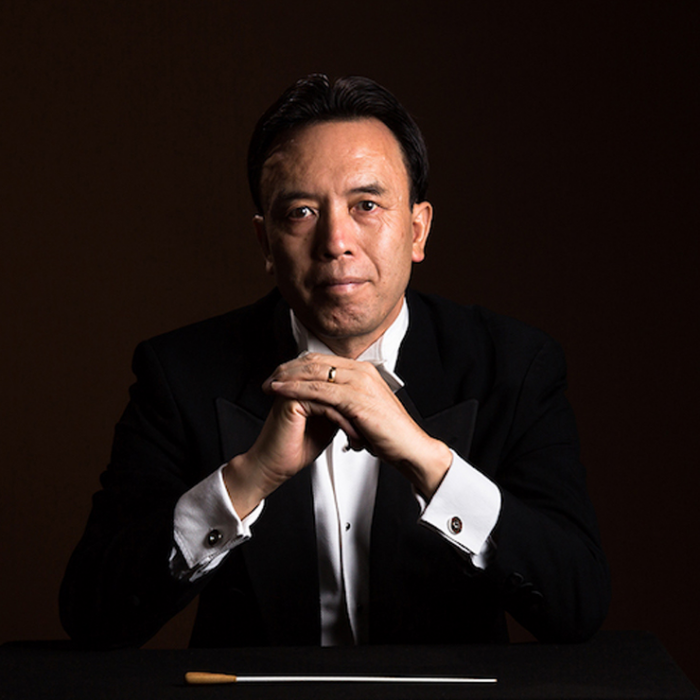
In 2024, Palm Beach Opera appointed David Stern to be the organization’s Ari Rifkin Music Director.
Stern, the son of iconic violinist Isaac Stern, had been with the company since 2015 as its Chief Conductor after leading positions at Israeli Opera and Theater St. Gallen in Switzerland. The conductor has had a major international career, performing with such companies as the Opéra de Lyon, English National Opera, Boston Lyric Opera, and the operas of Metz and Massy in France, among others.
Stern has maintained a strong focus on building the next generation. In 1998, he worked with Stéphane Lissner to create the Académie International d’Art Lyrique at the Festival d’Aix-en-Provence. In 2003, he founded Opera Fuoco, an organization that has been invited to perform with the Paris Philharmonie, the Théâtre des Champs-Elysées, as well as the Amsterdam Concertgebouw, the Luzern Festival, the Vienna Konzerthaus, and the Shanghai Symphony Hall. In 2024, Opera Fuoco commenced a multi-year residency with Opéra Massy. The residency will include, among several other projects, a production of “The Return of Ulysses.”
His impact at Palm Beach Opera has been instantaneous. The company made headlines in 2025 when it announced that soprano Anna Netrebko would make her return to the United States in its annual gala recital. In 2026 the company’s gala recital will feature another superstar, soprano Lisette Oropesa. The 2026 season features three major operas, all of them starring some of opera’s major stars.
OperaWire spoke with Stern about his work with the company, the current season, and his future goals.
OperaWire: You were announced as Music Director at Palm Beach Opera two years ago, but your relationship with the company goes back much further. How has your understanding of the organization and its audience evolved?
David Stern: While it is true that I have been music director for the past two years, I had been the principal conductor for a bit more than a decade — this is my 13th season conducting this house. During that first decade I was limited in my input to the planning, but I did get to know how the company operates and who our audience is. This is a singular corner of the world. On one hand, it is mostly a retirement community; on the other, it is filled with people who have had extremely successful careers. If they wanted to hear opera, they would go to the Met, or jump on a plane — often private — to Paris, London, Vienna, or Milan. The demand and expectations are extremely high. The challenge is to convince them that the PBO can be an extension of the experiences they have known. We do have the advantage, though, that this audience still very much appreciates the live moment — and these days, that is not something to take for granted.
OW: When you stepped into the Music Director role alongside new General Director Jim Barbato, what was the shared vision, and how has it evolved?
DS: Jim and I had been colleagues here for many years, and together we dreamed of new directions for the company. Expanding the repertoire is a high priority. Carlisle Floyd’s “Susannah” and Samuel Barber’s “Vanessa” are two ideas we are still pursuing — major masterpieces from the American canon that are too rarely performed and yet highly accessible. But these are ideas we need to develop over time. With each change of direction there is a period when it is our responsibility to reestablish the trust the public has for our institution. It is no secret that we are in the middle of a worldwide crisis for culture. The general political anxiety does not bode well for spending on culture, in the public or private sector. Every production of opera that occurs today is a statement that we need to survive in this strange new world. It is therefore a necessity that we favor recognized operas in order to maintain and grow the Palm Beach audience. Doing “The Pearl Fishers” this season is a step in the right direction, but the bulk of our repertoire will necessarily remain quite conservative.
OW: Florida feels increasingly like a home for major opera stars — between Palm Beach Opera, Florida Grand Opera, and Opera Naples. Why do you think that shift is happening?
DS: It is no surprise that the weather here makes a huge difference for many of our singers. Our season spans from January to the end of March or early April — the months when it is best to avoid the cold of the north. Even my hometown, Paris, is not at its finest in these months. Ella Fitzgerald never sang “February in Paris.” And since so many members of our audience were season ticket holders at major houses in the north, the singers here are met with a special welcome and appreciation that is part of the Palm Beach experience. Our tradition is to have a session with the public after our Sunday matinee shows, and the respect and interest shown to the soloists is very heartwarming.
OW: Are there works you haven’t yet had the chance to conduct that you’d love to bring to Palm Beach?
DS: “Vanessa” and “Susannah” remain high on the list, but I would add some Massenet, Handel, and Britten to the programming. We haven’t done a “Salome” in a long time, nor “The Cunning Little Vixen,” and I would love to do “Pelléas et Mélisande.” I also think our public would love Ravel’s “L’heure espagnole.”
OW: This season features “La Bohème,” “The Pearl Fishers,” and “Rigoletto.” You’re conducting the latter two — what draws you to those scores, and what are their particular challenges?
DS: “Rigoletto” is simply one of the greatest operas ever written, and the conductor’s job is to navigate it so that it speaks for itself and doesn’t get bogged down by dusty traditions or excessive impulses. Truly, it’s all there in the score. “The Pearl Fishers” is another case entirely. Bizet was so very young and ambitious. He wrote a very impressive first act and a marvelously paced second act, but the overall interpretation needs more nurturing than Verdi. All the interpreters need to express themselves outside of the traditional boxes in order to give the piece the respect it deserves. The very French subtleties of the score need to be nuanced so that the audience experiences every waft of Gallic poignancy. It is a hands-on challenge.
OW: How would you describe your approach to the role of opera conductor — particularly in how you work with directors and singers?
DS: I, unlike a number of colleagues, love the work with the director during the piano staging rehearsals. An opera conductor is, above all, a collaborator. If you have not communicated with the director ahead of the first day of rehearsal, then you have not taken advantage of the potential of the art form. It is so easy to be pugnacious and demanding with singers and directors, but it is much more rewarding to take the time to shape ideas in a gradual, collective process. By the time opening night arrives, it is the conductor’s job to have found the key to every scene, every phrase, every breath. You cannot control everything that may occur during a show, but when the right impulse is there and I connect with the moment — the orchestra, the singers, the technical crew, and the audience — we all feel it.
Today’s conductor must also be responsive to the future of the art form. I am proud to be connected to the young artist program of the PBO and of my company in Paris, Opéra Fuoco. Working with young talent is the most rewarding aspect of my career. While nurturing young singers is essential, it is also important to remain realistic — preparing future generations for a workforce with few opportunities is not fair. We need to develop the talent, and then do our best to hire them in our mainstage productions.
OW: When did you first fall in love with opera, and which works and composers have stayed closest to you?
DS: I was lucky to be mentored by Antonio Pappano and John Eliot Gardiner when I was an assistant in the early 1990s. I was working with Pappano on “Otello” in Brussels, and the tenor was Giuseppe Giacomini. It was my first experience working with an Italian tenor of the great generation, and I never recovered from the opportunity. I still tremble. As for favorite repertoire, I will always be happiest with the composers who understood text the best: Monteverdi, Handel, Mozart, and Strauss.

Stories you may also like…
Q & A: Baritone César San Martín on the Emotional Power of Zarzuela, Returning to “La Verbena de la Paloma” & the Global Nostalgia for Our Roots
Q & A: Mezzo-Soprano Anita Rachvelishvili on Returning to Her Path, NYC, Teaching & The Importance of the Greek National Opera