Q & A: Mimi Johnson, the Founder & Director of Performing Artservices (1972) & Lovely Music (1978), on Robert Ashley’s ‘Celestial Excursions’
By Jennifer Pyron(Credit: Matilde Chambon)
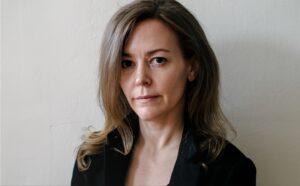
Mimi Johnson is founder and director of Performing Artservices (1972) and Lovely Music (1978). She was married to composer Robert Ashley and continues to produce and tour his work, including all of Ashley’s operas, from “Perfect Lives” (1978-81) through “Crash” (2013-15) and “Quicksand “(2011-16).
OperaWire reviewed Johnson’s most recent productions of Ashley’s operas, including “Improvement (Don Leaves Linda)” (2019) at NYC’s The Kitchen, and “eL/Aficionado” (2021) and “Foreign Experiences,” (2024) at NYC’s Roulette Intermedium.
In celebration of Johnson’s upcoming production of Robert Ashley’s “Celestial Excursions,” taking place at Roulette September 12th-14th, OperaWire reflects on Ashley’s works and Johnson’s productions.
OperaWire: Where did your inspiration come from when founding Performing Artservices in 1972?
Mimi Johnson: I was only 25 or 26. I had been living in Europe and it was while there that my mentor and coworker, a woman named Bénédicte Pesle, who was huge in what she did for artists, got me interested in the performing arts. There was no performance art background in my family. I was a standard English major in school and after college, because of family, I found myself living in Paris for several years. Bénédicte was involved with a lot of American artists, notably the Merce Cunningham Dance Company, and therefore John Cage, David Tudor, as well as other dancers and theater makers. They all needed administrative help locally. So we started Artservices in Paris. So many amazing artists were coming from the US. After a little while I said to myself, “maybe I’m in the wrong place.”
So I came back to New York and started Performing Artservices. I had the good luck of meeting another wonderful mentor, Jane Yockel, who really taught me everything. I was interested in the arts of all kinds (dance, theater, music) and I was not an artist, but I had discovered that you could be totally involved with this world and you didn’t have to be an artist. I had a job when I got here, a modest job. It was cheaper in New York then. I was having fun. My inspiration was to attach myself to the people who were making amazing work and help them to do it. To be the backup.
OW: And it was six years later that Lovely Music began?
MJ: Yes, very soon afterwards. I think I have to give credit to Phil Glass because he and his friends had started Chatham Square Productions (1971). I was working with Phil at that time as he was one of the artists Artservices was managing. And I thought, “hmm yeah this fun!” (laughs) So, I decided to start Lovely Music. I credit Bob (Robert Ashley) with coming up with the name.
OW: Who were some of your first clients with Lovely Music?
MJ: The first recordings were Bob’s very famous, ground-breaking, shocking at the time, “Private Parts.” David Behrman’s wonderful “On the Other Ocean.” Meredith Monk’s “Key”, Jon Hassell, “Blue” Gene Tyranny, and Peter Gordon. From there, came the second group of recordings including Alvin Lucier, Gordon Mumma, Jacques Bekaert, David Tudor.
I really liked the electronic sounds. I really, really liked them. (laughs)
OW: And it seems you had a long run with John Cage as well, correct?
MJ: Yes, because of my earlier experience in Europe I was lucky enough to meet John while I was a gofer on a Cunningham tour. He was an amazing man and so generous. We got along really well and when I told him I was coming to New York, he said “well if you come to New York, you can work for me.” I knew nothing, but John was an amazing (and patient) man and I worked with him from then until he died in 1992.
OW: And in regards to Robert Ashley, what would you say is the most impactful reason for producing his operatic works?
MJ: During all the years that I worked with him as a partner, I never thought of myself as a producer, so to speak, because Bob was the producer. He knew what he wanted to do and I was there to support that and to make it happen if possible. Bob was only 83 when he got sick and died. His pieces are somewhat particular and considering that he did not write for an instrumental or acoustic orchestra, it’s somewhat complicated to allow other people to perform them. My goal, right now is to keep the works alive. I didn’t think they should die with Bob. I thought they could be repertory in my production world, and that it would be advantageous for more and more performers to become familiar with Bob’s method of performing. So, this is why I am doing this now. By the early 1990’s, with “Improvement (Don Leaves Linda),” Bob had fully developed his system of making a pre-recorded orchestra that replaced traditional instruments. He began working with Tom Hamilton at that time. Tom and Bob would spend weeks preparing the orchestra then “the band” would come in to perform their parts live.
I also realize that I’m not going to be around forever, nor is Tom, so I wanted to be sure that the orchestras, technical instructions and librettos were in shape to make them available to others. Singers who are used to having fully written out parts and exact instructions about what they should be doing, must develop a new mindset. That’s what we’ve been doing the last few years, trying to make it easier for others, in the future, to perform the work. This is what we are working towards. The New School performed “Dust” in 2017, and it went very well.
OW: How do you enjoy working with the vocalists for his operas? I feel like you have a really tight crew that I’ve experienced doing excellent work in past productions, including “Improvement (Don Leaves Linda)” (2019) at NYC’s The Kitchen, and “eL/Aficionado” (2021) and “Foreign Experiences,” (2024) at NYC’s Roulette Intermedium.
MJ: This IS a tight group, yes. The original singers including Paul Pinto, Gelsey Bell, Brian McCorkle, Aliza Simons and Dave Ruder, came to Bob in 2011. I got a call at the office one day and it was Dave Ruder saying, “my friends and I are going to perform ‘Perfect Lives’ in Williamsburg tomorrow at various sites.” I said, “Bob let’s go, let’s go.” We rented a car and we followed them around Williamsburg for that wonderful, magical day. Bob was really enthused. He was thrilled….so pleased that they were performing his work!
At that time we had just started working with Performa about bringing back “That Morning Thing” (1967). I called up the Performa producer and said, “you know this might be really good for Performa.” So they came out that day and watched them and then the group, naming themselves “Varispeed”, created “Perfect Lives Manhattan” (2011) that November for Performa. They’ve performed this a few more times in other cities. And they all ended up performing in “That Morning Thing” at The Kitchen in 2011. A couple of years later when Bob started working on “Crash” for the Whitney Museum with Alex Waterman, he cast them (Gelsey Bell, Brian McCorkle, Paul Pinto, Dave Ruder, and Aliza Simons) along with Amirtha Kidambi in the opera. By the way, “Crash” is the only totally a capella opera. There is no orchestra. The six performers make their own orchestra. There are different kinds of stories in short segments. During one section, three performers tell the story, while the others chant. And then they switch around. After “Crash,” I produced “Improvement (Don Leaves Linda)” at The Kitchen. For this we added Bob’s “ghostly voice” for the intro. Next I moved onto another opera (“eL/Aficionado”), written for four performers, and I added a new singer, Kayleigh Butcher. Tom Hamilton had the great idea to take a part that had been sung by baritone Tom Buckner and put it in the mezzo-soprano range. So, we found Kayleigh, and also soprano Bonnie Lander. This is how I keep adding singers.
“Celestial Excursions” has a new singer too, baritone Mario Diaz-Moresco. He performed in the “Dust” production at The New School.
OW: Tell me all about “Celestial Excursions.”
MJ: Tom Hamilton and I were having a coaching session with Kayleigh (Butcher) yesterday and what we remarked on is that there are several references to ghosts. Bob and I had spent a lot of time with my mother who was not well and was in assisted living. We went back and forth a lot to visit her in Arizona and Bob spent a lot of time with older people. If you knew Bob, you’d know that in a group of people you could just see him listening to voices. He studied the way people talk. Their cadences. What they were saying was almost secondary. It was more about how they expressed themselves. So, he was around a lot of older people, and of course he was getting older too, and they became the characters and the theme of this opera. Everything is very autobiographical. I mean, everything is autobiographical anyway. So, Bob had these stories he wanted to tell and this is how he organized them – as if they were memories of these characters. This opera immediately followed “Dust.”
OW: Do you resonate the most with “Celestial Excursions” because it is so personal to you?
MJ: So is “Dust.” Everything is personal. Every single opera. I can’t choose one or the other. I mean, people have their favorites. Kyle Gann was totally in love with Linda in “Improvement.” He was in love with the character Linda. Fascinated by her.
I don’t really have favorites. The one I’m working on right now is my favorite.
There is a whole lot of wonderful text and music in “Atalanta (Acts of God).” This one really needs a revival because it goes back largely to the 80s. It’s got a lot more improvisation in it. And therefore, it’s hard. It’s especially hard because I am not a musician. Thank god for Tom Hamilton.
OW: Do you feel like “Atalanta (Acts of God)” will be the next opera that you aim to produce?
MJ: I think it should be. I managed to produce three of the four operas in the group “Now Eleanor’s Idea.” I never got to the individual opera “Now Eleanor’s Idea” because of all the Spanish in it. The characters in the opera are in the Low Rider community and speak a very particular kind of Spanish. So I decided to produce “Celestial Excursions” because it’s the next in line after “Dust.”
But I think the writing in “Atalanta (Acts of God)” is astounding. I always approach the work with an English major’s attitude, so what I love is the language. I mean, sometimes you just faint. It’s so good. And I think that’s the major thing that sets Bob apart from other people writing any kind of opera – his librettos. He never set others’ poems or texts to music. He created text and music more or less simultaneously. He wrote a cohesive story first, then edited it and forced it into the rhythmic structure he wanted.
What is it that you find charming about his works?
OW: I’ve had the pleasure of reviewing “Improvement (Don Leaves Linda),” “eL/Aficionado” and “Foreign Experiences.” I’ve always been fascinated with how Bob writes for the voice. He captures the beautiful cadences that happen in a room full of conversations. Whenever I was little, my family and I would always go out to my grandma’s house in Southeast Oklahoma where people gathered in the backyard and came into the house to eat. I think it was while having these conversations, especially while eating and then we’d immediately play a card game afterwards or a big game of dominoes, that I would just sit there and close my eyes as a kid to capture moments of conversational sounds and just think about how this, right here, is the most alive space in my world that’s happening right now. I feel a familial affection to these sounds and I think they are the most difficult to duplicate as you get older in your memory, unless you record them of course. You know, I can have a memory of it, but I sure do miss just being in the thick of it. And so, I feel a nostalgic connection to Bob’s works that go beyond the composition as a whole because his works always get to the point and the core of why he wrote it – the libretto.
MJ: Exactly. You came to the same place that he did. I mean, I didn’t meet him until he was forty, but there are pieces like that from the 60s and 70s. There’s a piece called “The Fourth of July” (1960) on magnetic tape which is literally a recording of people in the backyard talking. So, that’s what fascinated him too, those speech patterns and cadences.
OW: I also think what sets Bob apart from other composers was his ability to transcribe and write a score of these conversations. Note for note, word for word. His gift of intelligence for this level of writing takes my breath away. His razor sharp focus that is the through-line of his works reveals his mastery as a composer in this way. I don’t know if any composer would do this type of work today without technology helping them. I imagine him sitting down and doing the work.
MJ: I think the thing about him is that he did sit down and he did do the work. Around the house he’d repeat certain phrases all the time. It could drive you nuts. (laughs) And you could watch him in conversation with someone and he’d be grinning at the person talking to him and enjoying the speech patterns of that person. It took me a while to get used to it, but that was Bob.