Q & A: Composer Damien Geter & Librettist Jarrod Lee of ‘Delta King Blues’ on the Evolution of Opera
By Arnold Saltzman(Photo credit: Rachel Hadiashar)
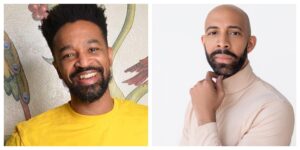
Two likeminded creative souls, while working in the production of the Met’s “Porgy and Bess,” met over coffee, serendipitously, decided to collaborate on a work based on the life of Robert Johnson, and the legend surrounding his life. The resulting opera is “Delta King Blues” and the men in question are composer Damien Geter and librettist Jarrod Lee.
Geter is the current music director of Portland Opera and composer of “Loving v. Virginia,” which premiered earlier this year at Virginia Opera. His catalogue of compositions includes numerous symphonic choral, and chamber pieces that have been performed worldwide. “Delta King Blues” is his second opera. Meanwhile, Lee, who is also a bass-baritone, is no stranger to writing opera libretti as his resumé includes usch works as “Hello, Star,” “Two Corners,” “The Ordering of Moses, and “Kandake, among others.”
Their new venture is set for its world premiere this weekend at IN Series. OperaWire recently spoke to the duo about creating the work and their collaboration.
OperaWire: How did the commission come about?
Jarrod Lee: As a member of the IN Series’ Mary Caldwell Dawson Fellowship, I had regular check-ins with Tim Nelson. In one of our zooms, Tim asked what I would like to present as a librettist at the close of my time in the fellowship. I mentioned my collaborator, composer Damien Geter, and our goal of creating an opera based on the life of Robert Johnson. Tim shared his phone’s screen showing the playlist he was listening to prior to our meeting, and it was Robert Johnson. It just had to be.
Damien Geter: I believe Jarrod was working with IN Series when the topic of a commission came up. He brought up my idea that he and I discussed – writing an opera about Robert Johnson to Timothy Nelson, AD at IN Series. Coincidentally, Johnson was in Tim’s mental sphere at the same time.
OW: Why this subject?
JL: Why not? Opera has the capacity and capability to take us on great journeys even through the complexities of the human soul and the myth that surrounds our choices. The myth of Robert Johnson’s story is as operatic as anything else one can think of in the canon of opera. People sell their souls all the time for money, fame or even a name but they can’t have it all, all the time. Something must be sacrificed.
DG: Robert Johnson is the most important American musician. Everything we hear in the blues, and a lot of what we hear in rock n roll was conceived by Robert Johnson. The legend surrounding his life is also Faustian – great material for opera.
OW: Do you think that you’ve created characters who will have a future and appeal to a broad audience of opera fans?
JL: Yes. I guess it depends on how you define “broad audience.” We created characters that were true of the time, and real to the story. In that vein, as long as folks are interested in the story, they will be interested in the characters.
OW: How would you describe your working process? Did you work together to draft the narrative or have the libretto first?
JL: Damien and I have a way of communicating that helps with storytelling which works well for our working process. He shared the idea of Robert Johnson’s life and the possibility of it becoming an opera over coffee during our time of working together in the Metropolitan Opera’s 2019-2020 production of “Porgy and Bess.” During the shutdown, I sat at my mother’s dining room table and researched, then I sat with as much material as I could find. When I finally began to write, the characters started talking. In a traditional fashion, the libretto came first. Then I sent it to Damien for us to discuss. We explored the possibilities and found our groove.
DG: For me, the libretto always comes first, but Jarrod and I are in conversation before he starts writing, and after he finishes the first few drafts. When we feel like we have a final draft, I then go off and write, but I am in constant contact with him in case I have questions or want to bounce some ideas off of him. I love working with Jarrod, and I hope we get to write something together again someday. He’s a great collaborator.
OW: What is your writing background and how did you approach the libretto?
JL: I grew up in a family of storytellers. I watched how they used certain words and inflections to color my imagination. I’m also an opera singer who loves intentional character driven storytelling and listening to the composer’s composition that supports the storytelling. Writing is no different for me and my approach is like entering a room where the conversation is already happening. I write what they say and before I know it, I have a libretto.
OW: Damien, you have made a transition from opera singer to Opera Director and Conductor. How did that transition come about? Was that difficult? Do you miss singing?
DG: I’m actually trained as a conductor, but because of the gatekeeping in this industry, it’s taken a while to get here…actually, I’ll say my arrival is right on time. I don’t miss singing. I don’t miss having to rely on my body to be in top form all the time, not to mention the mental gymnastics that come with being a singer.
OW: Will you continue to perform standard repertory in your role as Director of Portland Opera in addition to developing new works?
DG: That’s the plan.
OW: How do you see opera as evolving in new works?
DG: Opera IS evolving. Modern stories (and some lost stories) are being presented. The way in which they are presented is changing. I think audiences are hungry for an upgrade.
JL: I see Opera evolving more as a vessel for storytelling and the new works allow that vessel to reach beyond the opera house and find new homes that may not look like anything we have seen in the past. In Opera’s evolution, when folks are asked what are they going to see, they will respond with “The Delta King’s Blues,” or “Lalovavi,” or “Bayou Legend,” or ”Cloud Nebula,” or “Fire Shut Up in My Bones,” or “My Name is Florence,” or any other fabulous opera created by my fellow creatives. I think as we are evolving as humans, artists and creatives, we are also evolving opera. New works have been here. New works are here, and more new works are coming. Let’s see them, celebrate them, and enjoy them.
Categories
Interviews
Stories you may also like…
Q & A: Composer Paola Prestini on ‘Sensorium Ex’ & VisionIntoArt’s ‘Make Make Innovation Festival’
Q & A: Azrieli Commission for Canadian Music Laureate Nicholas Denton Protsack on Creating Ecologically-Minded Music