Q & A: Jason Duika on Being a Verdian Baritone & His Upcoming ‘Rigoletto’ Debut
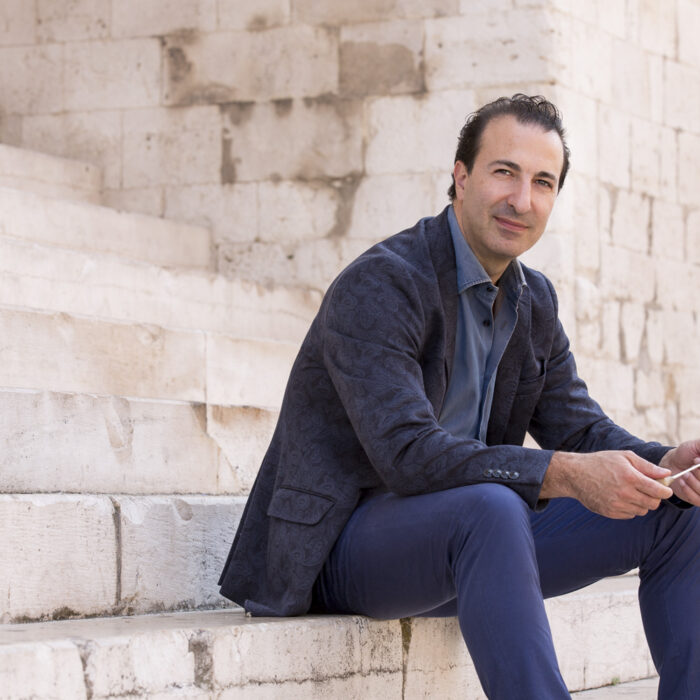
By Mike Hardy(Photo: @MontePhoteaux)
Jason Duika has been steadily making a name for himself as an up-and-coming American Verdi Baritone, having sung with over ten companies in the US to critical acclaim. He has sung over 20 operatic roles professionally, including the title role of Verdi’s “Nabucco,” in October of 2019 with West Bay Opera, in California, where the reviews said, “Baritone Jason Duika triumphed in the role, with a range from vengeful and commanding to pitifully weakened after his blasphemy to moving and reverent after he turns again to God. Both singing and acting were top-notch.”
Jason spoke to OperaWire from his home in Sylvania, Ohio about his passion for Verdi and his upcoming debut in “Rigoletto” at the Heartland Opera Theatre, Joplin, Missouri.
OperaWire: I know you’ve sung in quite a lot of varied opera houses around the US. Was that by virtue of you doing a lot of traveling around or is that the way contracts have gone for you?
Jason Duika: It’s the way the business goes for everybody. It used to be many, many years ago, five or six decades, you know, you could be a baritone, what’s called a house baritone, really anywhere in the world. That still exists in the big houses or in Europe, where you can do what’s called festing or guesting, and that includes Great Britain, France, Italy, but mostly Germany. The United States is not doing so well right now, as people are well aware.
And it’s a scary time for us. I’m trying to be careful about that but also stand up for what I know to be right. It’s harder than ever in the United States to make a career. So, I have to write to a lot of companies. My manager has to follow up. I go and I do dozens of auditions.
I’m lucky if I’m hired one time. And I’m starting to enter the prime of my voice type. And what that means is, is that bigger companies, they want to hear you in four or five years. Smaller companies, many of them are ready to hire you now, but I am getting hired. I’ve done something like 17 or 18 arts organizations, 10 or 12 opera companies, and Rigoletto will be my 28th operatic role.
I’m what’s called an established regional singer and I’ve sung for some big companies. I’ve sung for what’s called ‘consideration for main stage audition’ for the Met. That was in 2022. So, I’m being considered for them. They just haven’t hired me yet.
OW: Do you think sometimes it’s a question of luck as well, being in the right place at the right time maybe?
JD: Absolutely, a lot of the people I think who are young and having a big career, not to say that they’re not talented, many of them ARE very talented and have done the work technically. They were ready at that point, and they were in the right place at the right time. And that luck was a big company, and it just opened things up for them. The rest of us have to struggle, have to do the lay work, and so I write opera companies and symphonies every day and introduce myself, and many times I hear back from them, and most of them are delighted to hear from me. And I CC my manager and he follows up and once in a while that leads to a contract. You know, COVID really also did a number on us here in this, as it did everywhere. And our country’s arts were not subsidized before COVID and there are 50 less opera companies, five zero, less than there were 30 years ago in the United States.
So instead of 175 or 180, there’s 130, 125 houses and yet the market is saturated with singers. It’s only so much that the business can do to hire only so many singers. So, you know, whereas five, six, 10 years ago, I first started I might have gone up against six or sixteen, and still in specific cases I will, but now it’s 60 or, at a big enough company, 600 other baritones. Granted, my voice type is a little more unique in that I’m a true dramatic; what’s called a dramatic baritone, a Verdi baritone. True dramatics are more rare but out of 600 there might be 60, 10%, you know, or I’m guessing. And then there’s you know, appearance; a question of looks too, and all sorts of other things, I can only speculate about, that goes through the casting director’s mind. So you kind of have to balance, you have to balance your ego with it all and not let any one audition bring you down.
OW: Well, I’ve heard several recordings of your performances and it’s inarguable that you have a very fine voice. It must be soul-destroying at times, having to trust fate to get that big contract among such strong competition.
JD: Thank you. I’m blessed that my manager is one of the best in the business. He feels the same way. It can take a while for a career to catch fire, to bloom. And I take heart from the fact that I’m still on the young -ish side of my fach, my voice type. I’m only 42. So, I believe in my further 40s there will be more, like Rigoletto, which even though it’s in a regional company, Heartland Opera, it’s got a lot of heart. And even for that opera, I think they received hundreds of applicants and singers, you know, even for a regional company in Joplin, Missouri, and it’s with full orchestra and chorus.
So, I’m delighted to have my first opportunity to sing here because “Rigoletto” is one of the top 10 most done operas, and I’m hoping it snowballs into more “Rigolettos” elsewhere. I was just talking to my manager about singing for some of the dream houses I aspire to sing at, throughout Europe, and Great Britain and Scotland, where my heritage is from. So, my hope, knock on wood, (I’ve got a wooden desk here); hopefully someday, I’ll sing Germont or “Traviata” or anything at those companies. That would be wonderful.
OW: Tell me about the work you’ve put in for this role and what preparations you’re making.
JD: Well, it’s the longest in my rep, by far, “Rigoletto.” It’s considered the Everest, the Mount Everest of Verdi baritone rolls. It’s a good hour 20-25 minutes of singing, depending upon tempi a little faster a little slower, or I should say a little longer a little shorter. It’s the highest. I consistently do the high A flat at the end of “Si Vendetta” at the end of Act two and then the high A at the very end of the opera. But now, every time… I just sang through the whole thing yesterday with my accompanist… and every time I do it the high notes are there because the voice is settled and the technique has been amply worked on.
I’ve been working on “Rigoletto” since 2020. In 2020, we were locked in with the pandemic and I was like, I’m not going to just goof off, I’m going to learn roles. And I spent six months on “Rigoletto” during that time. And then I came back to it over the past few years; came back to it last August, and I was cast in September. They had let me know that I might end up being selected, and I had a good feeling. And I was notified on September 28th that I had the role, and I was over the moon.
The role is so dramatically and histrionically so challenging too; not just vocally, but because Gilda dies in your arms at the end. And I’m not a father yet, but there are times when I’m singing it where I have to steal away. It’s acting without acting because in acting you can cry and scream but you can’t do that when singing or the voice collapses. You have to be able to sing this exquisite work and that therein lies the acting; those many moments where I have to get out of my head and kind of be a little dead so I can sing it so beautifully, but still pretend that I’m, you know, I’m with her. It’s so heart-rending.
But vocally, my God, Verdi. Oh! He demands so much of you. You’ve got to sing very, very high, very, very low, and with very, very long phrases. Impossibly long phrases. Renée Fleming, one of my favorites, talks about navigating passages of Strauss or Verdi like you’re a swimmer, like Michael Phelps, with all the lengthy breath. It’s not untrue.
I have an extraordinary teacher, Andrea DelGiudice, who’s been with me for 10 years. and she helped me find my Verdian sound. She, and my manager, Peter Randsman, enabled me to audition for these types of roles. I’ve auditioned for the lead roles in “Trovatore,” “Macbeth,” and “Otello” but they’ll happen when they happen; just like this “Rigoletto” came about; sometimes when you least expect it. But this is the first one in the new set that I’ve gotten and they were just delighted. I just had a session with my manager to go through it and my coach Kevin Bylsma who’s the artistic director of Toledo Opera which is where I live. That’s a great regional house. It’s a very well-known regional house of about 75 years here in Toledo and a lot of famous singers, Met singers, and others have come through it. I debuted with them in 2024 as Capulet in “Roméo et Juliette.”
But, as I was saying, working with Andrea DelGiudice and my manager Peter Randsman, we’ve been working hard at it for about six months. I’ve got about three months left. So, nine months is a good amount of time but I’m glad i had the previous years’ experience of learning and practicing the role. As I was singing it yesterday, I thought not only how far it has come just beautifully, but to finish it still with no issues with the voice because it’s so demanding. But from a technical standpoint, as I was singing it yesterday, I was thinking: “Wow! This has been such a journey in and of itself, just technically.”
I’m able to add new colors and nuances and back off a little bit. Because if you give 110 % every note, you’re not going to get through something like this. It’s too much. And the more I age into my instrument, the more I’m able to control. This is my third Verdi title role. I’ve sung “Nabucco,” “I due Foscari,” and “Rigoletto” will be my third, although I’ve sung Germont in “La Traviata” and Ford in “Falstaff.”
OW: So, as a Verdian baritone, how do you view Puccini? I understand you auditioned for “Tosca?”
JD: Yes, I did. Puccini, for the baritone, he wrote a little differently than he did for the heroic tenor or soprano. I feel that with Puccini you’re a little less center stage. As the baritone, you’re kind of woven in with the orchestra, certainly with center moments. I’ve sung Scarpia’s “Te Deum,” many times and it’s lower. He’s such a villain. It’s the same language. It’s not that different. It’s a little heavier orchestration. “Rigoletto” was still in the early phase of Verdi, but arguably “Traviata,” “Trovatore,” and “Rigoletto,” the trifecta of the greatest that Giuseppe Verdi ever wrote, Yeah. I don’t think Puccini could have done what he did without Verdi paving the way.
I mean, the reason I’m a Verdi nerd on top of being a Verdi baritone, you know, he was ageless. And in his almost 90 years, 88 years, you know, he was heavily influenced by Wagner later. So, you have the “Rigoletto” more with the boom -chuk -chuk, boom -chuk -chuk…still like in “Traviata,” moving towards more of the through-composed. “Parisiamo” is recitative, more like Ford’s aria, but then you get into “La Forza,” and then “Un Ballo,” and later into “Otello” and “Falstaff.” He was so heavily influenced by Wagner, his compositional style, it evolved at the end of his life to include, I think, two of probably the greatest operas ever written. I’m a massive fan of “Otello” and “Falstaff,” but “Rigoletto” also, and justifiably so.
Every character, when it’s their turn, is spotlighted by how he wrote it. It’s Gilda… It’s me… It’s Gilda… It’s me… He envisioned it as six duets. Gilda and Rigoletto in this magnificent tennis match the whole time.
And then when the Duke is on, he’s on! And when Sparafucile is on, he’s on! So, he really created the orchestra to support and underpin them in the most incredible way. I can’t say enough about what an honor it is. I think we get caught up in the ego a lot, and it’s an honor to sing this. Of course, we need to be paid and be able to pay.
But I think we get caught up in that and forget about the, what’s being rendered. I have a little bust of Verdi, I go and I tousle his hair every now and then, you know. I say, thank you maestro, that was a good one! I think you would have liked that one. So, there’s a certain reverence about being able to sing it, which has deep, deep meaning for me.
OW: That’s an endearing, charming thing! I always say, you can’t beat Puccini! But then I will listen to a good Verdi role, and I think it does run pretty close. Of course, Verdi links beautifully to that earlier period of Bellini, Donizetti, and Rossini, with the Verismo. What about Mozart?
JD: Mozart, I adore. I’m not cast very much in his works because they feel like my voice is really more dramatic than that. So, I kind of lament. I’m like, yes, but I could still sing it! (laughs)
It’s fine. They just sing with their voice. It’s okay. When you listen to Mozart at the end of Act four of “Figaro,” when he apologizes, it’s the simplest little thing…(sings the opening of “Contessa, Perdono”)…or “Lacrimosa.” It’s those tasty little treats he gave us that are extraordinary. I’m also a geek for Mozart, but what I was going to say is that Verdi did for Puccini what Bellini and Donizetti did for Verdi.
OW: What do you aspire to sing in the future? What would be your dream role?
JD: Oh, well, this is one of them. It’s always been Rigoletto. I would love to sing Count di Luna in “Trovatore,” another Verdi. I would love to sing Renato in “Ballo.” I’ve sung “Eri tu.” I’m doing it in a gala in Toronto two weeks before I go sing “Rigoletto.” I’ve performed that aria 300, 400, or maybe 500 times. I would love to sing the whole role though, the whole of Renato.
“La Forza” is another, another dream one. Don Carlo in “Forza” and Don Carlo in “Ernani,” which is pre-“Rigoletto.” I’ve already sung two of the hardest, which was my debut. “I due Foscari,” I sang in 2019, the full role. And then the following fall, I sang Nabucco in “Nabucco.” I’ll never forget my manager pulled me aside after and he said Nabucco is widely considered the heaviest of all Verdi baritone roles, and the Act four is what I used to audition for this “Rigoletto.”
But I’d also love to sing Scarpia. Moving into slightly different echelons, I have started to flirt with a little Wagner. I’m not going to say which role, but there’s a Wagner role out there that I would love to sing someday. But I’m also happy if my career keeps me in the Verdi’s, as he’s my voice type and my favorite, and the one that is most intuitive for me to sing. My teacher calls me clinically Verdi. It’s the one that makes the most sense, and I feel the most at home in technically and dramatically.
OW: What else does this year hold for you?
JD: I have a gala in Toronto right before this “Rigoletto,” and I’m singing “Eri Tu,” and then another musical theatre piece for that, that’s May 2nd, and then the “Rigoletto” is May 22nd in Joplin. We go down two weeks earlier to stage and rehearse and all that. But right now I’m focusing on “Rigoletto.”
I’m working with my teacher and my manager and my coach and my other coach in Italy, Yuri Napoli, to prepare it all and it’s just enormous. A lot of it’s memorized, all of it’s learned. But if they want us to show up for the first day with everything memorized, I’ve got to keep on it, you know? It’s just drilling, drilling, drilling. And it’s so much. You can’t drill the whole thing all the time. You drill parts and then the whole and then parts, and then the whole. I have an amazing team. It’s a lot of work. It really is, but the work is part of the joy and the gloriousness of it.
OW: Who do you look to for inspiration? Who inspires you?
JD: Singing wise? Oh…a LOT of people! My favorite of all time, the Verdi baritone who I really love more than any, is Leonard Warren. It’s just Leonard Warren or bust. He was my favorite for my voice type. Ettore Bastianini is also an all -time favorite, but Piero Cappuccilli also was just incredible! I grew up on Seal, Sting, Whitney Houston, Celine Dion, and then the famous tenors. And my mom and dad would play, before I sang, I was just a little boy, they would play Pavarotti, I love Pavarotti! But I’m also a huge fan of Jussi Björling and Franco Corelli. Corelli may very well be, my favorite. Fritz Wunderlich is marvelous. My current singer that I adore is Piotr Beczała. He’s extraordinary. I also love the European baritone Ludovic Tézier. I just saw a DVD of “Simon Boccanegra” of his. But if I had to pick an all-time favorite, it would have to be Leonard Warren.
Stories you may also like…
Q & A: Prof. Mark Tucker & Prof. Isolde Kittel-Zerer on Reviving Hasse’s ‘Artaserse’ at Hochschule für Musik und Theater Hamburg
Q & A: Ana María Martínez on the Oscar Nominated Song ‘Sweet Dreams of Joy’ from ‘Viva Verdi’