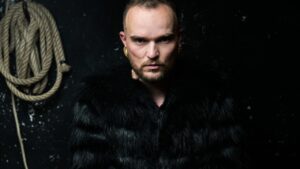
Q & A: Countertenor Nils Wanderer on Discovering His Soul’s Voice & the Evolution of Opera
By Mike Hardy(Photo: Guido Werner)
Wanderer by name, wanderer by nature, Nils Wanderer is an internationally acclaimed German countertenor, actor and choreographer. He was winner of the 2022 Bundeswettbewerb Gesang and Second Prize Winner of the world’s most prestigious opera competition, Operalia, in the same year. He has been hailed, by Olyrix, for his “beautiful, dark, well developed and amber colored voice which deploys a wide palette of colors throughout the action, with irony, tenderness, resentment, authority, magnanimity, all with a remarkable pronunciation and a magnetic theatrical presence.”
His concert and oratorio repertoire spans over four centuries from Purcell, Vivaldi, the Bach family, Handel and Pergolesi through Berlioz, Wagner and Elgar to Bernstein and Cage; as well as his own pop/electronic music program ‘WANDERER.’
OperaWire spoke with Nils at his Mother’s home in Germany.
OperaWire: Hello Nils and thank you for speaking with OperaWire. Countertenors are a pretty rare breed. Tell me about your background. How did you discover you had this amazing voice? And was it a conscious effort to sing this way? Because I assume you can also sing in the normal tenor range.
Nils Wanderer: I’m from a craftsman family in a rural area. A very village-y background and I love it. I was cast in my kindergarten for a boys choir, and so I joined not knowing what it was, never having read music before. I was five or six years old of course. That’s when I started to sing.
I loved the feeling of seeing the emotion in people’s eyes on stage. It was very beautiful for me. I was like: “Wow, that’s a superpower that you are able to connect with people.”
And so I continued to sing. Then I became a professional dancer, and I went to boarding school at a monastery called Maulbronn. It’s a UNESCO heritage site, where there is a big focus on music. And so, I trained as a singer, a flutist, and as a conductor.
OW: So, you initially were a tenor, or a baritone? How did you discover this other voice and what changes or steps did you take to nurture and develop it?
NW: I really sang in both voices. After my voice broke, I just continued singing in my soprano register and I added the baritone register. There was no big conscious decision of doing anything. So, when I performed in a concert, maybe I sang “Panis Angelicus” as a countertenor and then I sang gospel afterward as a baritone.
It was just a very free time. And also, I didn’t know that there was such a thing as a countertenor, because I’m not from a musical background. I knew I wanted to become a singer and a theologist. I got a theology scholarship and then I found out that I would have to study for both, and that would be too much (laughing).
So, I applied to some music universities, and I got in as a baritone. I sang things like Conte Almaviva, Ballantine’s prayer. I sang the St. Matthew Passion as a baritone. And then I got in and in the first year I sang as a baritone or like a “tenor-baritone,” quite a big voice and with a good range. And because I was a dancer, I sang in a lot of musicals and operettas because I could move. I was 18 and already had my first gigs which was beautiful to make some cash because of course, I had to take care of that as well!
After two semesters I told my teacher: “Listen, I have a voice inside of myself. Please don’t laugh. I think that’s my authentic self. I think that’s my human voice, my soul voice.” And so I sang for him “Lascia ch’io pianga,” one of the most famous arias of the Baroque repertoire. And he sat at the piano and he said: “Okay, we have to change everything. Because the one thing is that it’s really good, but the other thing is that it’s just not ready.”
A week later I sang my first Christmas oratorio as an alto. I had not sung Bach since I was a child, but I knew that it was me. So, Bach and the sacred music of Bach: St. Matthew Passion, St. John Passion, Mass in B minor, they all really made me want to become an alto. That was the reason for me. This voice of soul, the voice of the Holy Spirit, it was very special. And I really felt so comfortable in sharing this voice with people. It came so naturally. It was never artificial. It was never constructed. It was never in any way produced. It was just my natural voice, which we then of course had to build up because it has to be big enough. I’m fortunate that it’s quite a present sound, which is nice to be able to project over the orchestra. I also sing a lot of uncommon repertoire. I sing Stravinsky’s “The Rake’s Progress.” I sing of course all the modern repertoire, everything from Britten onwards. I sing Donizetti, but I also produce electronic music.
So for me it was important that my voice is versatile and not only focused on one thing. But my roots are of course in the world of classical music and that’s where I come from. And that’s where I draw my aesthetic. But my kind of way of becoming a singer was that I was always more of an artist than a musician. And this I had to learn while studying. I had to learn to become a musician and now it’s one of my most important traits. But that was really hard-earned.
OW: Explain to me the physical enactment of what you have to do. Obviously, I presume you’re going to have to use your head voice an awful lot. I always imagine that it must be quite difficult to produce breath control for that, to sing with sustained falsetto. I can sing a little, although I’m a tenor with a poor top.
NW: My experience is that most tenors, if they sing as a countertenor, tend to become more altos, while baritones really can swap into the soprano register. I think part of it is because you approach your high notes with full chest, which then, as a countertenor, become my low notes. So, something like your high F is my low F. It’s a different way of navigating the voice. And I think everyone has a different secret or different ingredients to this technique. For me, it’s very important that I incorporate my chest voice. It’s a big part of the way I sing. I love to mix it. I love that my registers are even because I want to be able to project and produce sound in every register. And I sing a lot of low repertoire, and you want, as a countertenor, to be heard. You want it to be full, and you want to of course touch the audience. And for that you need volume and you also need color.
And then of course, many of my friends are also singers, but as a countertenor, I feel like we are more like neurosurgeons, in that because we only sing with the inner sides of our vocal cords (we don’t use the full vocal cords) we cannot be too sick, we cannot sing on it, we cannot push it too much because it will definitely break. So, what we need to do is we really have to be careful and controlled in approaching the sound. And then once you’re there, for me at least, once I can sing my first note in a performance I know how the evening will go.
I will know from that first note, if I can let loose and what we can really do, we can play with it, we can take all the colors or because of course people get sick around you, and it may affect you also, you may feel like: “Okay, today I have to work for it.”
And that means for me, it has to be very focused, it has to be controlled. It always has to have that constant flow of breath, which is super important. Not to hold the voice, not to push the voice, because it’s just more fragile.
And you don’t want the voice to sound like a choir boy (at least, that is not my aesthetic) but I also don’t want to sound like a dramatic mezzo with a super huge vibrato. The problem is, I think, the superpower of a countertenor, at least in my voice and the way I sing, lies in the male core, surrounded by a warmth and also a roundness. And it gets lost once you push it. It gets very stringy and very hard, harsh sounding. And that’s the last thing I want. So, I prefer then to be more active in supporting the voice when I feel I’m not in a perfect state, which we all are in sometimes, and it was a process of learning to use it.
OW: It sounds very complicated, very technical. Do you take special steps to protect or care for your voice?
NW: I can only say I’m happy I started to sing early on with my colleagues because I watched them, I learned from them so much in how they navigate their respective techniques and what is actually effective for them. The one thing is what you teach and what you learn; what you study in the room and that’s super important. That’s your foundation. It’s the way you want to stay healthy and the way you want to master a role, but the other thing is real life, which you can take on stage: Will you have a cold? Are you emotionally unwell? Did you have a bad day? Did you have a super good day? And so for me, the technique always has to be flexible. You have to have a base, and you have to have some kind of solid foundation. But then sometimes you have to decide on the spot. If I feel like my lows are not closing super amazing today, let me go into my chest. Let me mix it differently. Let me use a brighter vowel to get more overtones out so it really carries. So, it’s a trial and error thing and I think it comes with time.
I’m 30 years old now. I’m still not there but I am giving it my best, and I love my profession. I’m more of a person who really, dearly wants to connect with the audience and who wants to portray emotion. And for that, I feel like it’s important to have a voice which is produced naturally and which carries well but also has all the colors and emotions in it. And that’s maybe sometimes I prefer to sacrifice one or two runs for a beautiful, heartfelt note.
OW: You’re not just the first German winner of an Operalia award, but also I think the first Countertenor to receive such an award, putting your Fach on the map. What did it mean for you to achieve that?
NW: Yes, I was the first German ever winning any award there, which is insane to me (laughing). And for me, what was incredible about it was that I decided to do Operalia because I am from this village and I thought this was my one shot to show what I do. I decided, very unapologetically, to only sing the repertoire I love. So, I didn’t go for the flashy stuff, I didn’t go for the coloratura stuff. I went with a Monteverdi lullaby, I went with a slow Handel “Suicide aria,” and I went with one of my signature ones which is Oberon from “A Midsummer Night’s Dream.” And what I experienced was that those industry professionals, I felt, really saw me for me. They didn’t try to change me or try to tell me what to do. I felt like they really appreciated the way I sang and the way I portrayed my arias.
I was very grateful because I love to be the underdog. It’s something which is very comfortable to me. But in this competition, you have to bring your A-game, and you have to bring what makes you, you. And you have to be individual as a person. You have to sing what is in your heart and what is “you” as an artist, because, obviously, no one will get into Operalia if you’re not a good singer. That’s something we can all agree on. The singers who arrive at Operalia are amazing. But it’s also about artistry, which type of personality, what voice touches you or what voice has something that says it maybe has a future? What’s the potential of the voice?
And so I was really happy that they saw that in me. It opened many doors. It put some credibility to my name. After I’m still a person, like always calling myself a wanderer. My last name is Wanderer and I’m always wandering between the worlds as I’m also doing pop and jazz music, I produce electronic music, I sing in my song recitals from Purcell to Sting or Strauss, whatever I want. It always has a string of emotion or a sub-title or topic, but I will always push boundaries. I was really happy that they accepted that. And they were like: “No, we love that. Opera is changing.”
And I also feel it now. Everywhere I go, I see much more shifting and I’m happy about that. I think it’s important to protect the beautiful old productions which are iconic and very masterfully done. But I also think it’s important to portray society nowadays and to be able to open the doors to everyone, because opera is for everyone. And by saying that, I feel it’s important, for example, that the Met does all of these new productions of the world premieres, where we can actually get to experience, as an audience, real life on stage: Beautiful, amazing black artists gracing the stage, singing in a most wonderful way, or queer life portrayed on stage. Right now, it’s more important than ever, I feel. And so, I’m really proud to be a part of this generation who’s able to maybe help by pushing the boundaries.
OW: You’re a very passionate man and I can see how the emotional context of everything you do is so important to you. I also know that you’re ambassador for the German AIDS Foundation, and I read somewhere that you had faced some discrimination simply for being a gay man?
NW: Yeah. I think that the only time I suffered that, what I would say it was, I was the first countertenor ever studying at my university. I didn’t suffer from homophobia, I just was part of a system in former East Germany, in Weimar, where there were of course queer people, but I was maybe a bit brighter, a bit more colorful.
I had a beautiful teacher who always supported me, but I feel like what had to happen was I had to wiggle myself into the system a little bit to find a place, and I did. And I have to say, I had a very successful study life, and I had really big opportunities while I was studying there. But now, if I think about it 10 years later, there’s a completely different world. I remember, for example, in my Master’s recital, I was wearing earrings my grandmother gave me. And one of the judges came and was like: “Why would you wear earrings on a stage? You’re a man.”
My take: “I’m also an artist. I’m also a human being. And I want to bring my personality to you.”
I will never wear a suit, ever. It’s not me. Never was. Not my way. And I don’t even think the comment came from a bad place. It was just that I felt, okay, that will be my task: I will be here as a singer, hopefully singing well, hopefully doing a good job, and while doing that, being a queer man. And it’s not something I use as a big flag, like: “Here, I’m gay, gay, gay! Hire me.”
But, it’s an important part of my life. I’m an Ambassador for the German AIDS Foundation. I work with a lot of different AIDS helping points and charities and raising money for them. And I see the amazing work they do. My biggest idols, they died of AIDS, like Klaus Nomi and Freddie Mercury. And so, I would never ever again compromise on that. That’s just something that’s part of me, part of my character, part of my voice, and I’m proud of it.
OW: It’s sad to see that there is still a degree of prejudice and discrimination in society in some quarters towards the LGBT communities.
NW: It’s super, super important what we’re doing right now, which is having an open conversation about it. Believe me, my dad is a biker. I heard you are a martial artist. My dad also is a martial artist. He is a hunter. I grew up in black and white. He has a very strong opinion on everything. And I love that. I think it’s okay. But I also see that maybe that’s also a big part of our job, which we have as singers, as people in public life, in the public eye. We need to attract conversation and to embrace open conversation about it and to make it a safe space for both parties to actually communicate their worries, their needs, whatever it is.
And that’s why I also love that we now have those new productions of opera, which sometimes touch on those kinds of topics. And sometimes it maybe opens the minds to both parties. Maybe they will see something they have never seen before. Maybe it will start a little glow, a little fire in some of them to be like: “Okay, maybe that’s the way I can see it as well.”
But because I come from a rural area, I really respect everyone’s opinion. I just feel it’s important to reflect on things and to also take other people into consideration and not to just close up and form your own opinion.
Especially in these times right now, I try to be very clear about protecting queer and trans life because it’s in great danger at the moment. We see it in Germany, for example, we have clubs closing down, we have queer people being attacked again, we have so many other things happening.
OW: Let’s focus on happier things. What would you really love to sing and what does the future look like for Nils?
NW: So my dream actually, I think hopefully comes true this season. I’ll be at the Metropolitan Opera in New York for the first time. I’m proud and very happy about it. And I will sing in this new opera about Frida Kahlo. That appeals to my strengths: the new, the world premieres, the new pieces. I will sing the role of Leonardo, who is a very close friend of Frida, and who is actually portrayed as a drag queen in the first part, playing Zsa Zsa Gabor.
That’s something I’m very happy to do. It will also be streamed on MET HD worldwide in many cinemas. I think it’s a statement. And I think it’s beautiful music also. And the production with Deborah Colker, a famous choreographer, means that I can bring in my dance background too. This is a match made in heaven.
My dream, my goal, besides singing at the Metropolitan Opera, which now is happening, is to start working as a director, in addition to my work as an opera singer, because I love it. I’m running my own festival, Wanderer Between the Worlds, in my hometown, and I really see myself more in deciding what kind of artistry needs to be shown, at least in Germany. And maybe to have my own production company, bringing my own operas to the stage, my own projects. But singing is always my number one. Singing is who I am. It’s my soul. It’s my life. And it’s what I think this guy, (points heavenwards), gave me to share with the world.