Q & A: Tenor Allan Clayton on Revisiting Musica Viva Production of Schubert’s ‘Winterreise’
By Zoltan Szabo(Photo: David Cox)
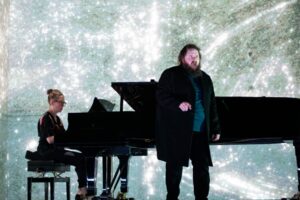
In 2022, a small artistic team took a tour around six Australian cities to present a unique take on Schubert’s renowned “Winterreise.” Lindy Hume directed the staging with David Bergman as video designer, Matthew Marshall as lighting designer, and Kate Golla as the pianist. At the core of the performance was British tenor Allan Clayton, who has drawn major renown for his stage presence.
The tenor, who has become the go-to “Peter Grimes” interpreter of the modern era, previously spoke to OperaWire back in 2022 prior to setting out on this project with Musica Viva Australia. Now, with the project set for another tour courtesy of Musica Viva, Clayton spoke to OperaWire about his prior experiences with “Winterreise” and this upcoming tour.
OperaWire: Can you give me an approximate idea of how many times you have sung Schubert’s “Winterreise?”
Allan Clayton: Probably not that many times. We are going to perform it with Kate Golla eight times on this current tour, same as the last time we did it in Australia. Kate and I also performed the same program in London, at the Barbican. Then, I had just four concert performances of it with Paul Lewis in England and in Amsterdam. I did it once as a student, too. I also performed Hans Zender’s version of the cycle, once with Simon Rattle in Munich and a few times with the Aurora Orchestra about two years ago.
OW: So, it would be fair to say that you have a wealth of experience performing this work. Could you name three adjectives or terms, that come to mind, to describe what this song cycle means to you?
AC: It is about love, loss and very briefly, hope. Beautifully tragic music. It typifies the Romantic era, the poetry of the early 19th century: reminds me of “The Sorrows of Young Werther,” of the lost hero – absolutely archetypal. This hero is far more real and bleak than, say, some of Mozart’s tenor roles, for example Tamino in “Magic Flute,” or Don Ottavio in “Don Giovanni” – not from a dissimilar period.
OW: Mozart did not write too many tragic roles for the tenor voice in his operas…
AC: A few, still. Idomeneo, as a tenor protagonist gets as close to tragic as possible. Also, in “La finta giardiniera,” Belfiore has a major breakdown in the middle of the opera, with some of the most extraordinary music Mozart ever composed.
OW: Returning to the upcoming tour, you performed the same music with the same collaborators, in fact, probably in the same venues in 2022. Has the interpretation changed much in the interim?
AC: We are starting with intense rehearsals tomorrow, so I’ll be in a better position to report on that afterwards. I think the last time, we took slower tempi for some of the songs, and we may discuss that with Kate Golla. Also, I have recently performed with a different musical partner and that has certainly changed the way I think about some of the songs.
OW: Did you apply a different musical approach in your collaboration with Paul Lewis?
AC: Not directly. However, the necessity of the recital format meant that I had to concentrate more on conveying the text to the audience. In this forthcoming tour, we will have a dramatic setup, with Fred Williams’s landscapes on LED screens behind us, with staging and lighting and I can be more expressive with my body and gestures. But I certainly would not prefer one over the other – they are just different.
OW: So, working with your “musical partner,” as you aptly named the pianist in a Lieder recital, to what extent can that collaboration influence your own concept of the composition?
AC: I have my own, at times changing, ideas about the songs and their character. At times, however, as soon as you put them together with the right musical partner, something does not quite feel right. I was privileged to have that in the last fortnight with Paul Lewis and similarly in this forthcoming series of concerts. We start rehearsing and then things suddenly make sense in a way they did not when I was practicing by myself. For example, in the fourth song, “Erstarrung,” if you do not have that constant left-hand movement in the piano part, it is difficult to find the right pacing or phrasing vocally. And as soon as you get that from your partner, you have this breathless excitement that propels you forward.
OW: Would you be open to interpretation suggestions from the pianist?
AC: Yes, always, it is a conversation. We try it and if it does not work, we try something else. To give you an example, Paul recorded the cycle years ago with Mark Padmore – it is a beautiful, beautiful disc! – and they played in the original keys that Schubert wrote. I, like many other singers, am usually using the Peters edition in which some of the songs are in a slightly lower key. So, at Paul’s suggestion, we did some of the songs in a different key from what I was used to. It meant that I had to change the way I use my voice and, therefore, how I performed them.
OW: Coming back for a minute to this current production, how do you see the relationship, the seemingly jarring juxtaposition between the quintessential 19th-century European winter in the song cycle and the quintessential 20th-century Australian landscapes of Fred Williams?
AC: The organisers came up with this unique pairing, which to me makes absolute artistic sense, and in turn, makes it a brilliant and very Australian enterprise. After all, bringing Western European cultural traditions is what Musica Viva (the organisers) does and does best. The choice of the paintings that Lindy (Hume, the director), Paul (Kildea, Musica Viva’s Artistic Director) and Lyn (Williams, the artist’s widow) decided on is phenomenal and in a beautiful way they match the various songs as if they were made for each other. One listens to “Irrlicht” (No.9) and looks at Williams’s canyons and chasms and gorges, and the pairing makes perfect sense.
It is a reinterpretation in a way. Simon Keenlyside did something similar maybe two decades ago but with dancers, so that was another way to look at this fundamentally wonderful music. This concept may be behind the new film, “Wuthering Heights,” titled in inverted commas – I just watched the trailer of it – because it is, again, a reinterpretation of the original by the director, Emerald Fennell.
OW: Another reimagination of “Winterreise” is Hans Zender’s radically new composed interpretation that you performed and recorded recently. Did that 20th-century re-scoring change your approach to the cycle?
AC: I still performed it with identical artistic intentions regarding the songs. But there are moments where the orchestration asks for Sprechstimme or screaming through a megaphone and then, I had to adapt the character and therefore my singing. By its nature, that version also expresses the music and the artistic ideas of “Winterreise” through the lens of the 20th century and through Zender’s musical style. This is particularly noticeable in the ending, which is an extraordinary three-page epilogue to the work, even more bleak than the original song, expressing Zender’s own voice in the most refined way. When I was rehearsing and performing the cycle with Paul in these last two weeks, I still had echoes of the Zender version in my ears and I am sure it will influence the way I will perform it in this forthcoming tour.
OW: Being able to sing “Winterreise” in so many divergent ways puts you in a unique position. How do you see yourself: as an opera singer or concert or chamber music performer?
AC: I get fewer questions from immigration officers or taxi drivers if I just simply say: singer. I think of myself as a classical musician. I certainly wouldn’t limit myself to Lieder or opera or concert work. Also, the colleagues I respect the most seem to do bits of everything, because they think (like I do) that the various genres all feed into each other and hopefully they make you a better performer in each aspect. But I tend to sing a fair number of British operas.
OW: Yes, you made operatic headlines last year with Mark-Anthony Turnage’s “Festen” at Covent Garden.
AC: It is an amazing but extremely demanding work, based on Thomas Vinterberg’s film that launched the Dogma 95 movement. Lee Hall’s libretto was superb as it brilliantly distilled the original movie. Tackling a piece that is as dark and difficult as this, one could not have asked for a better team, musically or dramatically. Everybody working on it was an open book, very positive, from the composer to all the singers and stage workers.
OW: Do you believe it is a work to stay in the operatic canon?
AC: I think so. It has already been invited to Finland this year. More London performances are to come and also, Amsterdam is interested.
OW: Not to make a value judgement but how would you compare it with Brett Dean’s “Hamlet,” in which you sang the eponymous part all around the world?
AC: That is an interesting comparison because Brett and Mark are very good friends. In fact, Brett credits Mark for becoming a composer. When Brett was violist with the Berlin Philharmonic Orchestra, he showed some of his work to Mark, whose comments gave Brett the confidence to become a full-time composer. From that stage, they mutually followed and respected each other’s work. Curiously, they both have a deep love of jazz and I think that one can hear it in the rhythmic density and intricacy of both composers’ work. Probably more overtly in Mark’s music, certainly in “Festen.”
OW: You also sang in the premiere of George Benjamin’s “Written on Skin…”
AC: Ah, which was another different beast again, a sort of third angle looking at 21st -century operatic music, a precious jewel: exquisitely crafted with a very small cast.
OW: So, what is your opinion of the by now infamous call by Pierre Boulez, some sixty years ago, to blow up all the opera houses? You are in an excellent position to value, even judge, 20th–21st century opera; does it have a future in our turbulent, busy lives?
AC: I think so. There are enough people fighting for it. My only worry is that I have to use the word “fighting” for it. There seems to be a constant need for opera to justify itself, particularly in fiscal terms. That is the biggest problem, because you cannot rationalise it financially. Staging, dramaturgy, technical conditions… it is all hellishly expensive, before you even bring singers on the stage. But it exists and still conquers hearts, because it brings together singing, dance, theatre – all these wonderful different art forms.
OW: Admittedly, Boulez uttered that provocative sentence before he accepted an engagement to conduct “Parsifal” and the Ring cycle at Bayreuth…
AC: That is also true. But if we look at just those three operas that we have mentioned: they are astonishing works of art. They will last centuries into the future and be looked upon with admiration, similar to all the great operas from the last four centuries. I think there are enough people who care about opera and that is the crucial point here. “Festen” had a limited run at Covent Garden, but it turned out to be an enormous success, and they could not reprogram it quickly enough. George Benjamin’s name was so revered that the initial performances in Aix-en-Provence were all sold out.
OW: How do you plan your repertoire for the forthcoming few years?
AC: That is always difficult, because you have to guess where your voice will be in five years’ time. Will I be ready to do certain roles…? So, it is the subject of a lot of conversations with my agent and with conductors I respect, because they know the repertoire so much better than I do and have a lot of experience with different types of voices in different roles. That said, I could probably make a living from just singing “Winterreise” and “Peter Grimes,” but I would go mad, and you just have to throw some new stuff in there.