Opernhaus Zürich 2025-26 Review: Tannhäuser
Magnificent Conducting & Stellar Cast Triumph Over Belaboring Production
By Laura Servidei(Photo: Herwig Prammer)
Richard Wagner wrote the libretto of “Tannhäuser” drawing on medieval German mythology, although its protagonist was probably inspired by a real person who lived in the thirteenth century. Mythology functions as a mechanism of psychological externalization: it takes the abstract, often chaotic dynamics of the human subconscious—our conflicting impulses, fears, and cultural values—and projects them into tangible narratives, transforming internal psychological crises into epic external conflicts.
Psychology Made Literal
“Tannhäuser” is no exception. The hero’s rigidly Manichaean conception of love, and his inability to reconcile its sensual and spiritual dimensions, are embodied by the figures of Venus and Elisabeth. His restless, immature dissatisfaction, his constant desire to be somewhere else, doing something else, is beautifully expressed first in his abandonment of Venus and later in his scandalous song during the contest at Wartburg. His self-destructive impulse is reified in the pilgrimage to Rome, while his self-loathing finds its ultimate expression in the Pope’s refusal to grant him absolution.
Director Thorleifur Örn Arnarsson embraces this psychoanalytic reading of the myth by making it entirely explicit: the story becomes a journey through the protagonist’s subconscious, presented as his own dream. This approach creates several problems and inconsistencies. First, it reveals either the director’s inability—or his unwillingness—to trust Wagner’s own narrative language, as though an opera that has inspired endless scholarly literature somehow required his explanation. Moreover, he painstakingly outlines his concept in the program booklet, perhaps because, in truth, it was not always entirely clear on stage.
(Photo: Herwig Prammer)
A Stage of Dreams & Fractured Selves
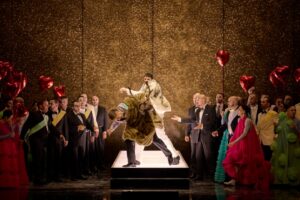
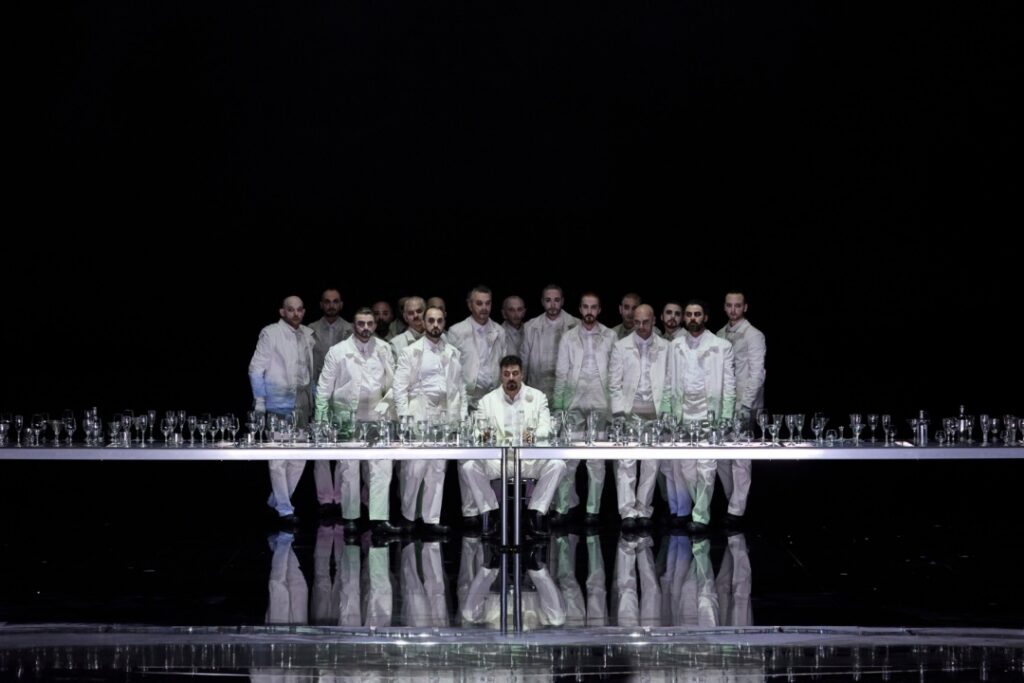
The stage is frequently populated by dancers dressed as Tannhäuser, mimicking his movements—at times comforting, at others threatening—physical manifestations of his subconscious. The pilgrims departing for Rome all wear masks bearing his face. In Erna Mist’s sets, the Venusberg is imagined as an elegant black chamber dominated by a long table in an otherwise empty space, lined with glasses and goblets that unfortunately reveal themselves to be plastic when they fall, producing both a cheap sound and effect. Wartburg appears as a vast room with gilded walls, a golden cage that, in the magnificent finale of Act two, closes in oppressively around the protagonist. After Tannhäuser’s return from Rome, the stage is littered with enormous shards of plexiglass, symbolizing the fragments of his shattered psyche—once again, a point dutifully explained in the program.
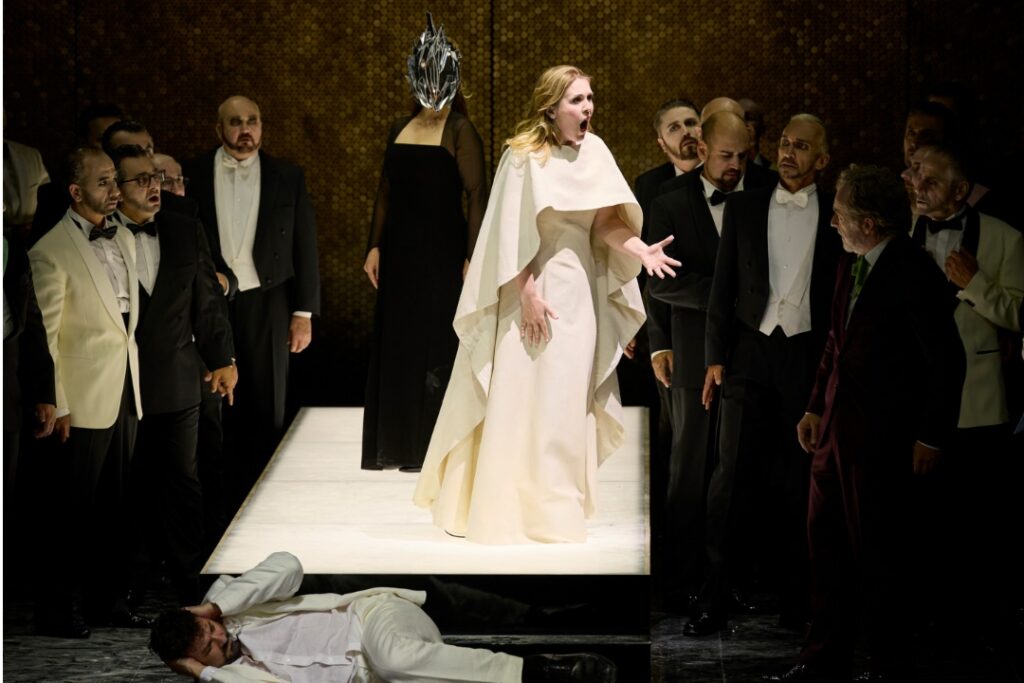
One of Arnarsson’s most successful ideas is his conception of Elisabeth as an inanimate object: a statue, apparently of a saint, standing on a pedestal at the beginning of Act two in the middle of the “teure Halle.” Dressed in white and completely covered in ceruse, she slowly comes to life, removing the white makeup as love awakens her humanity. She returns to her statue form in the final act, when her hope of love is finally destroyed after Tannhäuser fails to return with the pilgrims from Rome. On the opera’s final chord, Tannhäuser smashes the statue with a hammer—a gesture left unexplained even in the program. Overall, however, the production remained largely coherent and, above all, never interfered with either the music or the singers’ performances.
Sokhiev’s Magnificent Wagner
Conductor Tugan Sokhiev can justifiably be regarded as one of the rising stars of his profession—he is scheduled to conduct the next New Year’s Concert in Vienna—and in Zurich he demonstrated both an intimate knowledge of and a deep affinity for Wagner’s music, drawing a spectacular performance from the Zurich Opera Orchestra. His tempi were occasionally unusually broad, particularly at the opening of the overture, yet the music never lost its tension; the spacious pacing felt more like contemplation, allowing the richness of Wagner’s orchestral colors to emerge. The great ensemble at the end of the second Act was perhaps the musical highlight of the evening: Sokhiev condensed the full emotional and dramatic force of Wagner’s imagination into a magnificent, tightly controlled explosion. He also gave voice to the crucial narrative element that Arnarsson seemed largely to overlook: the power of Christian spirituality, the invincible strength found in humility, embodied by Elisabeth.
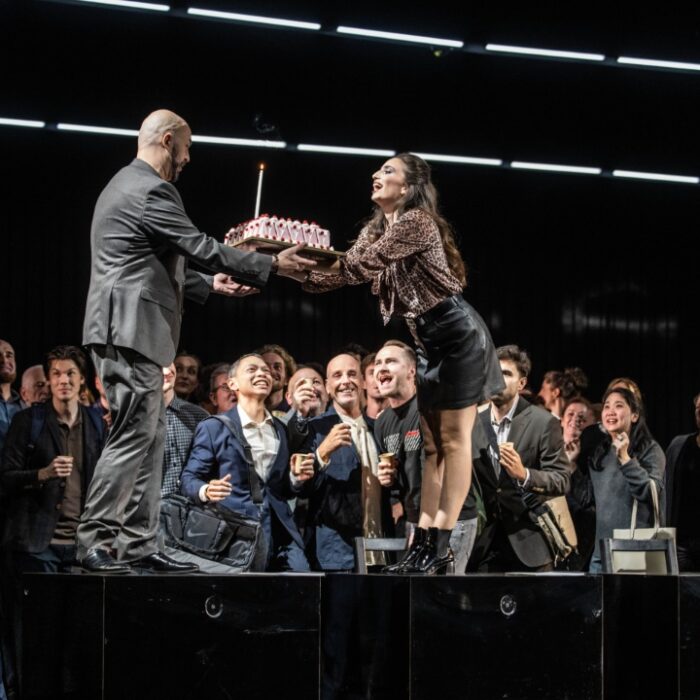
The Zurich Opera Chorus, despite a few tentative entries that will undoubtedly settle as the run progresses, sang with admirable precision and commitment throughout. The Pilgrims’ Chorus was deeply moving, while the festive scenes positively sparkled with energy, the singers clearly relishing Teresa Vergho’s witty and imaginative costumes.

(Photo: Herwig Prammer)
A Stellar Cast
The cast was consistently outstanding. Eric Cutler approached the title role with tremendous commitment, his tenor powerful and exceptionally well projected, yet retaining a bright, radiant quality in the upper register. His solid technique served him superbly, from the three stanzas of his farewell to Venus to the exhausting Rome Narrative.
Christina Nilsson made an electrifying Opernhaus Zürich debut as Elisabeth. Her voice combined warmth with brilliance, crowned by glorious high notes that were always fully supported and never forced. Her portrayal of the living statue was mesmerizing: when the figure first began to move during the extended orchestral introduction to the second Act, audible gasps could be heard throughout the audience. Her transformation into a young woman in love was entirely convincing, while her impassioned plea for Tannhäuser’s life in the Act two finale, begging that he be granted the chance of redemption, was profoundly moving, charged with religious fervor and despair. She may have lacked some projection in the lower middle register, but her seamless legato, emotional intensity, and gleaming top notes revealed an artist of genuine star quality.
(Photo: Herwig Prammer)
Rachael Wilson sang Venus, whom the production presents as a true femme fatale. She impressed equally through the richness and power of her mezzo-soprano and through the force of her stage presence, embracing the seductive goddess with irresistible conviction. Her upper register was thrilling yet always controlled and elegant, while her lower range remained natural, unforced, and sensuously attractive. She completed the portrayal with an ideal physique du rôle.
Christian Gerhaher appeared in his signature role of Wolfram von Eschenbach, bringing his characteristically smooth, luscious baritone. His interpretation was thoughtful and deeply considered: formal and noble during the singing contest, while his “Abendstern” was sung almost in a whisper. It occasionally bordered on mannerism and self-indulgence, yet remained unfailingly elegant and undeniably beautiful, the work of a supreme master of the Lied repertoire.
Hermann, Landgrave of Thuringia and Elisabeth’s uncle and father figure, is traditionally the embodiment of authority at Wartburg. Yet Arnarsson also uncovered an unexpected comic dimension: before welcoming the guests to the singing contest, he anxiously rehearsed his speech alone in a corner, punctuating it with exaggerated gestures. Christof Fischesser’s powerful, velvety bass captured both sides of the character, clearly relishing the humor while fully conveying the necessary dignity once the drama darkened.
The ensemble of Minnesingers was uniformly excellent, with Johan Krogius particularly distinguished by his ringing, incisive tenor. As the Young Shepherd, Yewon Han charmed the audience with a bright, silvery timbre and an irresistibly sparkling costume.