Opernhaus Zürich 2025-26 Review: La Clemenza di Tito
By Laura Servidei(Photo: Toni Suter)
Wolfgang Amadeus Mozart wrote “La clemenza di Tito” in 1791, the year of his death, to celebrate the coronation of Leopold II, Holy Roman Emperor, as King of Bohemia. The libretto, adapted from Metastasio, celebrates the Roman Emperor Tito as a magnanimous and forgiving ruler; this was particularly apt for the enlightened monarch Leopold, who governed through compromise and applied several principles of the Enlightenment, abolishing torture, confiscation of property, and the crime of lèse-majesté. All these characteristics must have appealed to Mozart, the Mason, who indeed celebrated Leopold with one of his masterpieces.
(Photo: Toni Suter)
When Clemency is Mistaken for Weakness
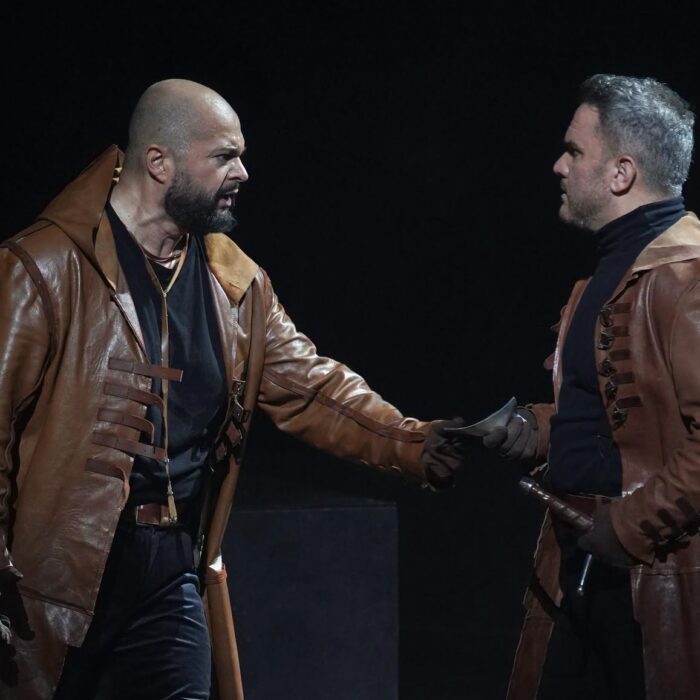
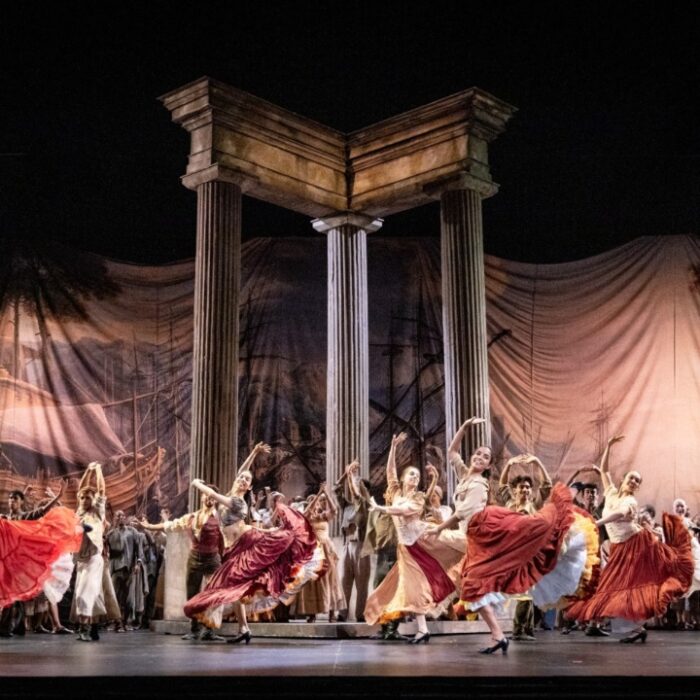
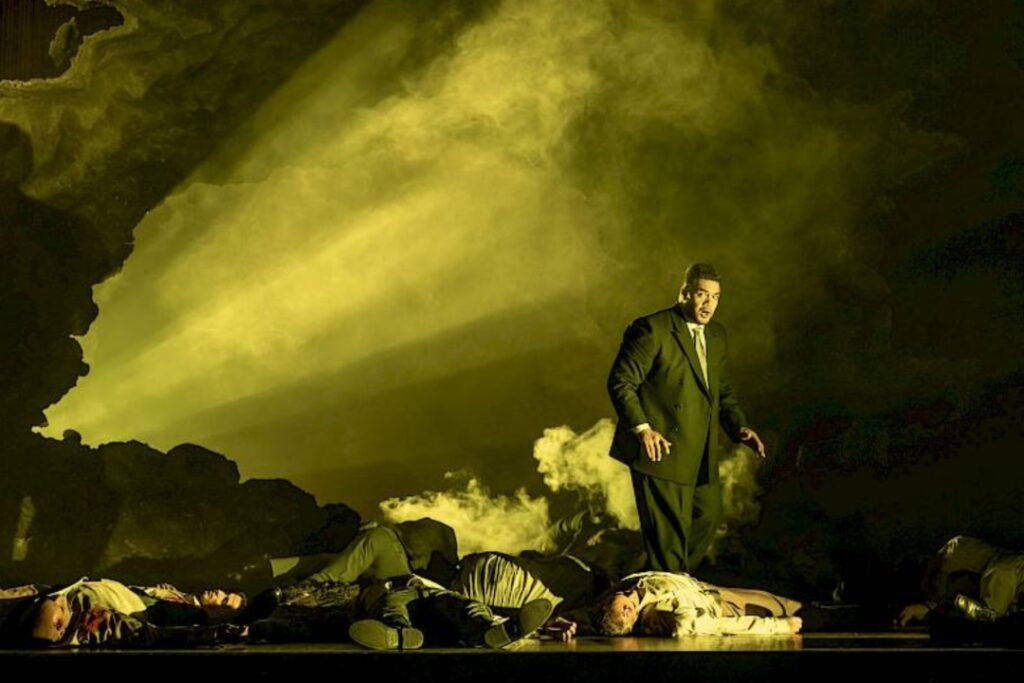
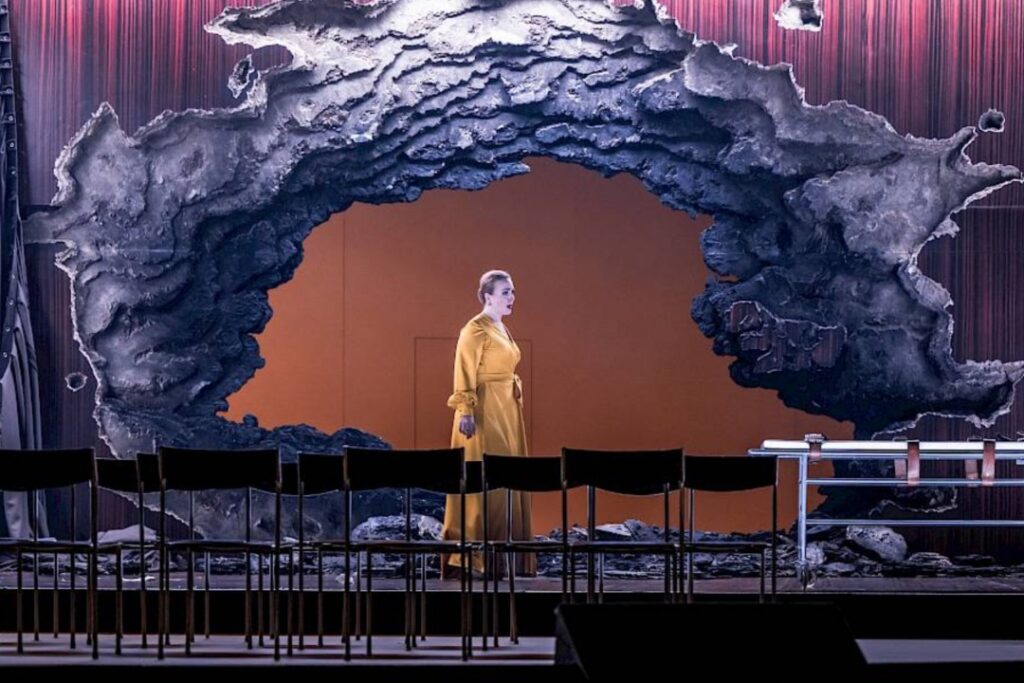
Director Damiano Michieletto, however, clearly does not share Mozart’s love and admiration for Tito the Magnanimous. His production at the Zurich Opera House shows everyone around Tito despising him and treating him with disdain, irritated by his good nature and clearly considering him a fool. The action is moved to the mid-20th century, as suggested by the men’s costumes (by Klaus Bruns): every man wears a suit and tie. The sets, by Paolo Fantin, depict a building strongly reminiscent of the bar in Edward Hopper’s Nighthawks, placed on a revolving platform that reveals both public and private settings. During the overture, Publio, the Praetorian Prefect—here reimagined as a kind of secret service operative—plants bugs beneath furniture to spy on the other characters. Tito is voted into power through Publio’s machinations, and during one of his first act arias four men mock him by wrapping surveillance tape around his head and laughing at him. Throughout the opera, whenever Tito attempts to embrace a friend or shows kindness and compassion to members of the crowd by patting them on the shoulder, they recoil in annoyance and irritation. After Sesto’s betrayal and conspiracy against Tito destroys the Campidoglio, and after Tito forgives all the conspirators, Publio takes matters into his own hands and poisons Tito, who dies in the finale. Michieletto clearly does not believe that a successful ruler can be guided by a good heart and a sense of justice, which raises the question of why he chose to stage this opera.
Minkowski’s Expressive but Uneven Mozart
The musical side of the production was in the hands of conductor Marc Minkowski, leading the orchestra La Scintilla, Zurich’s own period ensemble. Minkowski drew a beautiful sound from the orchestra, full of character and nuance. His interpretation, however, tended toward extremes: the fast sections were too fast, the slow ones too slow. The impression was that he did not entirely trust Mozart to speak for himself and felt compelled to exaggerate every affect expressed in the music. This was particularly evident in Sesto’s aria “Parto, parto,” taken at an extraordinarily slow tempo. Another questionable musical choice concerned the chorus: almost all the choruses were sung pianissimo, at times to the point of being difficult to hear. This softened the impact of the Act one finale, where the chorus’ “O nero tradimento” lacked the dramatic force it should have had. I wondered whether this was a directorial decision—just another way of diminishing the support shown by the people to Tito.
(Photo: Toni Suter)
Margaux Poguet: A Commanding Vitellia
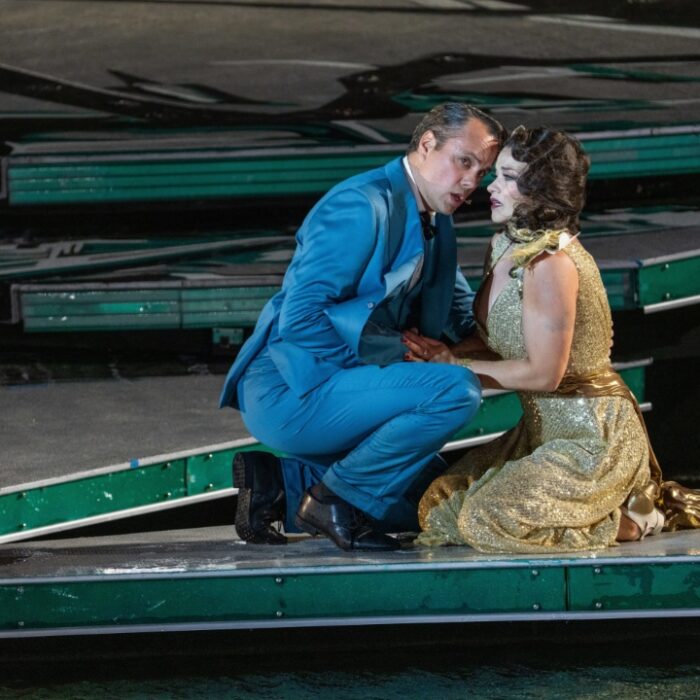
A wonderful cast made the evening a success. Margaux Poguet was Vitellia, the Roman noblewoman who, feeling rejected by Tito, orchestrates the entire conspiracy against him and seduces Sesto into carrying it out. Poguet’s soprano was full-bodied and smooth, her high notes dramatic and her coloratura brilliant. Her interpretation was deeply committed: in the first act she was entirely convincing in her femme fatale role, seducing the audience just as she seduced Sesto. In the second act, when the attempt on Tito’s life fails and Sesto is condemned to death, Vitellia breaks down and finds enough dignity and strength to confess her role in the conspiracy in an effort to save him. Here Poguet painted a compelling portrait, depicting Vitellia’s downfall with dramatic chest voice, broken breathing, and a splendid rendition of “Non più di fiori,” which too often is sung almost with bravura, as if to proclaim, “I’m the leading soprano, this is my great aria, and I’m going to sing the hell out of it!” But this aria is truly a confession and an acceptance of defeat, and that is precisely how Poguet performed it. This is a young singer whose career will be well worth following.
(Photo: Toni Suter)
Lea Desandre: A Fragile, Splendid Sesto
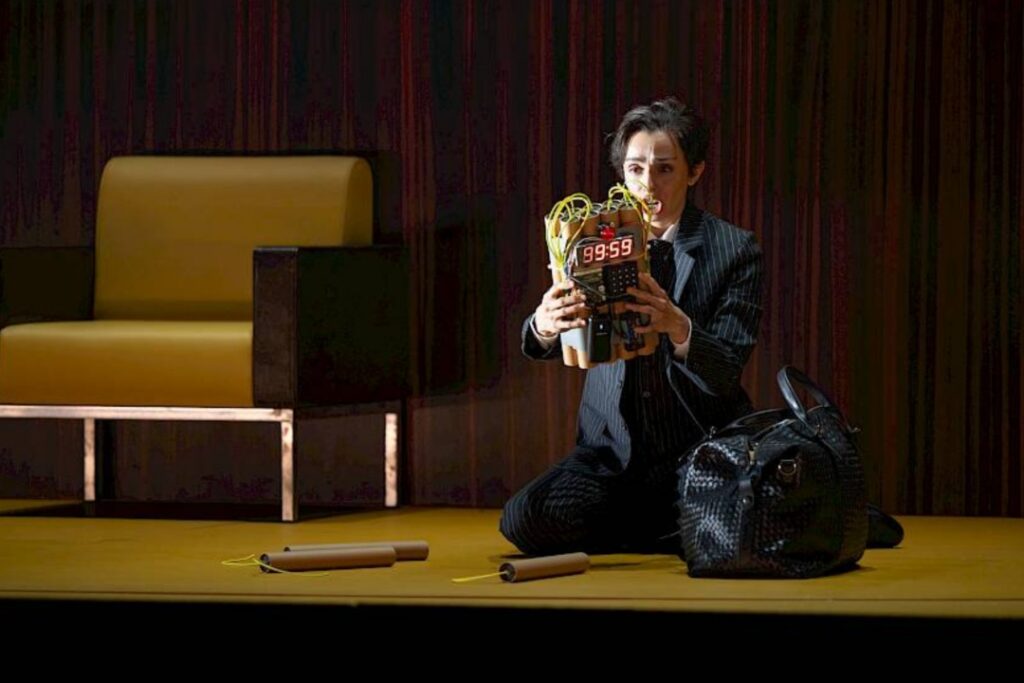
Sesto was Lea Desandre, whose mezzo displayed a beautiful timbre, splendid high notes, and flawless coloratura. A Baroque specialist, she is also exceptionally well suited to Mozart (her Cherubino is marvelous), and her emotional interpretation was both deep and touching. Her Sesto was fragile, overwhelmed by his feelings for Vitellia, a puppet in her hands. His immediate remorse after his attempt to murder Tito was both convincing and moving. Vocally she was ideal in the role, her interpretation of “Parto, parto” splendid despite the aforementioned sluggish tempo—her breath control sustained it with ease—and despite the bizarre directorial decision to have Vitellia leave the room during Sesto’s aria. Since the text is a continuous address to Vitellia (“My love, please make peace with me… look at me, and I will forget everything…”), the result was rather disconcerting.
(Photo: Toni Suter)
Pene Pati Restores Dignity to an Undermined Emperor
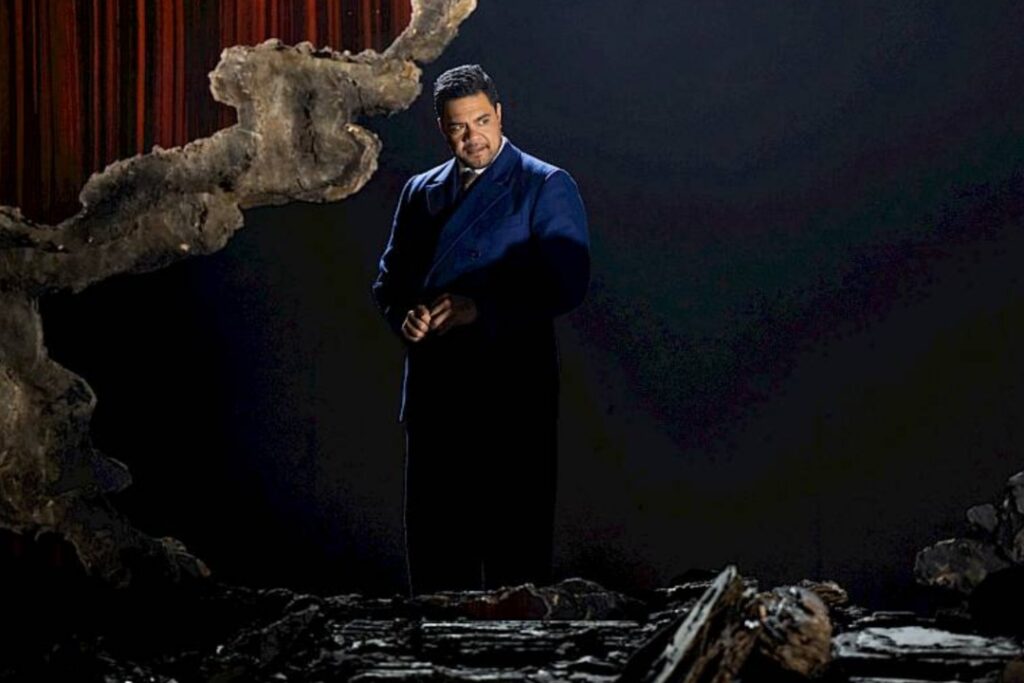
Tito was Pene Pati, his tenor light and bright, perhaps a touch monochromatic, but technically impeccable. In particular, Tito’s most difficult aria, “Se all’impero, amici Dei,” was very well executed, with agile coloratura and effortless high notes. His vocal interpretation restored some dignity and nobility to Tito, even as Michieletto did his utmost to make him appear foolish.
Siena Licht Miller was Annio, Sesto’s closest friend, in love with his sister Servilia. Licht Miller was highly convincing in the trouser role, her bronzed mezzo well projected throughout. Her aria “Torna di Tito al lato” was delivered with sincerity and emotional depth. Servilia, Sesto’s sister and Annio’s beloved, was sung by Yewon Han, whose silvery high soprano effectively captured the young woman’s honesty and innocence. In the aria “S’altro che lagrime,” her interpretation was perhaps somewhat generic, but the duet with Licht Miller, “Ah, perdona al primo affetto,” was enchanting.
Publio was Andrew Moore, whose well-rounded bass lent the Praetorian Prefect appropriate authority. In his only aria, “Tardi s’avvede,” he had some difficulty keeping pace with the unusually brisk tempo set by Minkowski. His portrayal of the villain, scheming behind Tito’s back and treating him as a mere political puppet, was spot-on.