Opéra-Théâtre de l’Eurométropole de Metz Review 2025-26: María de Buenos Aires
By Andréas Rey(Photo Credit: © Philippe Gisselbrecht)
Editor’s Note by David Salazar, Editor-in Chief: A previous version of this review misrepresented the genders of two artists and mentioned that a trans performer in several roles was “cliché.” This is offensive, unacceptable, and should never have been published. We apologize for this and will work to ensure this never happens again. The review has been modified.
With the opera house still undergoing renovations, Piazzola and Horatio Ferrer’s opera was performed in Metz from Jan. 16 to 18 at the B.AM. (Boite à Musique) for music lovers and not just opera fans.
Like The “Threepenny Opera (Dreigroschenoper),” to which it is similar in its popular character, “María de Buenos Aires” breaks with the traditional framework of opera. While “The Threepenny Opera” brings the street to the stage with a story of beggars set to modern music that can nevertheless be sung by everyone, “Maria de Buenos Aires” takes opera to the street by mixing classical music with jazz, milonga, and tango, without shying away from a few arias that have become popular songs.
In addition to the music, the difficulty of this work – which, in addition to opera, is reminiscent of Bach and Telemann cantatas due to its three-voice and orchestra structure – lies in the director’s task of embellishing the twisty narrative framework of this long modern poem. “María de Buenos Aires” is in fact more a portrait in verse of a woman, allegory of the city of Buenos Aires, than her murder and what follows.
Balancing Genres
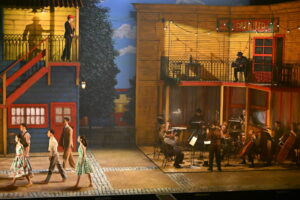
As for the music, the orchestra, dressed like tango players on a stage transformed into a Buenos Aires crossroad thanks to Cyrielle Lévêque and Sébastien Houper’s scenery and Christelle Feil’s costumes. The ensemble was comprised of a string quintet, a sextet with flutes, a septet with flute and piano, a jazz ensemble with all these instruments plus electric guitar, and an Argentine ensemble with the addition of a bandoneon. The ensemble, conducted by Victor Rouanet, managed to strike a balance between these genres. Nevertheless, in order to better illustrate this Argentine atmosphere, it would probably have been better if he had not been present on stage.
Director Paul-Émile Fourny overcame the difficulty of illustrating this hidden narrative in a very beautify and long poem by teaming up with dancers under the direction of Laura Lamy and Tristan Robilliard. With dance being the art form closest to music and poetry, the presence of silent characters was not entirely out of place.
For speaking characters, the greatest challenge for singers remains striking a balance between popular and classical styles. Spanish mezzo-soprano Patricia Illera deserves praise for her remarkable feat in maintaining this balance, particularly in her rendition of “Yo soy Maria.” Her dark, powerful, yet supple, velvety voice captivates the listener. The scene with the psychiatrists is also memorable, during which she varies between speaking and singing, and singing and speaking again, without ever straying from the rhythm imposed by the orchestral ensemble.
Sam Taskinen took on the role of several characters, including the voice of the Payador, bird, and psychiatrist, proving flexible and tender when she drew the words from Maria’s shadow, frank and clear when she was the narrator, and almost playful as the psychiatrist. Just as the audience will appreciate Taskinen’s tessitura as narrator, they will appreciate the playful frankness of Noah Vannei’s tessitura as the Duende, who advances the poem like a sunny yellow ribbon. In the same way that her borsalino usually covers her face, while her voice illuminates the story, her tone is clear throughout the cryptic libretto.
It would take pages and pages to explain how Piazzola managed to create a body of work that was both popular and sophisticated, Argentinean and European, universal in a word, but the listener immediately understands that this is part of its charm.