Opera is a Place: Understanding Why Younger Audiences Come to the Opera House
By Duncan Holzhall(Photo Credit: Octavio Alonso Maya Castro)
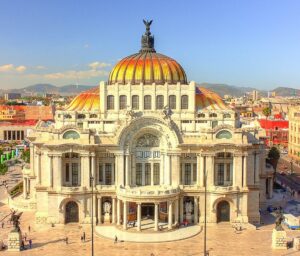
Visiting the Palacio de Bellas Artes made me fall in love with opera again. The open plaza welcomed groups of young people walking, laughing, and congregating. The bronze-tiled dome gleamed like a radiant sunset, hugging the luminous marble archway. Stepping inside, the grand foyer projected an entirely different regal stature. Whereas the exterior of the building was a neoclassical structure with Art Nouveau ornamentation, the interior rose with strong Art Deco lines and mascarons of the pre-Hispanic gods Tlaloc and Chaac. Moving from the foyer to the theater, hushed excited whispers swirled as friends pointed out details in the Tiffany Mosaic Curtain and the proscenium arch. Having spent my career working to give younger generations a voice in the industry, I was deeply fulfilled to see so many young people enjoying a night at the opera. But none of them were there to watch an opera. They were there to be at the opera.
This fundamentally shifted my thoughts about how to attract younger audiences to opera. Beyond the endlessly fascinating details of the theater itself, people felt a deep sense of inspiration and belonging and could merely exist within the walls of the Palacio de Bellas Arts. These young people, who were inclined to spend their time just admiring the physical space, could now be subtly enticed to experience the full breadth of the art form by witnessing the performances offered within. In other words, no one sold more tickets to the opera than the opera house itself.
Opera is misunderstanding its current position in the artistic landscape. It must move away from simply being a presenter of performances and fully embrace its role as a cultural institutional third place, which involves internal and external positioning changes to create a more dynamic dialogue with our communities. For those unfamiliar with the term, a third place refers to the social surroundings different from our usual first two surroundings (home and workplace, respectively). To use sociologist Leo Jeffres’ description, “It provides the feeling of inclusiveness and belonging associated with participating in a group’s social activities, without the rigidity of policy or exclusiveness of club or organization membership.” The third place is the space where our communities are truly built.
There are a range of cultural institutions in our daily lives that fulfill these promises to great effect. My mind turns towards art museums; while the operating model of these nonprofit institutions is similar to opera houses, they seem to experience far fewer issues enticing younger people to attend art museums. Why? At art museums, there is an assortment of offerings and engagement patterns that lower the barrier to entry and encourage shared social experiences. From small galleries to the most expansive collections, visual art showcases tend to have a diversity of styles, media, and subject matter represented across their spaces. If someone doesn’t resonate with a specific piece, they can move onwards to the next piece, room, or wing to find something more enticing. The freedom afforded to visitors to move and interact with the space in their own way is another distinction, which permits people to engage with the artistic offerings on their own terms. While curators painstakingly lay out exhibitions in certain ways to imply a direction and flow for traffic and viewership, any visitor can freely reject these ideas. The distinctiveness of the offerings and freer engagement patterns both lower the barrier to entry for newcomers: rather than beseeching a total novice to commit three hours of their evening to “Don Giovanni,” art institutions do not care whether people spend five minutes or five hours within their space. Art museums simply do not impose time commitments onto new audiences in the way opera houses do. Art museums have positioned themselves as institutions where groups of people can congregate around an activity, where culture can serve as both a background and a foreground to the social experience. Anyone familiar with Brian Eno’s philosophy behind ambient music (or even earlier, to Satie’s furniture music) understands the potency of art which is deserving of focused attention without demanding it.
There are inherent limitations to the medium of opera which prevent it from adopting these practices wholesale. As a linear narrative experience, opera requires attention to derive aesthetic fulfillment from the viewers, and there is no flexibility in how viewers can experience the artistic statements being made (beyond seating choices). It is fixed in time and space, which creates difficulties in an age of instant gratification via content. Compared to other art forms, the stylistic differences between operas are far harder to distinguish for amateurs and new audiences. The social aspect of attending the opera cannot occur during the presentation itself, but is restricted to the liminal spaces experienced around the operas (waiting in line, at intermission, coat checks, et alia), often diminishing the value of the art itself. However, understanding the best practices of other cultural third places allows opera houses to reorient their offering without betraying the core fibers of our art. Given the limitations it faces, as opposed to other cultural institutions, where in the opera world stands the exemplar?
Aside from the aforementioned Palacio de Bellas Artes, a fine example would be Opéra de Lille in the north of France. I will admit a slight bias in favor of my hometown company, but despite having been embedded in this community for only six months, I am far more aware of the Opéra’s position as a center for the people than either of my previous home cities (New York and Chicago). Opéra de Lille offers diverse programming options beyond standard operatic performances (such as their late-night “Insomniaque” chamber series and their post-work “Heure Bleue” concert series), as well as open weeks throughout the year to entice newcomers (though in fairness, many other houses do that). What sets Opéra de Lille apart is the company’s embrace of its role as a gathering place where people can come and “merely exist” within its space. The company does not force the musical experience to be the predominant factor in the visitors’ experience. Positioned in the historic center square of the city, Opéra de Lille offers a grand staircase where groups of people, young and old, rendez-vous. It is not just a central meeting point, as I have observed groups spending hours sitting and standing on the stoop of the opera house in deep conversation and enjoyment. At their recent Insomniaque concert, the Grand Foyer of the Opéra was festooned with mattresses beckoning audience members to lie down and let the music wash over them. This audience was filled with the same assortment of young people from the stairs outside. The audience gave both the artistic work of the chamber ensemble and the physical space of the early 20th century Neoclassical/Art Nouveau house equal attention. A colleague of mine mentioned attending a showing of “The Makropulos Case,” despite having never seen an opera before (certainly not the most friendly entry into the art form). He told me that while the work itself was “out there,” he wanted to go again because the space and atmosphere of attending the opera with his group of friends was incredibly inviting. Opéra de Lille has recognized their role as a central third place for the community to gather and spend their time, and as a result, younger audiences have found their way to the opera.
My colleague is not alone in prioritizing the physical experience of attending the opera over the artistic experience. Among my peers from outside the industry who have attended the opera, a great majority echoed their enjoyment of the physical space and the social-cultural experience over the artistic product on the stage. The term “vibe” is used a lot in these positive descriptions, but the experience of dressing up with friends to appear within a beautiful, monumental space should be encouraged by opera houses. For some newcomers to the opera, they will certainly be encouraged to return for shows. But for many, the social experience will hold far fonder memories, and those social experiences are associated more with the environment than the shows. The conversations had in the lobby, the champagne at intermission, and the excited comments made after the bows, are all social manifestations of the opera house. This is precisely the strength which opera houses can lean into: the majesty and history of their spaces provide a rich and fertile ground for individuals to contribute to the larger institutional memory of the building, creating renewed social interest in gathering at the space and thus sustaining the art form as a result.
In my book, “Voices of Tomorrows Songs,” I interviewed a dozen young opera professionals about the future of the art form. One of the interviewees discussed the ever-present issues at the Met in the 21st century. He cited Susan Froemke’s documentary “The Opera House” in his diagnosis, which traced the current issues of financial and cultural mismanagement of the house back to the space itself: “I think part of their problem was the New Met. I think all of their problems started with the New Met and this new idea, the one in Lincoln Center. Because you didn’t have such overwhelming expectations… I honestly think their biggest problem is that they were running into size issues [because] they went way too big.”
In the end of the book, I concluded that opera had an image issue, particularly with regard to the accessibility of the art form and the public sentiment surrounding the opera. But the primary focus of these issues has not been with the physical opera house where these shows are presented, but rather, with the present industry scaffolding covering the historic facades of the theater. Both of these concerns tie back to the core issue of opera houses positioning their environments as presenters of shows rather than places of culture and monuments to the community.
I am now working as a consultant in the built environment, with a specific focus on sustainability. Recently, I have been considering how we engage with the physical spaces around us and naturally, given my professional background, I have thought more deeply about the opera houses and theaters where I spent the formative years of my life. We should all reflect on our first experience at the opera. I would wager that during that very first exposure to the art form, we were just as taken by the beauty of the theater where we witnessed it. From the lush velvet seating to the gold filigree; from the brutalist exterior to the chandeliers in the foyer, we hold a deep bond to the physical environment of opera. For monumental structures and buildings, their continuity across time and situation enable successive generations to develop a sense of connection and identity by affiliation. In return, the personal and communal connection to these structures encourages the increased stewardship and care of the building. In simpler terms, the opera houses which made us fall in love with opera are as much a part of our identity as the art form itself; and because the opera house is part of our identity, we are more invested in ensuring the continued survival of the opera.
Since I wrote “Voices of Tomorrow’s Songs” in 2020, I haven’t once revisited the book until writing this essay. Despite going on to work in the opera industry for four years after authoring it, I left opera to pursue other ventures. Why? Because I had seen the industry timidly creep towards change only to back away at the first sign of trouble and hardship, retreating to the old formula that perpetuates opera’s image as an outdated form. Recently, I have begun to rekindle my love of the art form through the physical spaces where operas take place, rather than the industry which stages these performances. Other young people are falling in love with opera for the first time thanks to the theaters which stage the art form. We should not change the very fabric of opera as an institution, but it is time for us to leverage the physical houses to serve as institutions for our communities. Opera is not just an art form. Opera is a place.
Categories
Special Features