Opernhaus Zürich 2026-27 Review: Die Zauberflöte
By Laura Servidei(Photo: Herwig Prammer)
Wolfgang Amadeus Mozart’s “Die Zauberflöte” (“The Magic Flute”) remains one of the world’s most frequently performed operas. For centuries, it has captivated audiences with its magnificent score and multi-layered narrative. On the surface, it is a delightful, fast-paced fairy tale featuring eccentric bird catchers, slumbering dragons, and trials by fire and water. Yet beneath this whimsical theatrical facade lies a rich tapestry of philosophical themes and Enlightenment ideals, deeply influenced by the Freemasonry affiliations of Mozart and librettist Emanuel Schikaneder. Blending ancient myth, moral awakening, and cosmic dualism, “The Magic Flute” invites viewers of all ages into a grand allegory where simple wonder gives way to profound questions about human wisdom, virtue, and spiritual transformation.
A Fairy-Tale Vision at the Opernhaus
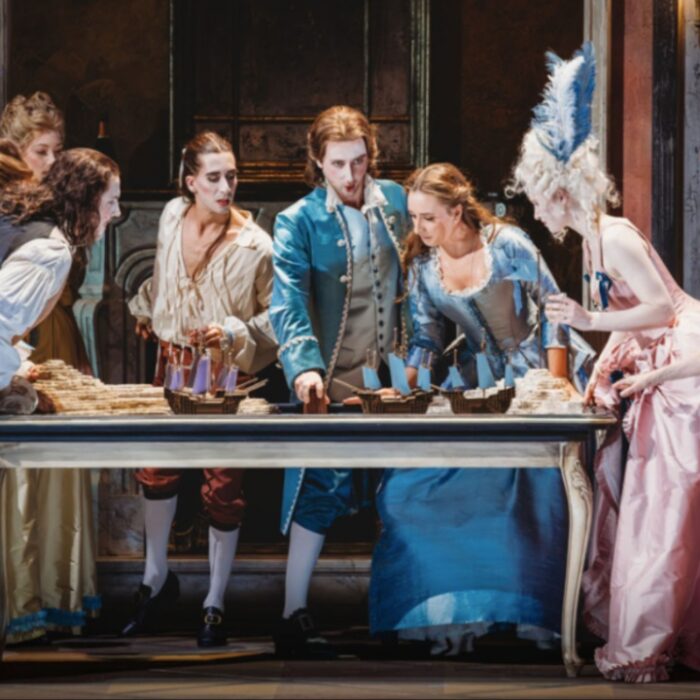
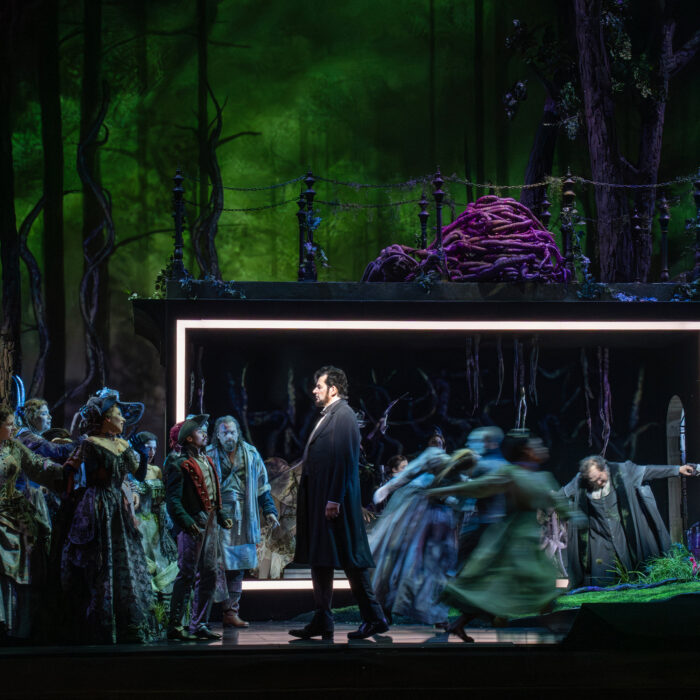
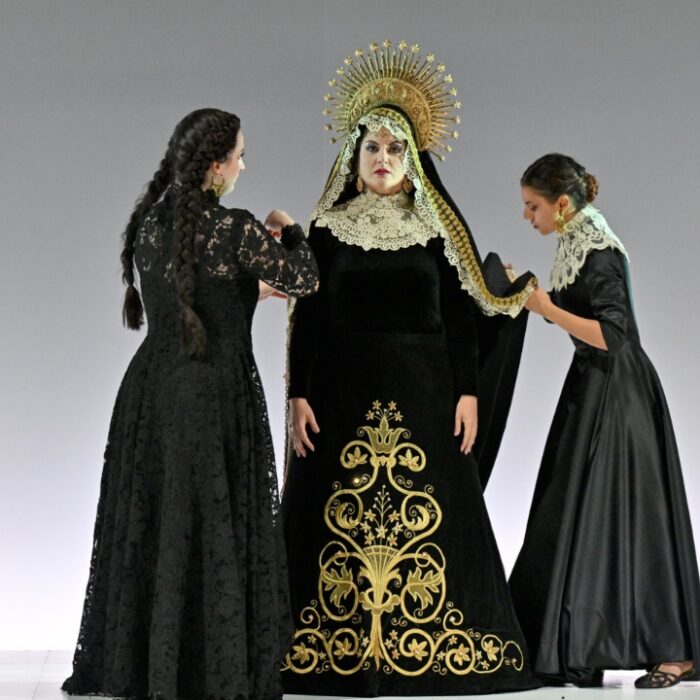
For his new production at the Opernhaus Zürich, director Daniele Finzi Pasca places philosophy on the back burner, focusing instead on the fairy-tale, dreamlike aspects of the story. His perspective is fresh, colorful, and rooted in strong imagery. Hugo Gargiulo’s sets are imaginative and beautiful, while Giovanna Buzzi’s costumes display a whimsical, glamorous flair. The Queen of the Night and her three ladies wear celestial headdresses adorned with stars, moons, and planets, and Sarastro and his acolytes sport elaborately crafted headwear. Many costumes seem crafted from rich, luxurious fabrics.
Birds serve as a constant motif: many costumes incorporate literal or suggested wings, while Papageno and the three boys ride giant birds–Papageno’s parakeet being particularly vibrant. Acrobats in bird costumes share the stage with the singers, driving the plot forward or performing on ropes and trapezes. Drawing on his background in circus arts and large-scale spectaculars like the Sochi and Turin Olympic ceremonies, Finzi Pasca brings an energetic vision to the opera that complements the libretto, at least in part. Humor abounds, with varying degrees of success; Sarastro gliding across the stage on his throne like a joystick-operated bumper car proved quite amusing. Intelligent video projections are used throughout, though the use of “doubles” for Pamina and Tamino during the trials feels somewhat avoidable. Overall, the production is visually enchanting, unpretentious, and refreshingly non-preachy–perhaps slightly shallow, but very entertaining.
Tarmo Peltokoski at the Baton
In the pit, conductor Tarmo Peltokoski led the Zürich Opera Orchestra with a historically informed approach. Although playing on modern instruments, the orchestra adopted a sound reminiscent of period performance–though not always to pleasant effect: at times the strings were edgy and loud, brass over-metallic. Both the orchestra and the singers heavily embraced appoggiaturas, fitting for Mozart’s style yet occasionally imparting a Baroque flavor. Peltokosi’s brisk tempi drove the performance with great spirit, remaining consistently supportive of the singers.
Regula Mühlemann Leads a Mozartian Cast
The entire cast embraced the production brilliantly, delivering interpretations that were light, humorous, and grounded in strong Mozartian style. The evening’s star was Regula Mühlemann as Pamina. Her lyrical soprano possessed a sweet, fresh quality and splendid, effortless high notes. Pamina’s despair in “Ach, ich fühl’s” was delivered with a seamless legato, resulting in a composed sorrow that proved far more touching than an overly melodramatic approach. Her rendition of “Tamino mein” was heart-melting.
Tamino was portrayed by Magnus Dietrich, whose tenor displayed moments of sublime beauty–such as his response to “Tamino mein”–where his voice’s lyrical quality shone. His Act one aria, “Dies Bildnis ist bezaubernd schön,” was approached with a more heroic yet gentle tone, with focused and secure high notes.
French soprano Jasmin Delfs took on the role of the Queen of the Night, showcasing brilliant, precise, and effortless super-high notes. While her timbre lacked the sharp edge traditionally associated with the role, her sweet, mellow tone actually aided the legato passages in the triplets of “Der Hölle Rache,” perfectly conveying the Queen’s maternal warmth and rendering her a bit more sympathetic. Her only misstep was ending her major aria on a high A rather than the written low A–an unfortunate choice.
Tobias Kehrer as Sarastro offered a booming bass with velvety, full low notes. His exquisite phrasing and well-placed high notes made “O Isis und Osiris” splendid. Unfortunately, by Act two’s “In diesen heil’gen Hallen,” his voice appeared to struggle, with visible coughing between phrases. While he managed admirably, the performance lacked the smooth naturalness one might have hoped for, though his interpretation remained a strong success overall.
Yannick Debus was an ideal cast member for the bird catcher, Papageno. Exhibiting charismatic stage presence–enhanced rather than hindered by his parakeet prop–Debus won over the audience through witty acting, a natural speaking voice, and a joyful embrace of his character’s antics. Most delightfully, even in the silliest scenarios, his singing remained pristine, well-supported, intelligently phrased, and elegant.
Strong Supporting Roles
Monostatos, the villainous guardian tasked with guarding and trying to seduce Pamina, was played by Nathan Haller. Dressed in a bell-shaped, hoop-supported skirt covered in light bulbs that a crow-like figure controlled remotely, Haller spun into a humorous frenzy whenever the lights brightened. It was delightfully silly without feeling overdone, and Haller clearly relished the role. His light tenor projected exceptionally well, delivering a precise and intense musical performance.
The three ladies–Hannah McCay, Karima El Demerdasch, and Dominika Stefańska–were remarkable in their ensembles, delivering precise and emotionally resonant singing. Meanwhile, the three boys from the Tölzer Knabenchor (Jakob Distler, Christopher McInnis, and Benedikt Eberl) were splendid, performing with immaculate intonation, strong projection, and superb phrasing and dynamics. Dressed as garden gnomes riding little birds, they were utterly adorable.