Opéra de Montréal 2026-27 Review: Werther
By Ossama el Naggar(Photo: Vivien Gaumand)
Opéra de Montréal presented Massenet’s “Werther”in Alain Gauthier’s conventional staging, with French tenor Julien Dran making his debut in the title role. Despite some fine singing, particularly from Julie Boulianne and Sophie Naubert, and Jacques Lacombe’s accomplished musical direction, the evening proved less compelling dramatically than it should have been.
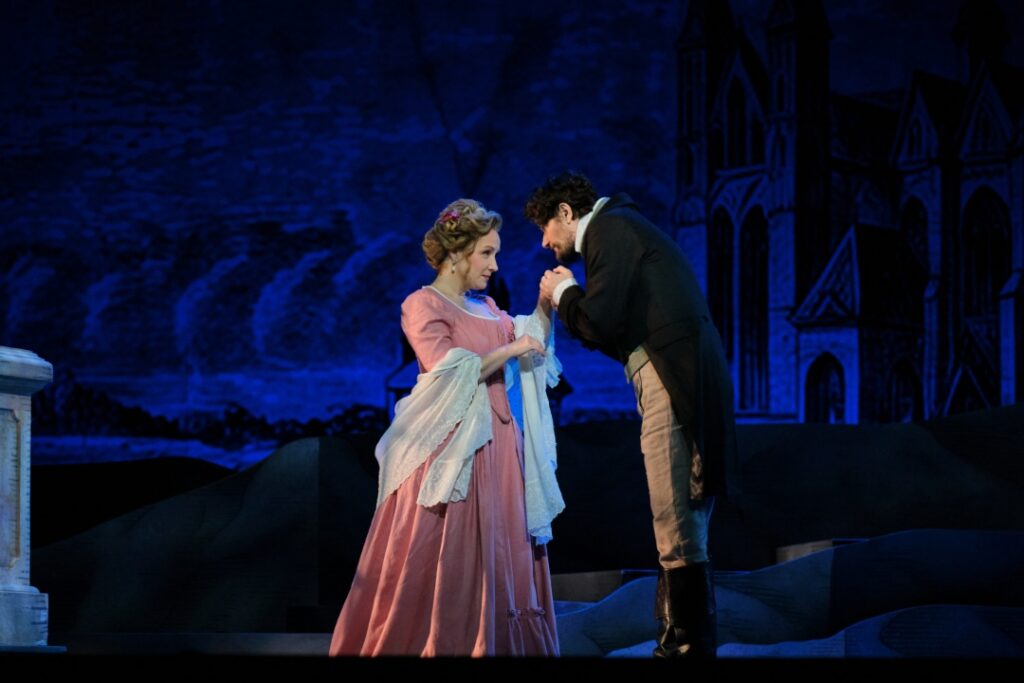
Julien Dran as Werther
Dran, whose recent performances as Edgar in “Lucia de Lammermoor” in Québec City in 2023 and Faust at La Scala last month had raised considerable expectations, made an uneven debut as Werther. His attractive, flexible instrument, refined mezza voce and natural affinity for the French repertoire initially suggested an ideal interpreter. However, he struggled at first to project across the expansive Salle Wilfrid-Pelletier. His diction also lacked some precision, and several high notes seemed less than entirely secure. Happily, his performance improved considerably in the second half.
His Act one aria, “O Nature, pleine de grâce,” was poised and moving, while “Un autre est son époux!” in Act two demanded a greater dramatic intensity than his relatively light instrument could consistently provide. He was much more convincing in “Pourquoi me réveiller?,” delivering the opera’s best-known aria with elegance and genuine passion. The audience responded enthusiastically, and deservedly so. His final scene was particularly affecting.
Dran possesses many of the qualities required for the role: elegant legato, expressive sensitivity, a refined mezza voce and an apparently effortless upper register. Whether his voice had sufficient central weight and projection to sustain the increasingly intense demands of the later acts remained an open question. Werther requires neither a lightweight lyric tenor nor a full-fledged spinto, but a singer capable of combining poetic intimacy with considerable dramatic power. Dran showed promise, although this first assumption of the role was not entirely convincing.
His characterization was also problematic. His Werther appeared excessively self-absorbed, seemingly more enamored of his own romantic ideal than of Charlotte herself. Such an interpretation might have offered an interesting psychological perspective, but it required a corresponding complexity in the relationship between the protagonists. Unfortunately, there was little chemistry between them.
(Photo: Vivien Gaumand)
Julie Boulianne as Charlotte
Julie Boulianne offered a more convincing portrayal of Charlotte. Her mezzo has matured into a warmer, richer instrument than the lighter voice associated with her earlier Mozart and Rossini performances. While this maturity lends the character considerable emotional depth, it did not always suggest the youthful vulnerability that initially attracts Werther.
Boulianne nevertheless gave a beautifully restrained performance. She avoided exaggerating Charlotte’s maternal disposition in the opening Act and was particularly affecting in “Werther ! Qui m’aurait dit ! Ces lettres !” and “Va ! Laisse couler mes larmes.” In these two scenes, she displayed impressive expressive control, allowing the character’s suppressed emotions to emerge without resorting to histrionics. Her Charlotte was dignified, aristocratic and deeply human. Ironically, her finest moments came when she was alone onstage, without having to establish the elusive rapport with Dran.
(Photo: Vivien Gaumand)
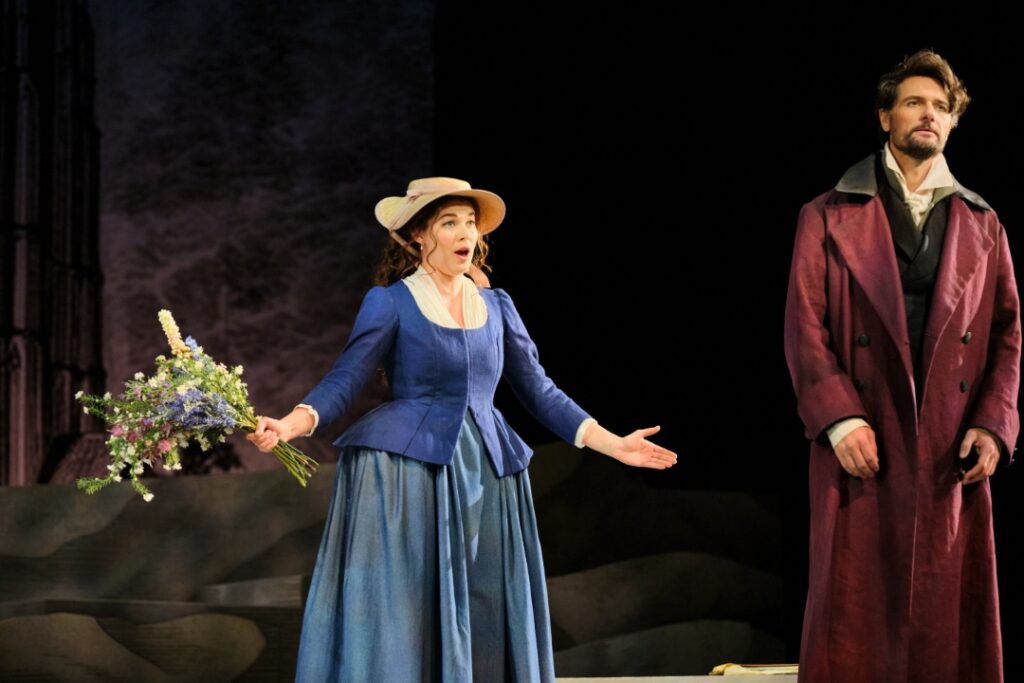
Sophie Naubert as Sophie
Canadian soprano Sophie Naubert, whom I had admired this summer as an outstanding Olympia in Lübeck’s “Les contes d’Hoffmann,” was an excellent Sophie. Her fresh lyric soprano and attractive coloratura provided a welcome contrast to Boulianne’s warmer mezzo. More importantly, she portrayed the character as an intelligent and empathetic young woman rather than merely a cheerful ingénue. One wished the director had made greater use of her potential as an astute observer of the emotional turmoil surrounding her.
Musical & Production Details
Hugo Laporte portrayed an honorable and dignified Albert, avoiding the authoritarian or cruel interpretation sometimes favored by directors. Tomislav Lavoie was an appropriately avuncular Bailli, while Jeremy Scinocca and Dante Mullin Santone were effective as Schmidt and Johann. Élie Lefebvre-Pellegrino and Pascale Brigitte Boilard completed the supporting cast as Brühlmann and Käthchen.
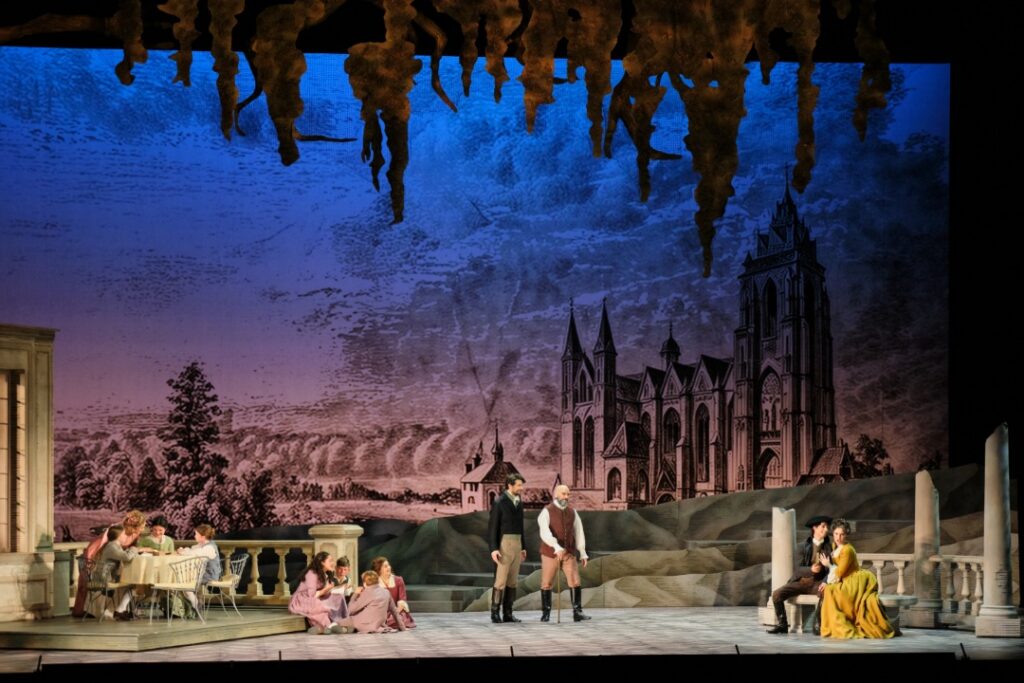
The principal disappointment was Alain Gauthier’s staging. I had seen this production previously in Toronto, and the memory of that experience made me hesitate before attending again. The opportunity to hear Dran and Boulianne ultimately prevailed, but the theatrical experience confirmed my reservations.
(Photo: Vivien Gaumand)
There is nothing inherently objectionable about a traditional staging. Yet fidelity to the libretto and period setting does not necessarily constitute an interpretation. Gauthier’s production offered an attractive but largely illustrative account of the story, reminiscent of operatic theater as it was practiced several decades ago. Although this conventional approach evidently appealed to much of the audience, it did little to illuminate the opera’s psychological complexity. Indeed, the first two Acts seemed interminably slow.
Goethe’s “The Sorrows of Young Werther,” published in 1774, was a literary sensation whose influence extended well beyond the world of literature. Its extravagant romanticism even became associated with a wave of imitative suicides. For a contemporary audience, a straightforward presentation of Werther’s sentimental excesses risks making the protagonist appear self-indulgent rather than tragic. A more imaginative staging might have explored the distance between his idealized conception of love and the social reality surrounding him.
The bourgeois Lutheran society of Wetzlar, governed by convention and duty, is central to Charlotte’s predicament. Yet the production made little of this social context. Particularly regrettable was the omission of the Pastor’s fiftieth wedding anniversary in Act two. The celebration could have provided a meaningful contrast between enduring conjugal affection and Werther’s extravagant romanticism.
Similarly, the relationship between Brühlmann and Käthchen, engaged for seven years, offers a subtle parody of romantic idealism. Their devotion could have served as a humorous mirror to Werther’s own tendency to confuse poetic exaltation with genuine love. This opportunity was largely ignored.
(Photo: Vivien Gaumand)
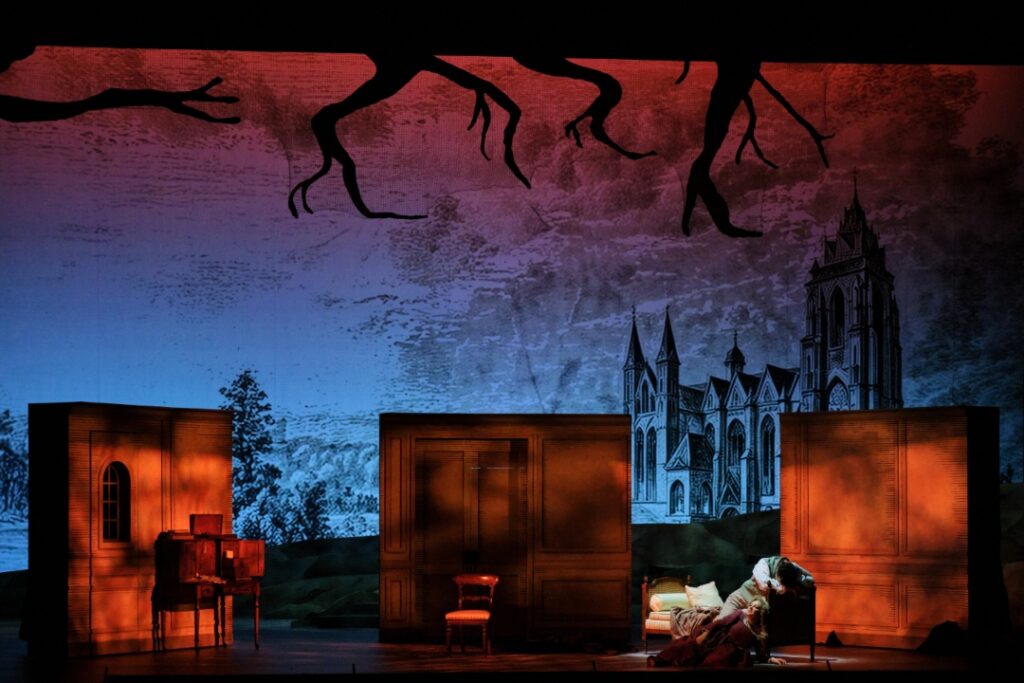
Olivier Landreville’s sets and Lëilah Dufour Forget’s costumes were attractive and appropriate to the period. However, the transformation of Albert’s home into Werther’s dwelling, achieved by moving the walls while leaving the furniture unchanged, was rather awkward. The most questionable directorial decision came during the orchestral interlude between the third and fourth Acts. Rather than allowing the curtain to fall and leaving Werther’s suicide to the imagination, Gauthier chose to enact it onstage. The choreography was unconvincing, and the result considerably less effective than the unseen event would have been.
The strongest aspect of the evening was the orchestral contribution. Massenet was a master orchestrator, and his richly colored score is essential to the opera’s psychological effectiveness. Jacques Lacombe conducted with considerable panache, drawing warmth and dramatic tension from the Orchestre Métropolitain. There were occasional passages in which the orchestra became too loud, particularly during the climactic moments, partially covering the singers. Nevertheless, the musical accompaniment was consistently rewarding and often more compelling than the staging.
Ultimately, this “Werther” offered beautiful singing, an accomplished orchestra and several individual performances of distinction. Dran demonstrated considerable promise, Boulianne gave a finely controlled Charlotte, and Naubert was an appealing Sophie. Yet a great opera requires more than competent musical execution and attractive period scenery. Massenet’s masterpiece is a complex exploration of romantic idealism, social convention and the tragic distance between imagined and reciprocal love. Montreal was offered a respectable, occasionally moving account, but one lacking the theatrical imagination necessary to make it truly memorable.