Opéra de Monte-Carlo 2026 Review: Così fan tutte
By Robert Adelson & Jacqueline Letzter(Photo: © OMC Marco Borrelli)
Over the past three years, the Opéra de Monte-Carlo has presented a complete cycle of the Mozart–Da Ponte operas in semi-staged performances by the Wiener Staatsoper. The series began in 2023 with “Le Nozze di Figaro,” continued in 2024 with “Don Giovanni” and concluded on February 9, 2026, with “Così fan tutte.”
When “Semi-Staged” Means Fully Staged
All three visits by the Wiener Staatsoper were billed as semi-staged (mis en espace), with dramaturgy credited to Lisa Padouvas. The previous installments were indeed minimalist: the orchestra placed onstage, virtually no sets.
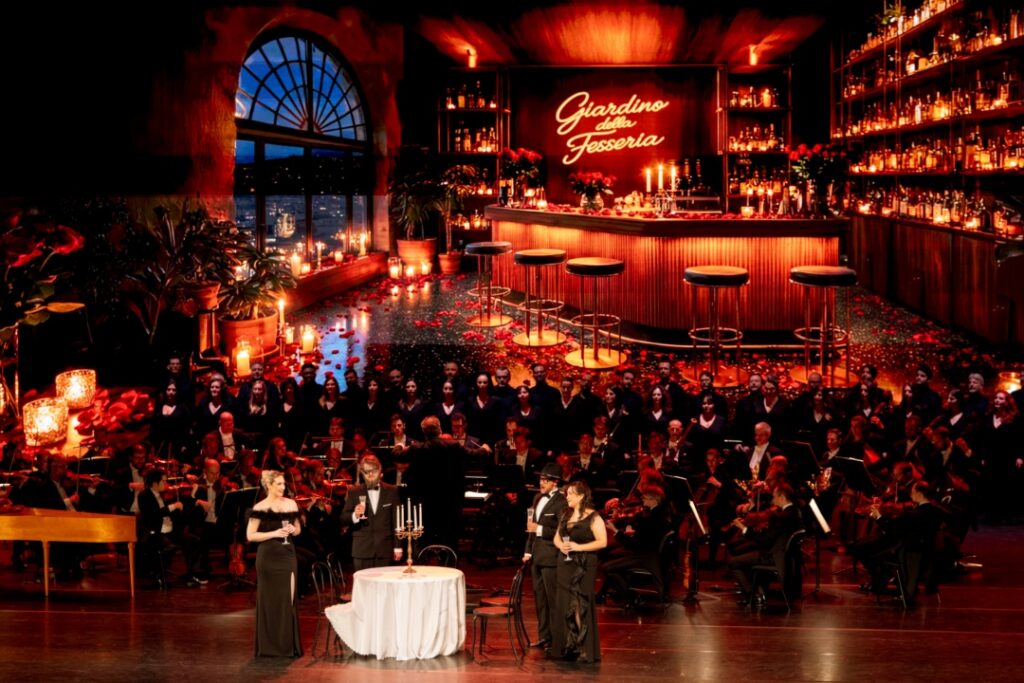
“Così fan tutte,” however, went considerably further. Giant projected images by video designer Emma Zimmel filled the entire rear of the stage—an interior of a bar for Act one and a domestic setting for Act two, both with sea-facing windows. These projections, though visually polished, were largely superfluous, as the stage already featured both a fully stocked bar on one side and living room furniture on the other side, creating an environment that was unmistakably theatrical.
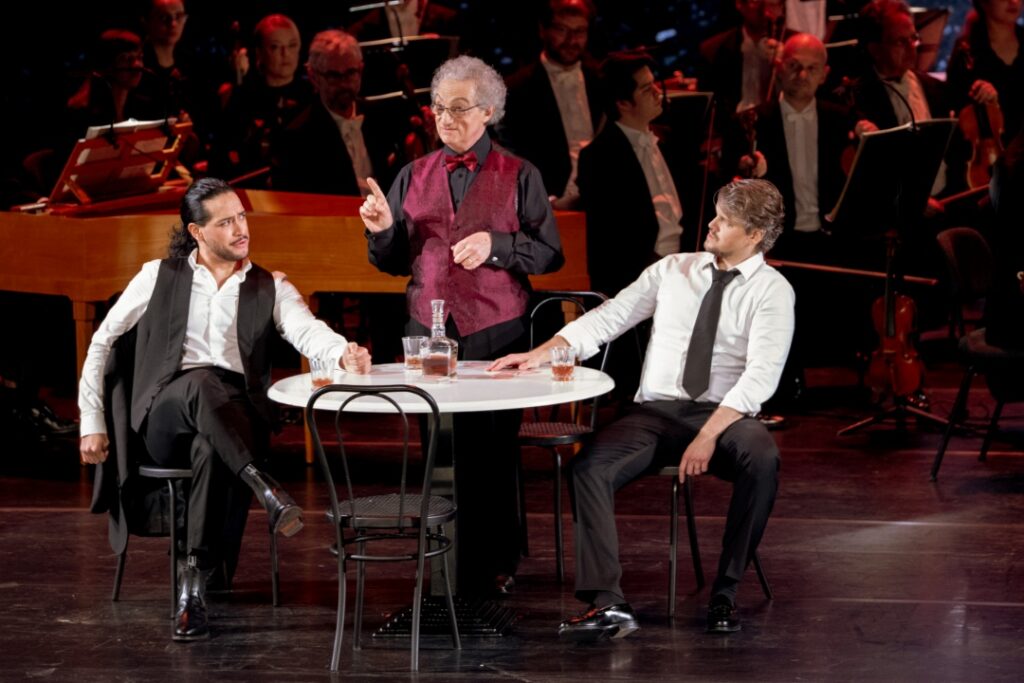
The cast consisted of outstanding actor-singers—notably Cecilia Bartoli (Despina), Alessandro Corbelli (Don Alfonso), and Peter Kellner (Guglielmo)—all in constant motion: darting through doors, clambering over furniture, and even rolling across the floor. Numerous costume changes added further theatrical flair, ranging from sweatpants and casual wear to elegant evening attire, military camouflage, and hipster beards and sunglasses.
(Photo: © OMC Marco Borrelli)
Bartoli’s Despina Steals the Show
Thirty years after making her Metropolitan Opera debut in the role of Despina, Cecilia Bartoli returned to the scheming chambermaid with undiminished theatrical electricity. Although Despina is hardly a “secondary role”—indeed, none of the six roles in this opera truly is—Bartoli infused every entrance with a palpable energy that instantly animated the stage.
Her Act one aria “In uomini, in soldati” displayed her famously agile trills, while “Una donna a quindici anni” became a masterclass in comic characterization. It was, however, in the ensembles that her vocal artistry proved most compelling. Alongside Alessandro Corbelli’s deliciously comic Don Alfonso, Bartoli generated a rhythmic vitality that propelled Mozart’s effervescent sextets with irresistible momentum. In her disguises as the doctor and the notary, she adopted wildly inventive and hilariously distorted vocal personas.
It was announced before the performance that baritone Peter Kellner had awakened that morning with “a throat issue” but generously agreed to sing, nonetheless. Only fleeting moments of roughness betrayed his condition, more than compensated by his commanding stage charisma and vocal commitment. As Guglielmo, he formed a strong partnership with tenor Filipe Manu’s Ferrando, whose Act two aria “Un’aura amorosa” was exquisitely shaped, particularly in the hushed and expressively ornamented da capo.
In many productions, a strong Fiordiligi dominates her more impulsive sister Dorabella. Here, the dynamic was reversed. Adriana Gonzalez portrayed a thoughtful, inward Fiordiligi, contrasting vividly with Samantha Hankey’s exuberant and emotionally volatile Dorabella. Both singers were vocally impressive. Gonzalez negotiated the treacherous leaps of “Come scoglio” and the expressive intensity of “Per pietà, ben mio” with authority, while Hankey’s standout moment came in “Smanie implacabili,” where her emphatic treatment of the appoggiaturas on the repeated words “mi fa morir” was thrillingly effective.

(Photo: © OMC Marco Borrelli)
Orchestra and Chorus Struggling Valiantly with Difficult Acoustics
To accommodate growing demand, each successive Mozart–Da Ponte production was presented in a larger venue: first Monaco’s Salle Garnier (524 seats), then the Auditorium Rainier III (1,000 seats), and finally the Salle des Princes at the Grimaldi Forum (1,864 seats). While this expansion allowed greater public access—all performances were sold out—it came at a significant acoustic cost.
In the cavernous Salle des Princes, resonance was virtually nonexistent, and singers frequently struggled to project evenly across the space. A turn of the head could drastically alter audibility for large sections of the audience. Matters were worse when the otherwise excellent Chorus of the Opéra de Monte-Carlo sang from backstage, rendering their contributions largely inaudible.
The magnificent Orchestra of the Wiener Staatsoper likewise suffered from the acoustics, losing much of the burnished richness for which it is renowned. Still, conductor Patrick Lange, stepping in for the indisposed Louis Langrée, elicited moments of remarkable warmth—most memorably in the sustained viola lines of the Act one trio “Soave sia il vento.” Outstanding wind solos included those of oboist Paul Blüml, clarinetist Gregor Hinterreiter (notably in the luminous introduction to “Secondate, aurette amiche”), and horn player Josef Reif.
The secco recitatives were imaginatively accompanied at the fortepiano by Richard Schwennicke, whose witty interpolations—including a Nokia ringtone during a scene involving a mobile phone—added a discreet layer of contemporary humor without disrupting the musical flow.
(Photo: © OMC Marco Borrelli)
A Comedy Unafraid to Be Comic
Unlike many recent productions that seek to excavate the darker psychological layers of “Così fan tutte,” this Wiener Staatsoper performance embraced the opera’s wit, irony, and theatrical sparkle. Without trivializing Mozart and Da Ponte’s emotional complexity, the emphasis on comedy resulted in a buoyant, stylish, and satisfying evening.