Opéra de Lyon 2025-26 Review: Boris Godunov
By Andréas Rey(Photo: Jean Louis Fernandez)
From October 13 to 25, the Lyon Opera House staged Modest Mussorgsky’s big opera “Boris Godunov.” An opera of Shakespearean proportions, the murder tsar resembles Richard III, with the added burden of a guilty conscience and, in spirit, certain historical operas such as Verdi’s “Don Carlo” or Meyerbeer’s. Its strength lies largely in the interplay of its different dimensions— psychological in the historical, historical in the religious, and even religious in a quasi-mystical sense with the absent god—each nested within the other like matryoshka dolls. The viewer thus sees, in a sense, the Kantian grandiose, something that transcends human dimensions, unfolding before their eyes.

(Photo: Jean Louis Fernandez)
Production Details
This is the first drawback of this production: Mussorgsky’s opera is long, lasting three and three-quarter hours, or even four in some versions. Lyon’s production is his original 1869 version, which is shorter than the 1874 version, and lasts two hours and 45 minutes. This shortened production, especially in the second part—the part in which the murder tsar struggles with his conscience—to focus the action on him, removes a large part of the substance of the secondary characters, thus creating gaps in Mussorgsky’s grand fresco 1874 version. The arias and recitatives are very sparse, which damages the narrative and musical continuity, transforming the opera into a collection of disparate scenes, the connection between which is difficult for someone unfamiliar with the original opera to see. As the staging essentially revolves around Godunov, removing the false Tsarevich from the drama in the second part, when he still appears in the original work, the viewer must guess that he is the monk scribe’s pupil, instead of seeing him on stage. However, as in Shakespeare or Pushkin, the characters surrounding the central anti-hero have a life of their own in Mussorgsky’s work. Here, they are only sketched out.
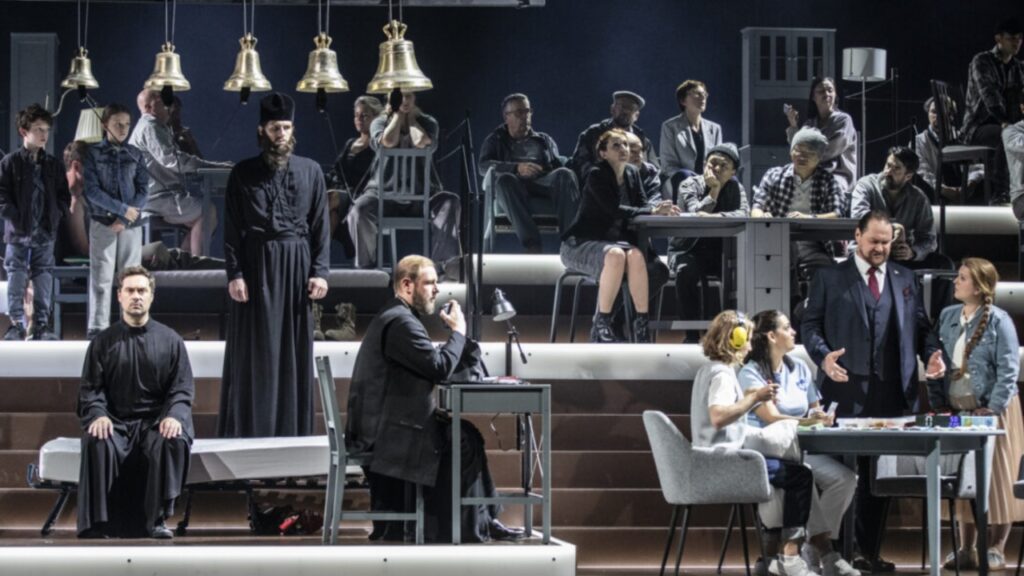
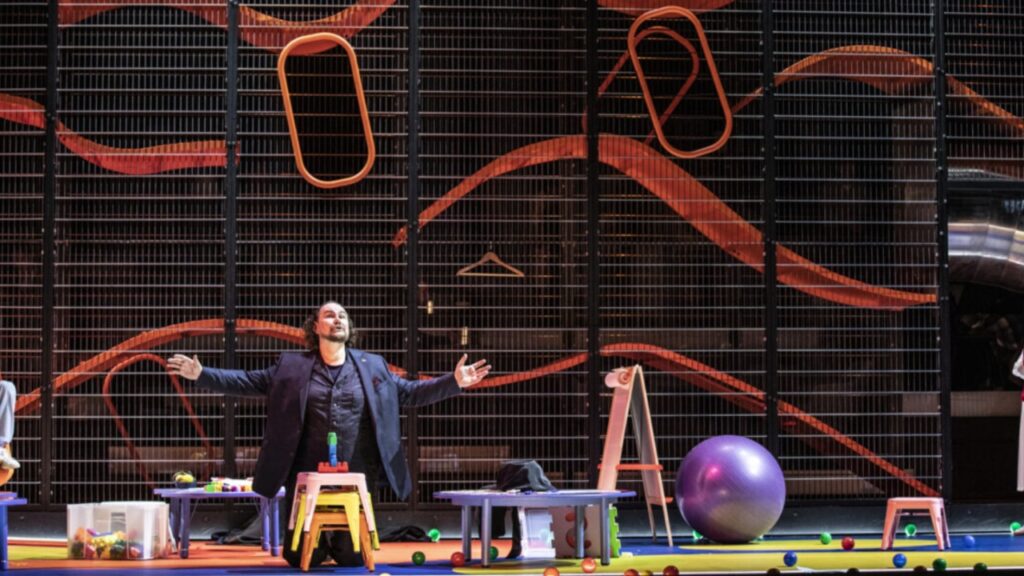
The second problem with this staging is the set design, especially in the second half, which turns the Palace into a kind of daycare centre for children, without any explanation being given for this.
A final question mark hangs over the impact of the cuts on the orchestra. This is more unfortunate given that it is already hampered by set changes, which regularly interrupt its musical flow. Unfortunately, it takes the entire first part to gain momentum, only finding its strength in the second part, around Boris Godunov. It therefore conveys Mussorgsky’s religious vision only weakly, thanks to rather sharp and strange motifs. And if it does wake up in the second part, it is unfortunately almost exclusively to surround Boris.
(Photo: Jean Louis Fernandez)
Musical Highlights
It would have been interesting to hear more from Norwegian soprano Eva Langeland Gjerde as Xenia, whose tessitura was captivating, Russian countertenor Iurii Ilushkevich as Fyodor, whose timbre borders on the feminine, and Russian tenor Sergey Polyakov as the more confident Prince Vasily Ivanovich Shuysky, but they barely had time to shine. It is also regrettable that bass Maxim Kuzmin-Karavaev as Pimen does not display his talents, advancing in only one key throughout his entire scene.
Fortunately, the choirs are strikingly authentic throughout the opera. Like the monk scribe and all the religious characters in the opera, they are an echo of the absent god, on whom the true dynasty, after the era of Boris Godunov and the false tsarevich, will be able to rely.
(Photo: Jean Louis Fernandez)
Fortunately, Russian bass Dmitry Ulyanov as Boris Godunov is gripping in his power and embodiment. He carries the entire second half, transforming it into something akin to Russian song with orchestra. His singing is articulate and firm, but with a fracture that grows throughout the drama. A true joy to listen to.
A truncated opera with all its consequences.