Wiener Staatsoper 2026-27 Review: Le Nozze di Figaro
By Laura Servidei(Photo: © Wiener Staatsoper / Marcel Urlaub)
Wolfgang Amadeus Mozart’s “Le nozze di Figaro” remains the gold standard of operatic comedy, effortlessly blending sparkling wit with sharp social critique. It takes Pierre Beaumarchais’s controversial play and transforms it into a breathtaking duel of wits unfolding over a single chaotic day.
Barry Kosky’s Concept
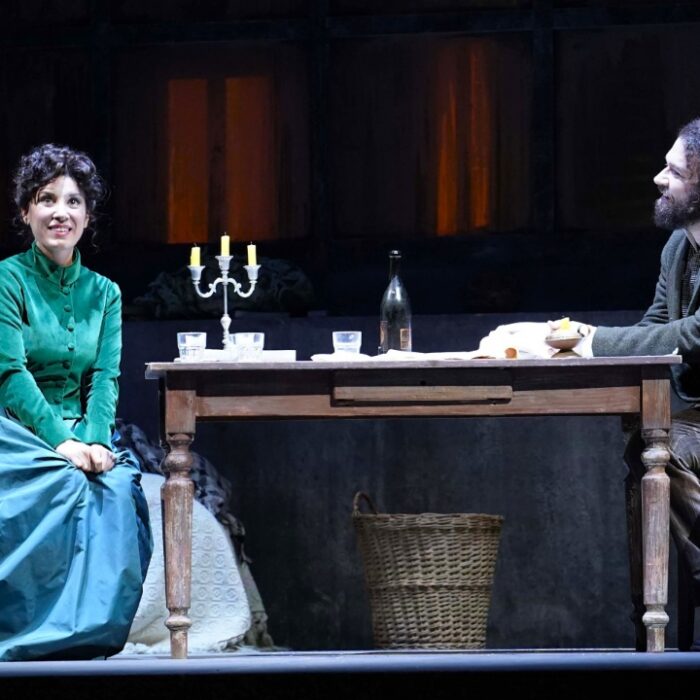
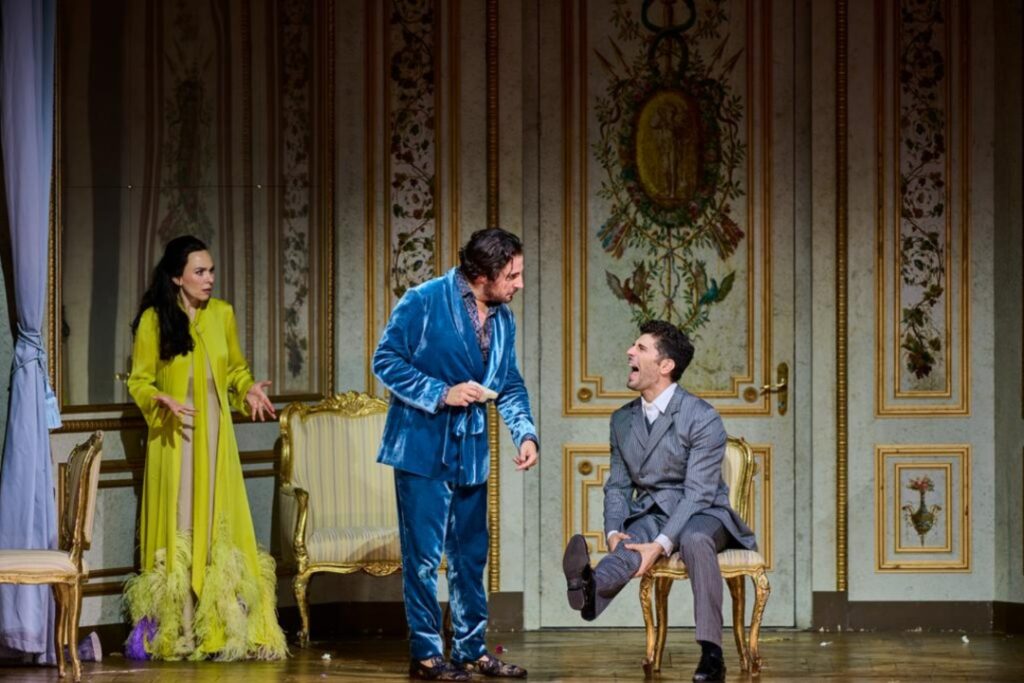
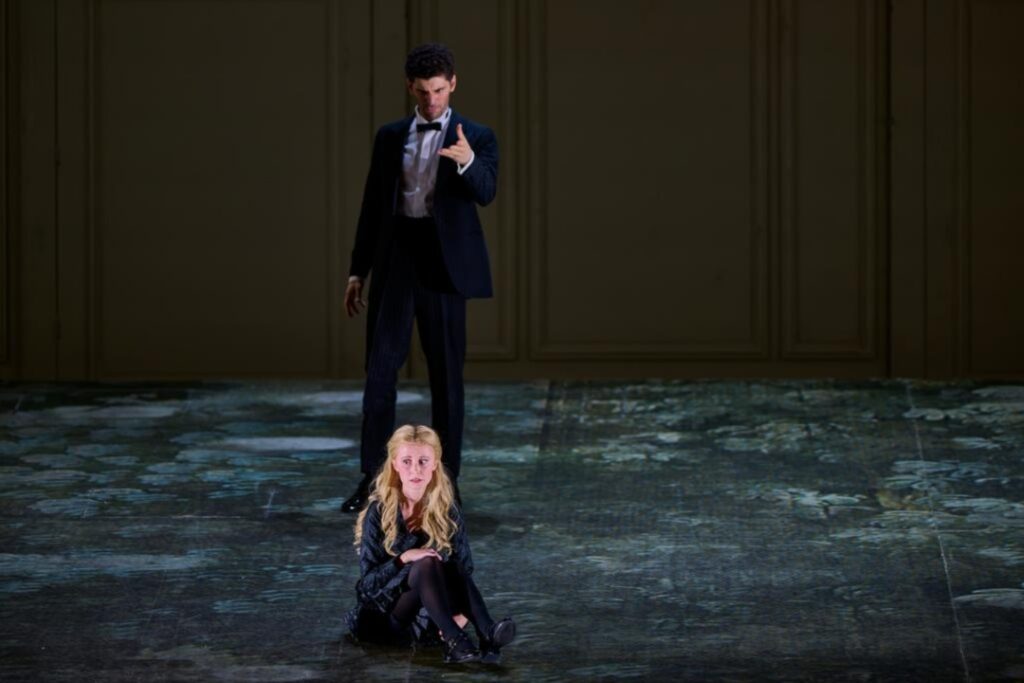
Director Barrie Kosky, in his 2023 production, appears not to completely trust Mozart and Lorenzo Da Ponte’s craft, relying on slapstick and grotesque elements to “enhance” the comedy. Updating the setting to a vague contemporary era renders the core subplot of the droit du seigneur (“right of the first night”) completely risible. This shift is paired with a 1970s-inspired wardrobe by costume designer Victoria Behr. Set designer Rufus Didwiszus opens Act one with a white wood-paneled corridor lacking space for Figaro and Susanna’s bed or an armchair for Cherubino to hide behind. In Act two, the Countess’s quarters feature a Rococo aesthetic equipped with the necessary spatial elements: a large window overlooking the garden and a door leading to the dressing room. Act three transitions to another Rococo room, stripped bare save for a line of chairs along the wall. Act four presents a raked green platform fitted with several trapdoors for character entrances and exits. The scene remains fully lit throughout, making the characters look absurd when they fail to see or recognize one another in the dark — a persistent staging challenge in this opera that few directors successfully resolve.
As is typical for Kosky, character direction is detailed and driven by specific concepts. The Count is depicted as both a brute and a buffoon. His attempts to seduce Susanna (and any other woman in sight) are awkward, creepy, and ridiculous, combined with a bullying demeanor that strips him of any usual sympathy. However, the physical assault on his wife during their Act two quarrel crossed a line: it rendered the final forgiveness and reconciliation entirely unbelievable. While this choice might offer a valid socio-political reading of the libretto, it directly opposes the emotional warmth of Mozart’s score in the finale. Additionally, putting the male chorus in drag alongside flamboyant costumes during the chorus scene felt unnecessary. The exaggerated acting style of Figaro and Susanna grew stale quickly, and the heavy trimming of the recitatives—alongside the total omission of Marcellina’s and Basilio’s aria cuts — was difficult to justify. Nevertheless, many visual compositions were striking, and the production maintained a brisk, exciting tempo.
(Photo: © Wiener Staatsoper / Marcel Urlaub)
Precision & Pace in the Pit
Much of this momentum came from Patrick Hahn in the pit, who led the Vienna State Opera Orchestra in a vibrant interpretation of the score. The overture was splendid — exceptionally fast without sounding rushed, and genuinely exhilarating. Lyrical passages remained transparent without descending into sentimental excess, and his support for the singers was steadfast. The only (small) misstep was his treatment of “Contessa, perdono,” which veered into overly romanticized territory by slightly exaggerating the pause and slow tempo. This second performance of the run suffered from a clear lack of rehearsal, resulting in missed entrances and ensemble imprecisions that were no fault of the singers or conductor.
Elsa Dreisig’s Stellar Countess
Elsa Dreisig as the Countess was the undisputed star of the evening. Her high soprano soared flawlessly through the hall during her two main arias, supported by exquisite phrasing, pristine technique, and brilliant top notes illuminated by a delicate, natural vibrato. She imbued her performance with sadness, regret, and quiet desperation while retaining the full dignity and nobility of her station. In the chaotic Act two finale, where her vocal lines mirror her maid’s mischief and energy, she remained impeccably precise and expressive. Her closing forgiveness arioso was simply heartbreaking.
The Men: Power, Parody & Vocal Prowess
Florian Sempey as Count Almaviva sang with a warm, lyrical baritone that occasionally felt slightly high for the role’s tessitura. His interpolated variations frequently lifted the melodic line into a register better suited to his voice — a standard practice, though it occasionally forced him to rely on theatrical exaggeration rather than pure vocalism when descending into his lower range. Dramatically, he gave one of the evening’s strongest performances, fully embracing the Count’s arrogance and shamelessness with spirited wit and flawless Italian diction.
Riccardo Fassi brought a deep, resonant bass-baritone to Figaro, possessing a booming power that would serve dramatic bass roles equally well. While his slapstick acting felt misdirected at times, this seemed to stem more from Kosky’s staging than the singer’s instincts. His peak vocal moment arrived in his final aria, “Aprite un po’ quegli occhi,” where he demonstrated a command of text and music that felt less secure earlier in the performance.
Cherubino’s Sparkle, Susanna’s Struggles
As his betrothed, Susanna, Andrea Carroll unfortunately seemed out of her depth. Susanna (together with Figaro) is the central engine of the plot, driving the action forward at every turn. Carroll’s soprano lacked core vocal support, creating a light soubrette sound where broader musical phrases lost momentum, leaving only high notes that frequently sounded pinched and nasal. While her Italian pronunciation was respectable, her recitatives felt rushed and devoid of authentic Italianate cadence or textual sensitivity. Dramatically, however, she remained appropriately energetic and conveyed genuine warmth and stage joy.
Cherubino remains one of the most beloved figures in the repertoire, and Alma Neuhaus did the role full justice with her rich, well-projected mezzo-soprano and ideal physique du rôle. Both of her arias featured intelligent phrasing, stylistic authority, and effortless high notes. She clearly delighted in playing the hormone-crazed teenager, offering a vibrant, uninhibited comedic performance.
(Photo: © Wiener Staatsoper / Marcel Urlaub)
A Solid Supporting Ensemble
The rest of the cast contributed to the evening’s success with committed, amusing performances, even when weighed down by directorial excess. Bartosz Urbanowicz delivered a solid rendition of Bartolo’s “La vendetta,” Stephanie Houtzeel was a spirited, modern Marcellina, and an honorable mention goes to Olga Surikova as Barbarina. Surikova’s soprano was silvery and clear, paired with flawless Italian pronunciation. She displayed all the qualities of a promising future Susanna.