Opera Australia 2026 Review: Hänsel & Gretel
By Zoltan Szabo(© Carlita Sari)
Elijah Moshinsky’s production of Engelbert Humperdinck’s (not to be mixed up with the British pop star!) “Hänsel & Gretel” premiered at the Sydney Opera House in 1992 to great acclaim and its first revival took place a few days ago. Considering that this delightful work features as No. 9 on Bachtrack’s worldwide review of most performed operas of 2025 (even ahead of “Rigoletto” and “Madama Butterfly!”), it is somewhat surprising that Opera Australia did not see the need to revive it for over three decades.
The opera was described by the composer as a Märchenoper (fairy-tale opera) who based it on one of the best loved stories by the Grimm Brothers. It references a number of well-known German folk songs, making it a perennial favorite for not only young children, but also, for young-at-heart adults. Its artistic values seemed obvious from the beginning; in fact, Richard Strauss accepted conducting its premier in 1893, while in the following year, Gustav Mahler led its first performance in Hamburg. Quite apart from the terrific musical setting, it offers opera companies the benefit of limited costs, requiring a relatively small cast and no involvement of a professional chorus (although the children’s chorus plays a major part in the final act). It also has a significant pedagogical advantage, as it can serve as a great introduction to younger audiences to the magical world of opera – so many benefits, with so little risk.
This production provides eye candy (pun intended) all the way. Ably led by revival director Claudia Osborne, the opening scene of Mark Thompson’s stunning set design takes us into the poverty-stricken, claustrophobically small kitchen/living room, where the siblings, Hänsel and Gretel, feeling bored, play and do homework, with much of the actual stage around them blacked out.
Act two, performed here without an interval, and beginning with the famous orchestral interlude, the Hexenritt or “Witch-ride,” takes the children and the audience into a forest, transformed in this production into an enormously enlarged version of the living room, with floor-boards one or two meters wide, a gigantic lightbulb hanging down from the top of the stage and a series of floor-to-ceiling balusters giving border to the right side of the stage. The two children look like tiny creatures in this brilliant visual presentation. At the end of this act, offering another chance for a gorgeous late-Romantic orchestral interlude, in the dream pantomime, five angels in blue (Humperdinck prescribed fourteen of them but that matters little) invite the children’s mother (by now dead) and father (by now, a drunkard, living with his second wife) to the stage, young and happy, to “wake up” the children and have a lovely picnic, until, alas, the mother collapses and is taken away, finishing both the dream and the act.
The Dew Fairy (Kathryn Williams) scene, opening the second half, presents more inspired visual entertainment, as she leads in what appears to be a ballet school end-of-year performing group: little fairies giggling on stage and joyfully waving to their parents.
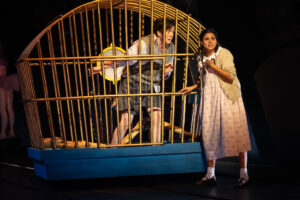
The Witch’s gingerbread house looks like an enormous cake, ornamented with lollipops and other sweets, complete with icing and a candle on its roof. Her massive oven rolls down somehow from a high wall, spewing sparkles at her demise. She locks Hänsel into a golden cage. Earlier, the Sandman (Shikara Ringdahl) appears in a stunning costume. Even earlier, the two children in the dream sequence fall asleep on an elaborate quilt. So much for the eyes to absorb, accompanied by lush, warm orchestral sounds that have the influence of Richard Wagner to thank.
This is, where this performance, perhaps not even through its own fault, fell short of expectations. Opera Australia’s highly skilled orchestra would certainly be capable of expressing elaborate 19th-century Romantic emotions, as it has done on many previous occasions. The magnificent chorale in the opening of the overture of the opera on horns and bassoons felt earthbound and uninspired, void of the uplifting, almost religious celebration this melody needs. The composer’s instruction in the score is “sehr weich,” or very soft, tender – not weak, the other meaning of the same adjective.
The cathartic effect of this opera greatly depends on the solemn beauty of the large number of interludes (without voices), enlarging the orchestra’s role in the final artistic product. Conductor, Tahu Matheson, led his musicians enthusiastically, yet the energy and spirit of the performance was nowhere near this excellent orchestra’s best.
Fortunately, the singers filled the evening with solid acting and some superb singing. Most outstanding on both accounts was Stacey Alleaume as Gretel. Her constant stage action, whether mesmerized by the Witch or hopping around like a little child never ceased to be a joy to watch. Their interaction with Hänsel (Margaret Plummer) was here teasing, there caring, often changing without warning – as children often tend to do – worked well throughout the performance, and their frightened, yet faithful Evening Prayer gave some of the most memorable moments of the evening.
It was perhaps the only problematic point of the production that the Witch could conceivably be utterly terrifying or the opposite: look like a parody – but mixing the two approaches seemed not to work. Jane Ede did her best in her extended scene in the final act, yet her costume hinted at comical elements (but then, why the Wotan-esque eye patch?), and both her singing and demeanor unsuccessfully tried to unify funny aspects of her role with the scary ones. It was a role not as well formed as others in the same performance. The parents sang on a reliably solid level: Helen Sherman, as the stepmother was a step too far from looking motherly, being upset about the spilled milk, while the only male figure in the opera, Shane Lowrencev, as the boozer father, had fun looking oblivious to life’s difficulties and yearning for another glass of drink of a completely different nature.