Oper Frankfurt 2025-26 Review: Amor vien dal destino
By Mengguang Huang(Photo: Matthias Baus)
Although Agostino Steffani’s music has enjoyed intermittent modern attention—most notably through Cecilia Bartoli’s influential album—fully staged performances of his operas remain strikingly scarce. Written in the 1690s for Hannover, but first performed only in 1709 at the Düsseldorf court, “Amor vien dal destino” stands at a stylistic crossroads. Italianate vocal expressivity, French-influenced orchestral color, and the emerging dramatic clarity of the German court opera tradition coexist in a score of remarkable variety.
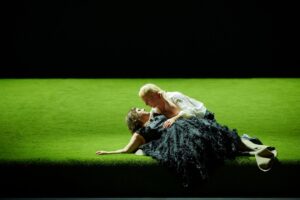
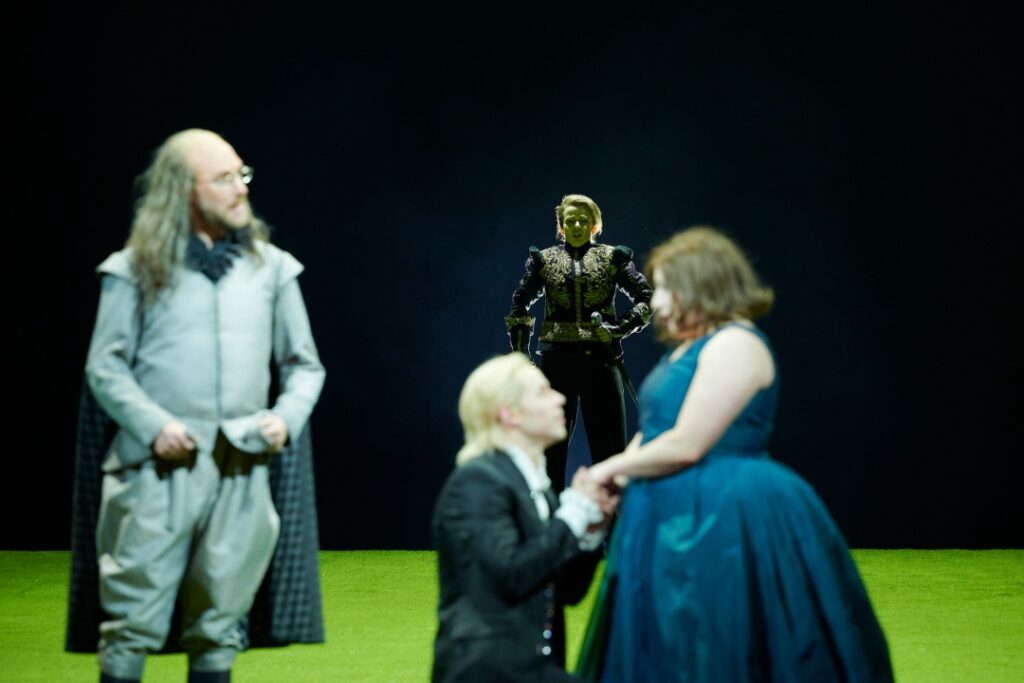
Nearly three centuries after Steffani died in Frankfurt, where he was laid to rest in the Kaiserdom, his “Amor vien dal destino,” finally resounds on the city’s main stage. This production features a stunning minimalist stage. The design places a vibrant green lawn against a cold, dark void, creating a surreal atmosphere where every gesture feels loaded with fate. Sculptural lighting isolates the singers in bright white pools, while low-angle beams cast long shadows across the green, recalling the metaphysical paintings of Giorgio de Chirico. This intensive focus creates a powerful shift between alienation and intimacy, perfectly matching Steffani’s many brilliant duets by highlighting the characters’ emotional bond within a vast, lonely space.

(Photo: Matthias Baus)
While the setting looks serious, it is surprisingly versatile and playful. The lawn offers moments of comic relief, such as when Nicea and Corebo pop their heads through the grass to spy on others and flirt. Turno is sometimes trapped in a “boxed light,” and a grid of fire pits later provides a dramatic backdrop for his fight with Enea. The costumes—ranging from period embroidered jackets to modern vests—ensure the characters are easy to identify. Everything culminates in a touching finale where the cast embraces under falling confetti, signaling a reconciliation that finally bridges the gap between rivalry and destiny.
Rich in metaphor and layered imagery, Ortensio Mauro’s libretto offers a striking depth of reflection on love, duty, and self-control, making the surtitles a genuine pleasure to follow. The singers respond with notably precise physical acting. Particularly effective is the contrast between two dramatic spheres: Lavinia, Enea, Turno, and Latino inhabit a more “noble” register, defined by tensions between inner emotional truth, bodily desire, self-restraint, and national obligation, while the exchanges involving Corebo and Nicea adopt a far more direct and overtly comic mode. This juxtaposition enables Steffani and Mauro to examine shared themes—love, power, and choice—from sharply divergent theatrical perspectives.
Illuminating Cast
At the heart of the performance stands Margherita Maria Sala as Lavinia. Her portrayal combines vocal warmth with expressive restraint, shaping Steffani’s long melodic arcs with exceptional sensitivity. Lavinia emerges as an emotionally articulate figure, acutely aware of the cost of her choices, and Sala’s gently weighted tone anchors the opera’s moral center—particularly in moments where Lavinia accepts the demands of her father’s crown over her own love.

(Photo: Matthias Baus)
Michael Porter as Enea was a nuanced alternative to the traditional heroic ideal. His voice was clear and focused, supported by an underlying lyricism that humanized the Trojan leader. Porter’s phrasing conveyed both resolve and hesitation, allowing Enea to appear as a man negotiating conflicting loyalties rather than a figure of unyielding destiny. Opposite him, Karolina Makuła as Turno was a forceful and volatile presence. Her incisive vocal brilliance and intense dramatic commitment gave vivid shape to a character driven by pride and desperation, most strikingly in her furious arias and explosive duets with Enea. If there was a slight reservation, it was that the sheer force of her performance occasionally risked overshadowing her counterpart.
Thomas Faulkner as Latino projected dignified authority, yet his very hesitation—at times bordering on inconsistency or reversal—laid bare a ruler whose vacillation felt like a painfully honest exposure of inner anxiety and vulnerability. Constantin Zimmermann brought weight and calm authority to Giove, while differentiating Coralto with understated theatrical intelligence. Pete Thanapat negotiated the dual roles of Corebo and Fauno with assurance, balancing noble rhetoric and rustic humor, and Theo Lebow as Nicea provided earthy comic relief without disturbing the opera’s emotional equilibrium. Daniela Zib’s dual portrayal of Giuturna and Venere is marked by vocal clarity and dramatic precision: her bright, agile soprano lends Venere seductive authority, while Giuturna’s music acquires a darker, more urgent profile.
(Photo: Matthias Baus)
Musical Details
Although period-instrument enthusiasts may still find reasons to nitpick—arguing that some passages, especially in the strings, lacked the staggered volume and sharply chiseled articulation of a Baroque ensemble—the instrumental performance was nonetheless exquisite. Under the meticulous direction of Václav Luks, the Frankfurter Opern- und Museumsorchester achieved a remarkably convincing period sound. They were supported by added early-music specialists including some veterans of René Jacobs’ 2016 Berlin production of the same opera. They ensured the articulation and nuances felt truly “original.” The basso continuo provided a rich foundation, with the theorbo, lute, and chest organ creating a diverse acoustic palette.
The individual contributions are standout: the concertmaster lead with stylistic elegance, while the oboists and bassoonists engaged in delicate, soulful dialogues with the singers. The percussion added rhythmic drive and more exotic colors. The Salterio, with its crisp, metallic resonance, paired with the harp to create a dreamlike, otherworldly atmosphere. This lush, ethereal soundscape acted as the perfect counterpoint to the minimalist stage, wrapping the audience in a hauntingly beautiful musical ambient.
Every crossroad demands a choice, but Steffani’s genius—musical, dramatic, moral—lies in refusing easy resolutions. Likewise the characters stand frozen at their junctions, perpetually caught between what they desire and what they owe, resolved only by God’s determinations. R.B. Schlather’s production honors this refusal, staging the crossroads itself rather than the paths taken. Against the surreal green and metaphysical shadows, the opera asks not “which way?” but “at what cost?” Three hundred years after his death, Frankfurt stages Steffani’s difficult question—and in doing so, finally gives his theatrical voice the resonance it deserves.