Musikfestspiele Potsdam Sanssouci 2026 Review: Il Trionfo del Tempo e del Disinganno
A Spiritual Metamorphosis on a Thunderous Night
By Mengguang Huang(Photo: Johannes Ritter)
Although the Erlöserkirche had initiated necessary building cooling measures the night before, the venue was undeniably still a sauna edition of a Händel experience. However, Ensemble 1700 and a robust lineup of soloists, paired with Nils Niemann’s concise and highly efficient stage and prop design, forged this thunderstorm-ridden night’s “Il Trionfo del Tempo e del Disinganno” into an intense, high-voltage emotional experience.
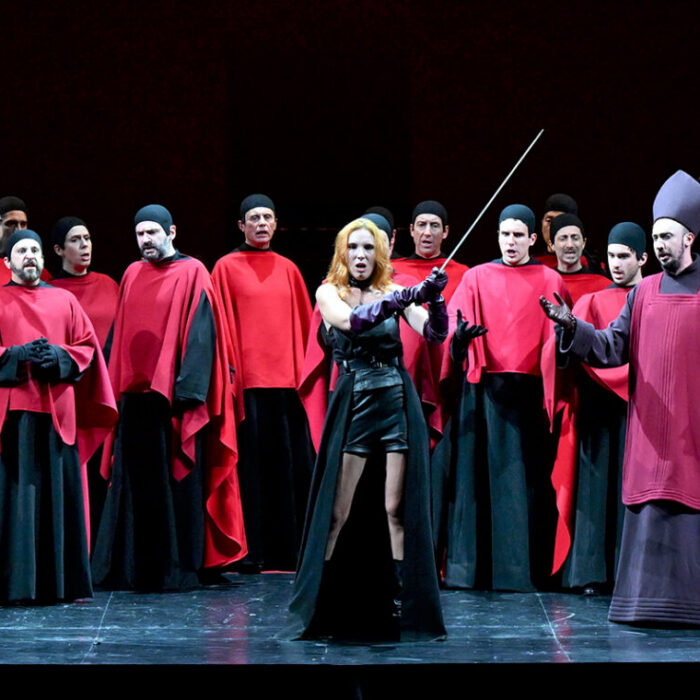
Over the past decade, a vast influx of productions has tried to capture the libretto’s suggestions of personal indulgence in excessive beauty and intoxication. These interpretations often overstretch the themes into contemporary critiques of consumerism. In contrast, this production remained profoundly faithful to the core message of the text itself, steering clear of any over-interpretation. Though billed as a semi-staged performance, the dramatic heavy lifting relies almost entirely on the four singers’ costuming and hand-held props which are largely inspired by Chrisitian liturgy. Bellezza wears a captivating, eye-catching red dress; Piacere was clad in a contrastingly vibrant, colorful outfit set in a striking yellow-and-blue palette; while Disinganno and Tempo are draped in more austere black-and-white attire, establishing clear character distinctions in the simplest, most direct manner possible.
Johanna Wallroth as Bellezza
Different from what was originally published in the festival brochure, Bellezza was sung by Johanna Wallroth, who has recently performed the role multiple times in Rome—the very birthplace of this oratorio. This twist of fate proved to be a true blessing for the audience; Bellezza is, after all, the ultimate showcase for a female singer to display her sheer vocal charisma.
She opened the performance by playing with an exquisite mirror, jewelry, and her earlobes, radiating an undeniable feminine beauty without a single trace of affected mannerisms. Upon first hearing, Wallroth’s timbre sounded remarkably rounded and full-bodied, possessing even a hint of rich warmth in her lower register. Right from the outset, this immediate vocal depth shattered any preconceptions of Bellezza as a stereotypically frivolous character.
As the evening progressed, benefiting from the score’s abundance of brilliant arias, the exceptional flexibility and precision of her high register were fully unveiled. Wallroth’s performance was also marked by a profound intelligence; in many of the da capo arias, she successfully created stark dramatic contrasts in the B-sections through sharply contrasting articulation and subtle nuances in timbre. Her duets with Piacere were equally a good match, where her brighter timbre blended seamlessly with Piacere’s more authoritative vocal line.
Yet, the most mesmerizing aspect of her performance was her psychological depth. We witnessed her internalization, self-doubt, and hesitation under the persistent mentorship of the two male allegorical figures. This internal friction culminated in the second (and most volatile) quartet, where amidst the intense clash of voices, her anxiety and near-hysterical breakdown were vividly realized, before ultimately dissolving into a powerful spiritual awakening and piety.
If there was any minor caveat to this otherwise masterful assumption of the role, it occurred during the bravura aria “Una schiera di piaceri.” Driven by immense confidence, Wallroth engaged in a thrilling vocal duel with the oboe. Here, the church’s lively acoustics caused a fraction of rhythmic displacement in a few phrases.
Francesca Lombardi Mazzulli as Piacere
Opposite stood Francesca Lombardi Mazzulli, whose portrayal of Piacere offered a masterclass in highly controlled, emotionally sophisticated artistry. Radiating a more seasoned authority, she deployed a deeply persuasive delivery and polished stage presence to repeatedly tutor Bellezza, painting a vivid picture of joy that captured her heart. This unwavering conviction peaked in the first half during “Un leggiadro giovinetto.” Accompanied by the organ, Mazzulli delivered a performance that was simultaneously sublime and sumptuous.
However, as the two male allegorical figures intervened, an unsettling anxiety began to creep into her heart. Under this mounting pressure, her articulation shifted toward a more commanding but anxious tone. In “Tu giurasti di non lasciarmi,” she unleashed her full vocal power alongside the heavy lower strings, utilizing dramatic pauses to suspenseful effect.
Mazzulli also demonstrated creativity in the celebrated “Lascia la spina, cogli la rosa.” She infused the familiar melody with fresh vitality through a light, supple articulation and nearly spiritual embellishments. Her explosive exit aria, “Come nembo che fugge col vento,” achieved an unexpected stroke of theatrical spark by synchronizing with the actual thunderstorm raging outside. As flashes of lightning pierced through the church’s windows at that precise moment, the fusion of nature and Mazzulli’s tempestuous music delivery could not have been more perfect.
More Cast & Musical Highlights
By contrast, the two male singers adopted the deliberate demeanor of earnest, old professors offering solemn counsel. Alois Mühlbacher as Disinganno convincingly realized Handel’s genius for word-painting while holding an hourglass to denote the fleeting nature of beauty. In “Crede l’uom ch’egli riposi,” he lulled Bellezza with a hypnotic, comforting tone, only to shatter the calm with biting articulation in the B-section. He likewise impressed in “Più non cura valle oscura,” carving out a vast sense of space underpinned by tasteful embellishments and superb breath control over long phrases.
Daniel Behle as Tempo conversely maintained a stiffer stage presence—whether by directorial intent or otherwise. Lacking interaction and eye contact with other singers, he remained largely glued to his music stand. His delivery was solid yet conventional, and his singing from the church pulpit in Part two felt like a literal sermon. Nevertheless, in both quartets, the two male voices blended beautifully with the women, avoiding the jarring, splintered clashes.
Throughout the evening, Ensemble 1700 under Dorothee Oberlinger delivered a captivating performance. From the Italianate overture to the central Sonata of the first part with its famous organ solos, the orchestra illuminated Handel’s score with crisp, agile articulation and a brilliantly luminous timbre. The basso continuo was equally vibrant, featuring delightfully fluid transitions from the lute and exquisitely played cello obbligatos. If one were to nitpick, the oboe’s articulation occasionally turned slightly muddy in certain rapid passages.
The production concluded in Bellezza’s final aria, “Tu del Ciel ministro eletto,” paired with Evgeny Sviridov’s noble violin solo. The oratorio ended precisely at 10 p.m. just as the church’s bell tower began to toll. Bathed in the radiant gleam of a golden Christian Monstrance, the timing of this spiritual metamorphosis could not have been more sublime—a perfect, transcendent finale to an unforgettable evening.