Musikfest Berlin 2026 Review: Porgy and Bess
By Zenaida des Aubris(Photo: Fabian Schellhorn)
George Gershwin’s “Porgy and Bess” has never fitted comfortably into a single category. Opera, Broadway, jazz, spirituals and popular song coexist in a score whose musical language remains unmistakably Gershwin’s. For its return to Berlin, Cape Town Opera joined forces with the London-based Chineke! Orchestra under Enrique Mazzola for a semi-staged performance at the Philharmonie, with Magdalene Minnaar directing.
Berlin has a notable history with the work. Its first appearance in the city came in 1952, when an American touring production gave 11 performances at the Titania-Palast with the then 25-year-old Leontyne Price as Bess, William Warfield as Porgy and Cab Calloway as Sportin’ Life. This latest visit was inevitably less lavishly theatrical, but the limitations of the Philharmonie proved surprisingly conducive to concentrating attention on Gershwin’s characters and, above all, his score.
Keeping Gershwin Moving
Enrique Mazzola understood something fundamental about “Porgy and Bess:” it must move. There is a temptation, particularly when presenting the work in an opera house or concert hall, to emphasize its operatic credentials by giving the music additional weight. Mazzola resisted it. His reading was energetic and rhythmically alert, allowing Gershwin’s changes of musical idiom to occur naturally rather than underlining them.
The Chineke! Orchestra proved a particularly responsive partner. Founded in London, the ensemble brings together musicians from diverse backgrounds. There was an appealing immediacy to its playing. Rhythms remained crisp, orchestral colors transparent and, crucially in a semi-staged performance, the singers were never submerged beneath the considerable forces at Mazzola’s disposal.
The score could swing when it needed to, but Mazzola also knew when to allow Gershwin’s longer lyrical lines room to expand. The result was an account that neither sentimentalized the score nor treated it as a piece of symphonic Americana. Instead, its disparate elements—jazz, blues, spiritual, popular song and grand opera—were allowed to rub shoulders with one another.
At the Heart of Catfish Row
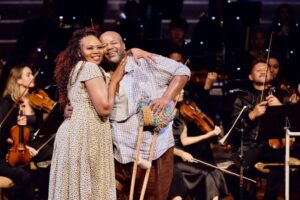
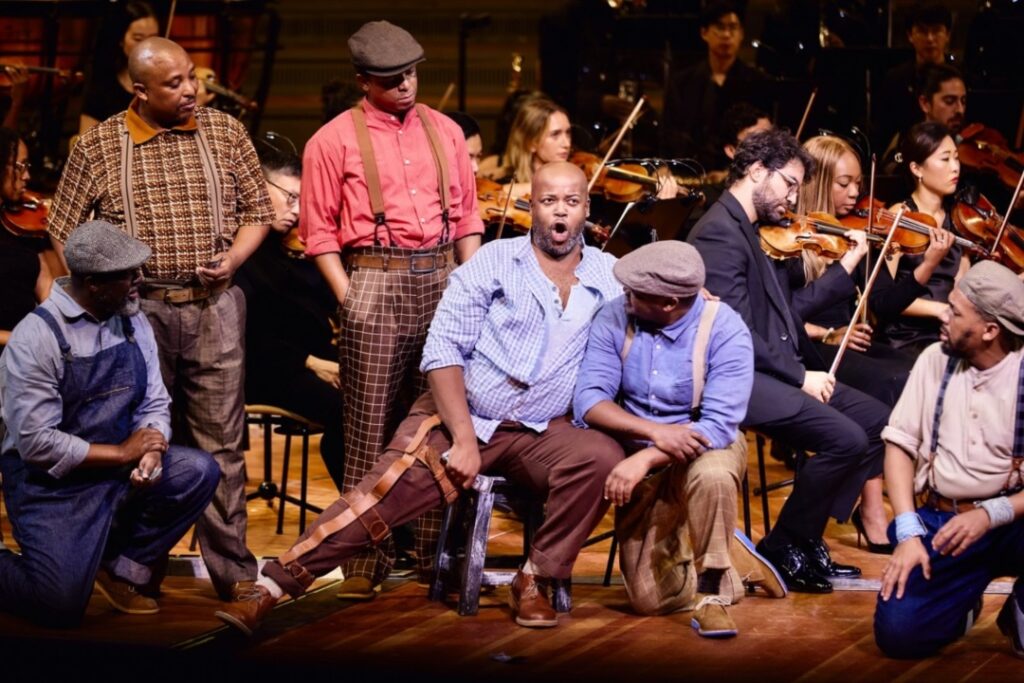
Cape Town Opera supplied a strong ensemble, with its two protagonists, bass baritone Siyabulela Ntlale as Porgy and mezzo-soprano Nonhlanhla Yende as Bess, anchoring it.
Ntlale brought both vocal presence and considerable humanity to Porgy. What impressed was the absence of sentimentality. This was not a man defined by his disability, but one transformed by the unexpected possibility of love. Ntlale made the character’s generosity and vulnerability convincing without turning either into pathos, and his relationship with Yende developed naturally.
Yende was an equally persuasive Bess, presenting a stately woman pulled in several directions at once. Her attraction to Porgy and the security he represents never entirely extinguished the other Bess—the woman drawn to Crown, drugs and the promise of escape offered by Sportin’ Life. It is precisely this instability that makes Bess dramatically fascinating, and Yende allowed those contradictions to coexist rather than attempting to resolve them. Together, she and Ntlale gave the performance its emotional center.
(Photo: Fabian Schellhorn)
Tenor Lukhanyo Moyake’s Sportin’ Life was less convincing vocally. Dramatically, there was much to enjoy. He moved easily through Catfish Row as its opportunistic outsider, watching for weaknesses and knowing precisely when to exploit them. Moyake embodied the character with considerable theatrical confidence, but vocally the performance lacked some of the ease and incisiveness needed to make Sportin’ Life genuinely dangerous. The characterization promised rather more than the singing ultimately delivered.
Soprano Brittany Smith’s Clara established an atmosphere of unease from the beginning. “Summertime,” perhaps the most dangerous number in the entire opera simply because of its familiarity, emerged not merely as a beautiful lullaby but as one tinged with apprehension. The sense of a mother attempting to reassure a child—and even herself—gave the music an appropriate undercurrent of foreboding.
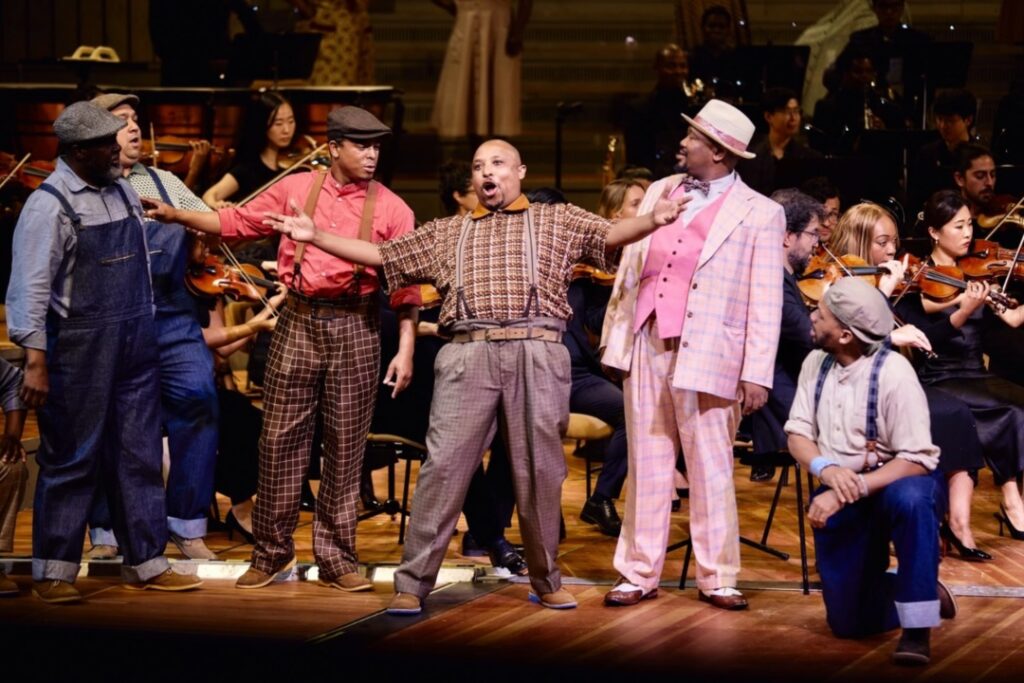
Around them, the remaining Cape Town Opera singers created a genuine sense of community. This matters enormously in “Porgy and Bess.” Catfish Row is not merely a backdrop against which the principals enact their tragedy; its inhabitants are the fabric from which that tragedy emerges.
(Photo: Fabian Schellhorn)
Creating a Stage in a Concert Hall
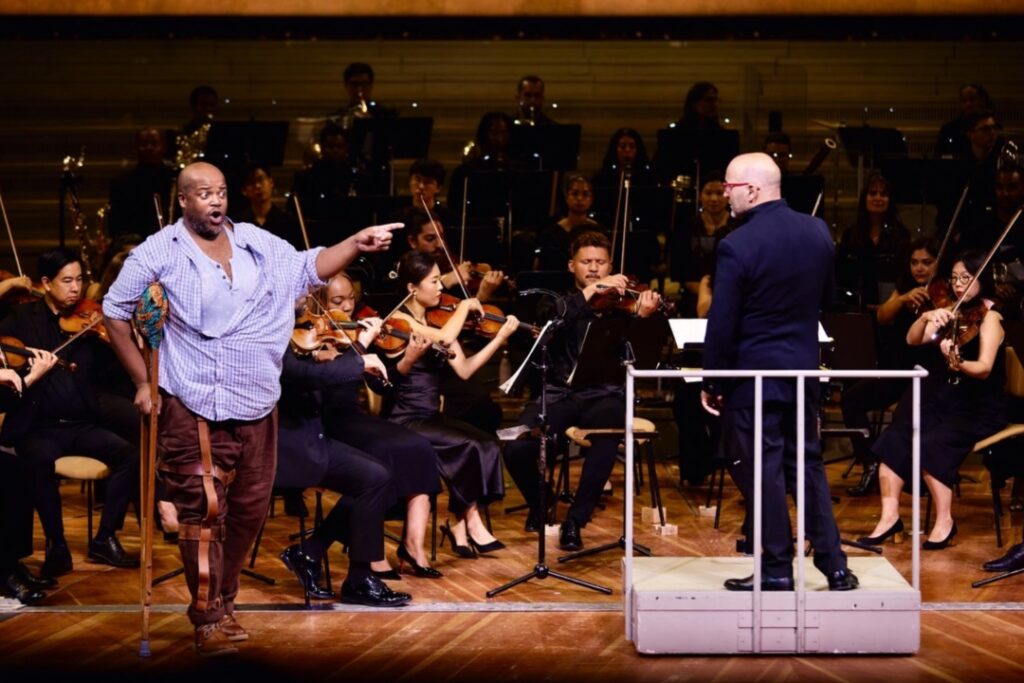
Director Magdalene Minnaar faced the perennial difficulty of semi-staged opera at the Philharmonie: how to create a theatrical world in a space emphatically designed for something else. Her solution was to concentrate on characterization rather than attempt to simulate a fully staged production.
It worked. Characters acquired distinct personalities quickly, sometimes through little more than a gesture, glance or reaction to another member of the community. Minnaar kept the action lucid and allowed relationships to register without excessive theatrical apparatus.
(Photo: Fabian Schellhorn)
Yaseen Manuel’s choreography was particularly well judged. Rather than trying to squeeze conventional stage choreography into the restricted performing area, Manuel used the available space intelligently. Movement felt integral to the life of the community, while never distracting from the musical performance.
Maritha Visagie’s realistic costumes, firmly rooted in the period of the work’s composition, supplied much of the visual information that scenery could not. Minnaar, Manuel and Visagie effectively made a virtue of the Philharmonie’s limitations. Their respective responsibilities—direction, choreography and costumes—were complemented by Antoinette Huyssen’s chorus preparation.
Ultimately, however, the evening belonged to Gershwin. Nearly a century after its 1935 premiere, “Porgy and Bess” remains an extraordinary amalgam of musical worlds that ought not necessarily to fit together but somehow do. Cape Town Opera, Chineke! Orchestra and, above all, Mazzola trusted those contrasts rather than smoothing them away. In the Philharmonie, with no and nowhere for either performers or music to hide, that proved more than enough.