Metropolitan Opera 2026-27 Review: Macbeth
Quinn Kelsey & the Metropolitan Opera Chorus Electrify in an Uneven Opening Night
By Francisco SalazarBack in 2007, the Metropolitan Opera premiered Adrian Noble’s take on Verdi’s “Macbeth,” a grim and dark modern day setting, transforming Shakespeare’s dark thriller into a horror story. It was a visually striking and theatrical production on which some of the company’s most renowned and striking performances, especially Lady Macbeth, took center stage.
To open its 2026-27 season, the Met has brought a brand new production and with it, new expectations. The production is all the more noteworthy as it represents a shift in direction for the company, which since the pandemic, had only opened its season with contemporary works.
Ultimately however, the result proved to be a mixed bag with one of its leading roles delivered with incredible passion and the other utterly lacking in it.
Cool & Cold
Soprano Lise Davidsen, who is at this juncture the operatic face of Peter Gelb’s artistic vision for the Metropolitan Opera, was the reason for opening this season with the Verdi masterpiece. Coming off a triumphant run as “Tristan und Isolde,” one can definitely see why she’s ubiquitous with the Met. That Isolde was a defining rendition in which the soprano displayed her vocal potency and artistic nuance. Her greatest triumphs with the company, however, have always been in non-Italian repertory.
At the Met, the soprano has attempted two other Italian roles: the title role of “Tosca” and Leonora in “La Forza del Destino” and in neither did the soprano portray her greatest artistic assets, her interpretations coming off as steely vocally and unidiomatic musically. In the case of Tosca, the raw intensity and stage presence was severely lacking while in “Forza,” Davidsen never sounded comfortable with the nuance of Verdi’s vocal writing.
Lady Macbeth was a continuation of this trend.
Here, Davidsen’s chest was lacking and her middle voice was often covered by the orchestra. Moreover, and perhaps more importantly, she struggled to create a clear portrait of who her Lady Macbeth was, mainly because she came off as passive throughout, almost relying on her immense stature and presence to do the work for her. In “Nel dì della vittoria,” the interpretation of text rarely came alive, the soprano speeding through it, while her “Vieni! T’affretta! accendere” was cold and missing resonance, especially as she went to the lower parts of her voice. In the ensuing cabaletta, “Or tutti, sorgete,” where she is conjuring the agents of hell, the voice maintained a similar opaque color. Given Davidsen’s heavier repertory, this particular cabaletta was always going to be a point of contention mainly due to the coloratura. Davidsen’s coloratura was constantly smudged and there was a lack of cohesion with the orchestra. And to add to this, Davidsen did not differentiate in her approach to the first or second repeat, the chose to bite into the text making it bland as the two verses sounded similar.
The drinking song “Si colmi il calice” lacked authority and the coloratura, again, was messy even if she did pull off rousing high notes and a solid trill. She sang the second iteration of the aria piano to express off the character’s discretion.
“La Luce langue” was a solid moment for the soprano as she dug into her lower voice on “A loro un requiem, l’eternità !..” In the second half of the aria “O voluttà del soglio !” her voice rose to new heights with great power and command and she thrillingly dug into the word “Cadrà” on each repeat. Her facial expressions seemed to portray that a sad, even remorseful woman.
The final sleepwalking scene was perhaps Davidsen’s best moment as she opened “Una macchia e qui tuttora” clearly crazed. Davidsen’s sound was darker and she sung the text with more clarity and a bit more staccato phrasing to emphasize Lady Macbeth’s state. But as the aria progressed, the singing and acting became more generic losing the tenacity she began with. Davidsen did end with a generous D flat.
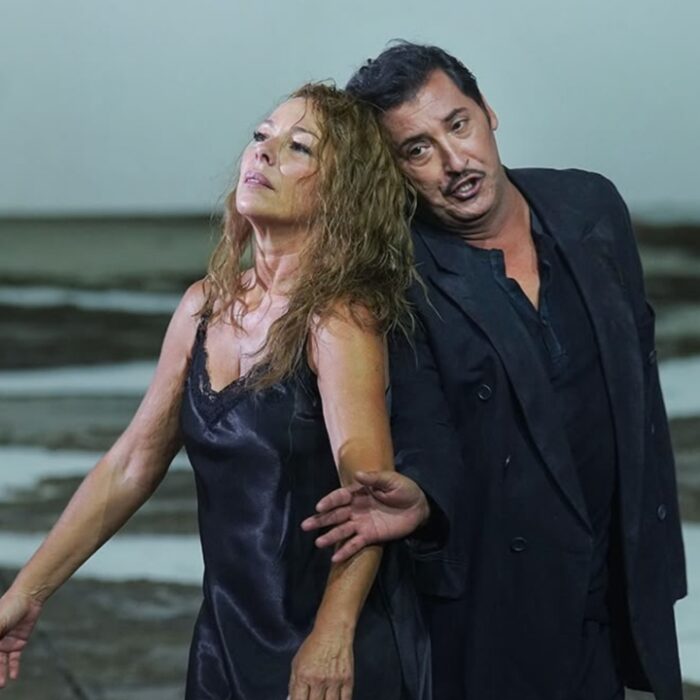
Perhaps what made her portrayal even more frustrating was the lack of chemistry with Quinn Kelsey. You felt a lack of connection between the two. It’s fair to interpret this loveless couple as lacking interest in one another, but the choice was not articulated with clarity. In her opening duet, Davidsen hardly looked at Kelsey and was attempting to get through the staccato and coloratura phrases which were sung at a sluggish tempo. In the banquet hall, as Kelsey increasingly became desperate and disturbed by Banquo’s apparition, there was no sense of reaction by Davidsen and she simply stood in place. You couldn’t figure out what this Lady Macbeth was feeling and that made the scene feel lacking in tension between the two. Only in “Ora di morte e di vendetta” was there some glimpses of that fierce Lady Macbeth that manipulates her husband as she sung with potent high notes and unleashed the immensity of her voice.
Ultimately, Davidsen’s Lady Macbeth came off as one-dimensional, creating a dramatic void throughout the entire opera.
Bombastic & Slow
The second biggest issue of the night was Music Director Yannick Nézet-Séguin whose conducting was full of mannerisms and simply dragged the evening, showing why he has always shied away from conducting bel canto. “Or tutti, sorgete” was the perfect example of where bel canto understanding is necessary, as both the conductor and Davidsen seemed in a tug of war regarding the tempo. The voice should be leading in this case, but Nézet-Séguin was not accommodating.
The other issue was that he prioritized his bombastic brass sound, to the detriment of the singers. Any time there was a crescendo, the thunderous brass overpowered ensembles. The “L’ira tua formidabile e pronta” section of the Act one concertato also saw the conductor cover the entire ensemble as he emphasized the rhythmic violins. The same happened with Banquo’s aria, “Come dal ciel precipita” where Nézet-Séguin’s orchestra almost overpowered the bass. While there were some thrilling crescendos, perhaps a more varied color would have made this few instances surprising and poignant.
Then there were tenuous and slow tempi that made this evening the longest Macbeth I have ever witnessed. The biggest misstep was “Patria Oppressa,” where he threatened to derail the glorious singing by chorus with his dirge-like tempi and random pauses that made the piece almost unrecognizable. The opening duet between Macbeth and Lady Macbeth was equally lacking energy and the tempi dragged.
Uneven
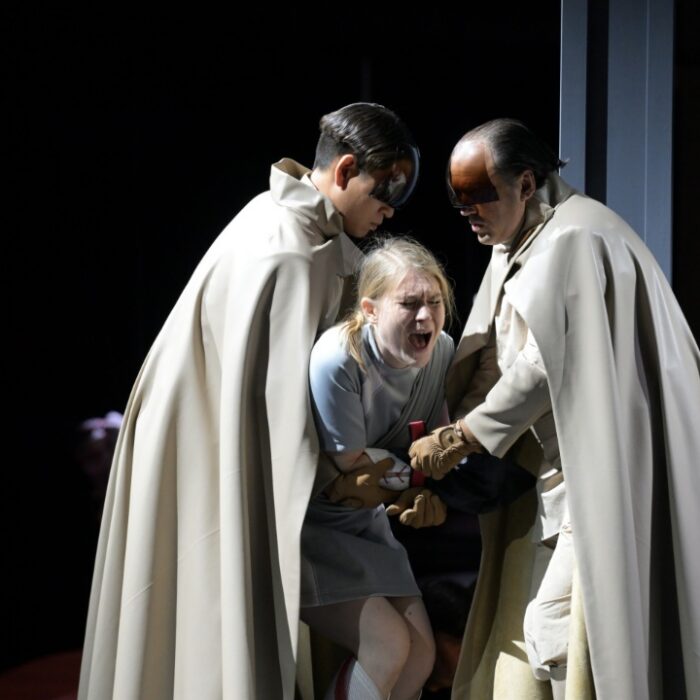
The new production by Louisa Proske was also a bit uneven, though incredibly detailed. Set in rubble and bombed out apertures with walls splitting apart and a towering funeral pyre, the production moves on a turntable, a staple of the Gelb era. Each time the turntable moves we see a new environment whether it’s the Macbeth’s bedroom, the banquet hall, Birnam Woods, or the witches’ lair. The environments are filled with detail and the lighting gives it a grim and haunting texture. The costumes by Montana Levi Blanco are some of the most textured I have seen in years at the Met; the witches wardrobe will make your skin crawl. Lady Macbeth also gets some of the most regal and elaborate costumes of the evening, evoking the power she has. And then there are the painterly tableaus that are created by stage direction. “Patria Oppressa” looks like a painting of a suffering population, as does the apparition parade in Act three, which is just haunting and ghostly.
One of the best directional choices of the evening was that the witches are constantly looming over everything, adding gravity to the story. They dress Lady Macbeth; they crown the Macbeths after Duncan’s murder; they watch over the Macbeths as they plot another murder in “Ora di Morte e di vendetta;” they watch as Macbeth is dying; and they even crown Banquo’s child at the end. It is a stroke of genius that emphasizes their control over the proceedings.
It truly has the making of great production but it’s marred by the lack of depth and some flimsy choreography. The battle scenes are extremely loud, especially in the opening of the opera and at the end. The dancers in the banquet scene are awkward and distract from the music. The other big issue is the blocking, as it seems most of the action are downstage, giving the singers little space to move around. Many times you feel that the action is static and lacking in intention. The banquet scene takes place mostly downstage with the actors barely moving, save for Lady Macbeth prancing on top of a table. At the end of Act one, the main characters remain mostly rooted to their spots. The other big issue is the ending of the opera where the chorus is singing of Macbeth being struck down and yet he is not dead. Instead you see the chorus beating him up before bringing him to the pyre. It is a bit comical and over the top and takes away from the poignancy of Verdi’s glorious music.
Proske’s production adds Macbeth’s final aria “Mal per me che m’affida,” which is welcome if unnecessary and the first part of the ballet, where there is a handsome choreography. One only wishes that they would have committed to the entire ballet instead of just one part of it as this just simply feels unfinished.
Electric
Thankfully the evening featured Quinn Kelsey, who delivered a committed performance as a weak and vulnerable Macbeth. Perhaps one would have wanted more strength in his characterization, if only to give him more of an arc from start to finish, but ultimately, Kelsey was so committed to his interpretation that we were moved and connected to him throughout. You could see his fear and hesitance in his monologue, “Mi si affaccia un pugnal! L’elsa a me volta?” which slowly built from piano singing to more fortes and showed cracks of insanity in Kelsey’s Macbeth. Then there was the banquet scene, which saw Kelsey’s madness awaken and the phrasing turned jagged and staccato-like with the baritone climbing on the table and attempting to knife the ghost of Banquo. It was a haunting scene and as Kelsey emoted the text, you sensed that this was a king unraveling quickly.
In the witches’ lair, Kelsey delivered a tour de force “Fuggi, regal fantasima,” which started with grit and force and slowly brought him into a crazed and confounded state. The sound got stronger and Kelsey dramatized every moment possible with bite in the text. “O mio terror!… dell’ultimo” was delivered with desperation and a powerful baritone that resonated throughout the auditorium. This was the moment when Kelsey really shined leading to a well deserved ovation.
That led to an “Ora di morte e di vendetta” where the baritone was consumed by death and blood. But in “Pieta rispetto amore,” Kelsey’s interpretation was all about vulnerability and simply showcased a king who was almost repenting for his action. The lines were shaped with a smooth legato that truly brought some of the best bel canto singing of the night. Then there was the “Mal per me che m’affida,” where Kelsey sounded a bit tired, but delivered with pathos, showcasing the tragedy of Macbeth to its full extent. The final “vil corona e sol per te!” was one final call of desperation.
In many ways, Kelsey carried this evening.
The chorus was the other star of the night creating dynamic characters throughout the evening. As the witches, the female chorus was playful, menacing, and eerie. They were unpredictable as the ensemble could showcase a bleak lower sound and then a bright mischievous timbre. Then as the refugees in “Patria Oppressa,” they portrayed the anguish and aching pain with their pianissimo sound as they opened the famed chorus and as they crescendoed you could feel their torment. In “La patria tradita” and “Macbeth, Macbeth ov’è?,” you could hear their triumphant voices singing with great resonance, brightness, and jubilation.
In the role of Banquo, Ryan Speedo Green started off uneven with his voice sounding grainy. But later in the evening, he gave an elegant account of “Come dal ciel precipita” with smooth legato phrases. His appearance as the ghost was also creepy and unhinged.
As Macduff, Freddie De Tommaso, sang his opening phrases with great strength and in the concertato, “Schiudi inferno inghiotti” his voice resonated with power. His aria “Ah! la paterna mano” was sung with an ardent timbre and gorgeous legato phrases that were filled with expression, intensity, and varied dynamics. It was truly some of the most inspired singing of the evening.
In the role of Malcolm, Jonathan Burton showcased a strong tenor that blended well with De Tommaso in their duet “La patria tradita.” He also impressed in the concertato in Act one. Marcy Stonikas as the Lady-in-Waiting and Bradley Garvin as the Doctor played well off each other looking spooked in the sleepwalking scene.
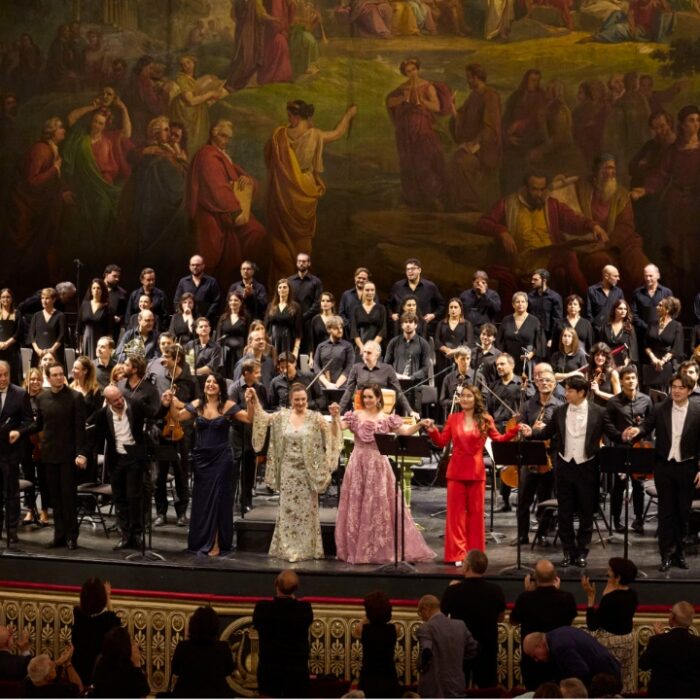
The audience and celebrities brought the energy, but ultimately, save for the leading man, this performance proved uneven.