Wexford Festival Opera 2026 Review: The First Festival
Caruso & Tóibín’s Sentimental Take On Wexford’s Inaugural Festival
By Alan Neilson(Photo: Wexford Festival Opera)
To celebrate its 75th anniversary, the Wexford Festival Opera commissioned a new opera from composer Alberto Caruso and librettist Colm Tóibín to be performed by the singers from the Wexford Factory, the company’s young artists program.
Tóibín’s Beautifully Constructed Gentle Comedy
Entitled “The First Festival,” Tóibín’s libretto takes us back to 1951, the year of the festival’s inauguration, to a Wexford and a way of life that seems long gone: it is a sleepy town, attached closely to its rural hinterland; the church still holds sway over people’s lives, and the attitudes and values are conservative, to say the least. Opera is generally seen as a highbrow entertainment, distant from the lives and experiences of the majority of the people and with unlikely prospect of generating much enthusiasm. On to the scene steps Dr. Walsh, the festival’s founder, with his idea to establish an annual arts festival with opera at its heart.
The opening scene is set in the motor vehicle tax office in Wexford Town Hall and quickly establishes the tone for the opera. A senior clerk called Betty barks out instructions while three very bored juniors, Bernadette, Brian and Aidan, answer the phones, attending to very dull questions. At every opportunity, they distract themselves with idle chit-chat and dreams of romance. Clearly, life for Wexford’s young was not particularly exciting, but when Brian enthusiastically mentions the prospect of an opera festival for Wexford, he is met with disinterest.
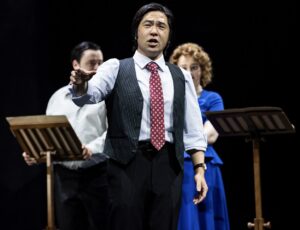
Conor Hanratty, the director and set designer, captured the scene perfectly with a simple staging, consisting of a line of desks behind which the three juniors went about the duties, with Betty’s desk at an angle so that she could monitor them closely. It was a drab and uninviting environment in which to work.
It was, however, not drab and uninviting for the audience. On the contrary, it was very funny. Tóibín is an excellent writer with a rare facility for comedy; the characters may not have been laughing, but the audience was! Betty muses on her love for the English with “their rosy cheeks,” while Aidan complains about Dublin girls, who can only laugh at Wexford men, while all the time the phones ring with callers who ask ridiculous questions, to which they respond with equally absurd replies. But there were few job opportunities back in 1951 Wexford, so what alternatives were there to working at the Motor Vehicle Tax Office?
Nevertheless, encouraged by Brian’s enthusiasm and his short renditions of extracts from well-known operas, their interest in the festival starts to rise, even if they do not know “the difference between Rossini and Rosslare.” This, however, turns to excitement when their thoughts turn to the many foreigners that will be in town for the festival and to the possibilities of finding romance.
Four singers rehearsing for the opera, Mildred, Laura, Gianni, and Facundo, are then introduced, and they, too, are looking for romance. The stage is now ready for the fun of the festival to begin.
The same themes continue to run through the drama: the suffocating morality, the search for romance, and the desire for new experiences. And, of course, it was all played to maximise the comic effect. All the characters eventually pair off: ‘Batty’ Betty with ‘Moldy’ Mildred; Brian with Facundo; Aidan with Laura; and Bernadette with Gianni. But then the real problems begin; where can they go for a bit of privacy? They cannot go home or to their boarding house. Too many people would object; too many people would notice. Can you imagine the scandal? One by one they all hit on the same solution: the Motor Vehicle Tax Office!
Hanratty’s imaginative direction exploited the full comic potential of the scene. Each time a new couple arrives, there is a period of embarrassed maneuvering and amusing dissembling. The office was becoming quite crowded, so when the fourth couple arrived, a horrified Laura asked if she had been brought to an orgy. Occasionally, a cleaner would pass through the office and notice nothing untoward going on.
The opera concludes with a suitably happy, rousing octet. It all proved to be great entertainment and good fun. The light mockery of the mores of 1950s Wexford was roundly appreciated by the local audience, who laughed along at what now appears to be absurd behavior.
There was, however, one instance that jarred. Tóibín decided to have the singers shout out the word “fucking” in a defiant, aggressive manner. Why? It was ugly, it was vulgar, and it shocked nobody, except maybe any young children that may have been in attendance – it was an afternoon performance! Moreover, it did not fit with the rest of the dialogue, which was light and amusing with a smattering of double-entendres that traditionally never offend. Its inclusion temporarily changed the atmosphere of the scene and the mood of the audience. It was so unnecessary.
Caruso’s Sympathetic Score with Plenty of Catchy Melodies
The music was composed by Alberto Caruso, who has already premiered two successful operas at the festival in recent years, both to libretti by Tóibin, with whom he clearly has a sympathetic working relationship. “The First Festival,” however, was a very different work, most notably by the fact that it was written for a small orchestral ensemble rather than for a piano accompaniment. It is an unambiguously light comic opera that incorporated accessible ensemble set pieces, with strong, catchy melodies, by far the most impressive of which was the octet “Wexford Stars and Wexford Nights,” which had the audience entranced. For the rapid dialogue, he composed suitably fast-moving music that not only played to the general comic tenor of the text but was also deliberately saturated with a sentimental sensibility.
The conductor, Andrew Synnott, did a fine job, eliciting a energetic and sensitive reading that moved in tandem with the shifting onstage drama, while carefully supporting the singers.
A Sparkling Performance from the Young Committed Cast
The eight singers from the Wexford Factory all engaged enthusiastically with their roles, producing neatly defined characters that they successfully molded to fit the comedy. There were plenty of smiles and good humor on display, which definitely played a part in making the show such a success. All were costumed in typical early 1950s clothing designed by Frances White, who successfully managed to match each costume to the character’s personality.
Mezzosoprano Eilis Dexter was a suitably strict, uptight office manager. Hidden behind the façade, however, was a young woman quietly waiting for a chance to experience the world, hopefully with an English girl. She possesses an attractive timbre, articulates her lines clearly, and successfully captured the two faces presented by Betty.
Soprano Catherine Hooper cut a fairly drab picture of Bernadette, who was clearly longing for something new in her life. After finding romance in the arms of an Italian singer in the second half of the show, she blossomed. Her singing sprang to life, becoming brighter, freer, and more resonant.
The tenor Seán Tester is starting to make a strong impact in Ireland. He has recently appeared in a number of productions across country to positive reviews from critics. It was quite fitting, therefore, that he should play the role of Brian, who is immediately excited about the possibility of an opera festival in Wexford. He possesses an attractive timbre, acts out parts well, sings with confidence, and sensitivity, and expresses himself clearly; characteristics he successfully brought to the role of Brian.
Baritone Timothy Mays appeared as the clean-cut, boring, and bored office worker, Aidan. Fortunately, he rose above his character to produce a pleasing portrayal in which he eventually finds the romance he has been searching for. His singing was pleasing on the ear and successfully fashioned to match his character.
Mezzosoprano Olha Palazhchenko as the chorusmaster Mildred, or Moldy Mildred, as she was known by the singers, was the rosy-cheeked Englishwoman of Betty’s dreams, albeit one with Ukrainian accent. She produced a well-sung, well-acted performance that showed off her colorful palette to good effect.
Eva Maria Kavanagh produced a sparkling performance as the soprano Laura, a role that allowed her to show off her bright, resonant, and versatile voice with its clear, attractive upper register.
Chinese tenor Yu Shao, who was playing the Italian singer Gianni, was given plenty of comic lines centered around the stereotype of an Italian lover, which, given the fact that he was not Italian, added to the fun. He produced a secure and beautifully sung performance and knew exactly how to maximize the comic affect of his character.
Fraser Robinson playing the role of the Argentinian baritone had the audience laughing out loud as he tried to connect romantically with Brian, neither of whom could understand a word that the other said. Robinson made a fine impression with his lyrically appealing, colorful voice.
All in all, it was a really entertaining afternoon. “The First Festival” is a sentimental, sensitive, fun take on a special day in Wexford’s history, one that 75 years on is still brightening its dark Autumn evenings, in what, thankfully, is still a relatively sleepy town.