Metropolitan Opera 2025-26 Review: Turandot
By Francisco Salazar(Jonathan Tichler / Met Opera)
On May 19, the Metropolitan Opera revived Puccini’s “Turandot” for the second time in the season.
Known for its epic score and its famed melodies, the opera remains a favorite with Met audiences especially due to Franco Zeffirelli’s production. For this second run, the Met assembled a cast of powerhouses that on paper seemed right for the roles, but on stage lacked chemistry and energy.
Maximalism
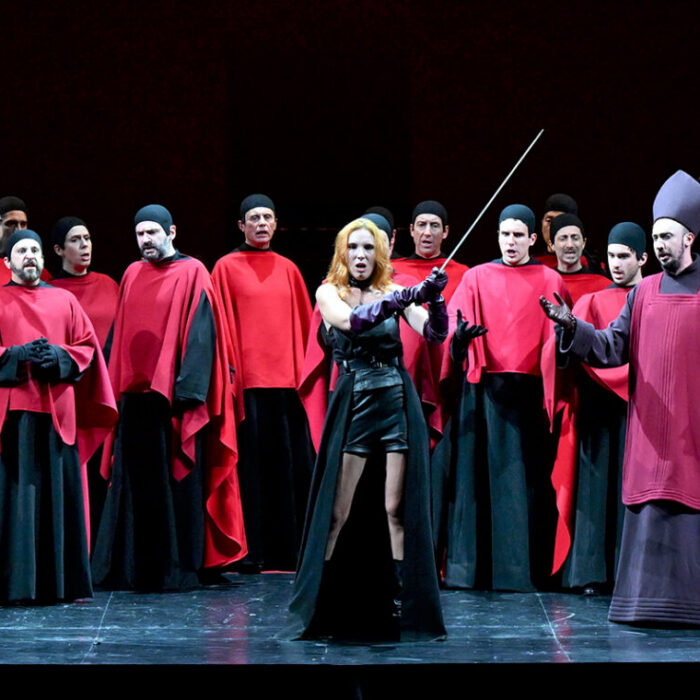
Before I get to the singers, I have to mention Zeffirelli’s epic production which continues to be a monumental staging for the Met, using everything in the company’s arsenal. Act two and the end of Act three still receive rousing applause and it is incredible to see a staging that brings you into a world so effortlessly. To date, it is rare to see a modern director understand the proportions of the Met stage giving it depth and expansiveness to move not only the chorus and singers but also to bring in supers and dancers. And what makes this production even more successful is how spaced out each player is, never making it feel crammed or thrown to the side.
Epic Sound
In the title role, Anna Pirozzi returned to the Met for the first time since her debut in 2019. Six years ago she sang one performance of “Macbeth,” so it is safe to say that this was really her first true full production with the company.
There is no denying that Pirozzi has a full dramatic timbre that can easily cut through the orchestra and fill the auditorium with searing sound. This was evident during her “In Questa Reggia,” particularly in her opening lines and in the climatic “quel grido e quella morte!” where her high notes rang with strength. It was imposing sound that was impossible to ignore. The subsequent phrases “Mai nessun m’avrà! Ah, rinasce in me l’orgoglio di tanta purità!” were also quite thrilling though they sometimes tended to be a little metallic. But while her full sound was outstanding, the middle voice’s lyrical phrases “Principessa Lou-Ling, ava dolce e Serena” and the subsequent ones seemed to be cut short with the legato lines disconnected. That was the same with the riddle scene where you could sense that Pirozzi was more comfortable with the forte and imposing lines than with the more nuanced middle and lower range. These lines lacked a variation in dynamics and in total dramatic force. The “Figlio del cielo” did show some of Pirozzi’s more dramatic impulses singing with an expressive line that displayed Turandot’s desperation.
Act three was a lot better for Pirozzi as she sang the Alfano duet with total control of her instrument. Pirozzi’s middle range was more lush during “Del primo pianto” and towards the end of the duet, her high notes rang with power and brilliance.
As Calaf, Brian Jagde sang with more nuance in the first act than I had heard before from him. His “Non Piangere Liu” brought an ardent suave legato line that slowly built to an explosive fortissimo at the end of the choral concertato with Jagde repeating his “Turandot” with thunderous high notes and a resonant sound.
Act two Jagde was most impressive as he walked on stage with confidence. At the end of “In questa reggia,” he blended impeccably with Pirozzi’s voice as he sang “No, no! Gli enigmi sono tre, una è la vita!” And in the riddle scene you sensed the tension in Jagde as his Calaf went through the trial of her riddles. As each riddle was announced, Jagde gave space between his lines as he thought through each answer giving us a little glimpse into his character and adding much needed tension to the proceedings. Each of his answers garnered more power and his final “La mia vittoria ormai t’ha data a me!” was full of strength. More impressive was “Ti voglio ardente d’amor!” which he took the higher tessitura to ringing effect.
Act three saw Jagde sing “Nessun Dorma” with the same stamina and power even if sometimes, I wished for more contrasts in his opening phrases and in the repetition of the opening melody in “Ed il mio bacio scioglierà il silenzio.” In the duet with Pirozzi, he sang with booming tone and triumphant authority.
But the biggest issue of the evening was the lack of chemistry between the two principles. Yes, Turandot is an ice princess and Calaf is a heroic prince that are just meeting for the first time. But the tension in Act two has be seen to believe anything that is going on. When the two leads look like they are disconnected from one another and more concentrated on hitting high notes, the entire evening feels more like a competition of who can sing louder. This evening felt like old school Met where people simply stood there and sang with no real interaction and while that may work for some, it did not work for me. I am not saying singers have to move around non-stop but a little interaction in character would have worked better. Jagde did follow Pirozzi’s every move in the Act three duet but there was no real reciprocal response. Pirozzi constantly came out of character when she moved down a staircase and that made her performance a bit distracting.
Hopefully as the run develops this issues will be resolved.
Mixed results
Angel Blue reprised her acclaimed Liu, which she had already sang in 2024. This evening was a mixed night for the soprano, whose “Signore, ascolta” saw the soprano sing with a resonant middle voice and gorgeous legato phrases. However, as she rose to the top of her voice, the soprano’s sound was rough and wobbly, lacking any bloom. It didn’t help that Blue looked uncomfortable in the scene. But in Act three, she sang a moving torture scene, starting with “Tanto amore segreto,” which saw Blue at her most expressive, especially with her radiant piano lines. As she moved into the “Tu che di gel sei cinta,” the soprano gave it her all, singing with full voice and cutting through the orchestra. The purity of her voice came to the fore and her acting was at its most gripping. That said, her top still lacked brightness and while Blue attempted pianissimos as she rose in the passaggio, she cut the notes short each time.
As Timur, John Relyea, brought a noble portrayal to the character. Vocally he started Act one with a dry sound that eventually warmed up. In Act three, he was emotionally gripping during “Liù bonta!”
Joo Won Kang, Andrew Stenson, and Tony Stevenson were the standouts of the evening as Ping, Pong, and Pang. The three relished their trio in Act two, singing with exquisite legato lines and blending their voices effortlessly. They were also playful with their blocking, adding energy to the night.
Carlo Bosi sang Emperor Altoum with a steady tenor, while Ben Brady as the Mandarin had a booming bass-baritone.
In the pit, Oksana Lyniv led a vibrant orchestra that kept the music going and worked well with the choral numbers. There were some rousing moments especially in the choral music that ended each act. However, her conducting lacked nuance and Puccini’s unique score felt rather monochromatic with pomp and circumstance the priority, the sound blasting into the hall. It was often detrimental to the singers and made the storytelling all the more predictable, adding no drama to the evening. There were moments where Lyniv fell behind the singers, especially during Act two where it was evident that Pirozzi and Jagde were either ahead or behind during “In Questa Reggia” and in the riddle scene. This imbalance was the most tension that was seen on stage. Unfortunately, it was the wrong kind.
In all, this revival didn’t get off to the most exciting of starts. Hopefully as the team warms up in subsequent performances, this will shift.