Metropolitan Opera 2025-26 Review: Porgy and Bess
Gershwin Revival Earns Grand Reception Thanks to Stunning Cast
By Logan MartellOn December 2, 2025, the Metropolitan Opera delivered a ray of sunshine with a jubilant opening of Gershwin’s “Porgy and Bess.” Last seen on the Met stage in their 2021 season, this year’s run featured new and returning artists who all came together for something as uplifting as it was exciting.
In regard to James Robinson’s production, many of my thoughts remain from my previous experience. The rather minimal set does well to evoke what it needs to of the surroundings of Catfish Row and Kittiwah Island, while not feeling so barebones that it comes off like a concept staging. The rotating set was mostly seamless as it varied between scenes, only being a minor distraction in one scene as it kept moving in gradual turns to eventually sync up with the chorus of fishermen as they set off to “It Takes a Long Pull to Get There.”
Making his company debut was conductor Kwamé Ryan, who spared nothing in fleshing out the dense textures of Gershwin’s score, where orchestral complexity and richness meet a freer, jazz-born expression. Able to fluidly pivot between moments of constantly-changing energy, Ryan’s attention to the dynamic work and talents of the musicians left no moment feeling like it was an afterthought. One example of this power came during Robbins’ wake as the lugubrious measures from the chorus and movements from the corps are quickly kicked into a celebration of praise as the Undertaker manages to offer a solution to the problem of burial.
With so many smaller numbers and poignant themes laden within their overarching scenes, Ryan’s conducting was a sonorous gauntlet of musical styles and stunning Gershwin composition which he navigated to splendid effect.
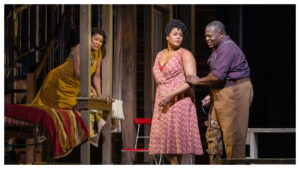
In the role of Porgy was bass-baritone Alfred Walker, who brought remarkable depth in his undertaking. Having had the chance to see Walker in the opposing role of Crown last time around, his performance was a captivating reminder of how versatile an artist can be. His warmth was apparent through earlier moments like “Little Stars” and he related ample vulnerability when deflecting Maria’s suggestion that he held feelings for Bess. These qualities came together beautifully during Walker’s more romantic numbers with Renee’s Bess, and their voices complimented each other well as they shifted between shared, lyrical phrases, and sweet, contrapuntal assurances of their love.
Walker’s experience saw him well at ease with either simpler, banjo-led tunes like “I Got Plenty O’ Nuttin’,” or packed choral textures like the powerful finale “O’ Lawd, I’m On My Way.” While more than able to bring the self-directed heartbreak that makes up much of Porgy’s character, Walker’s portrayal was expertly balanced by a sense of faith which reared its head in moments such as when he prayed for the late Robbins or the resting Bess. This sense of hope is what ultimately transforms so much of the character’s suffering into something greater, turning an otherwise tragic ending into one of nearly folkloric proportions as he readies himself to find Bess once more.
As Bess, soprano Brittany Renee navigated her role with heartbreaking finesse. The role calls for great emotional and musical complexity as Bess grapples with her relations to Crown, Porgy, Sportin’ Life, and ultimately herself. The wanton personality she entered with for the opening scene soon gave way to more affectionate and reflective tones as she tried to build a new life with Porgy and clear her image in the community. Her duet “Porgy, I is your Woman,” featured plush and rounded high notes from Renee as she swore her love.
Her interactions with Crown and later Sportin’ Life displayed tremendous inner conflict and stunning musicality. Bess’ confrontation with the former on Kittiwah featured poignant hues from Renee as she painted the image of Porgy sadly waiting for her return and translated wonderfully into the ensuing, self-deprecating number “What You Want Wid Bess?” where her anguished high notes mixed with the lurching brass and snares to create a hypnotic sense of trying to fight the inevitable. While Bess’ arc is, in the end, a tragic one, Renee’s interpretation convincingly and captivatingly embodied the woman and the sense of frail humanity that makes her downfall come from a place almost anyone could understand and even relate to.
This run of performances features bass-baritone Ryan Speedo Green as Crown. Having last seen him in the role of Jake, this made for a splendid exploration of Green’s more aggressive side as he swaggered and tried to impose his will on those around him. He handled his combat scenes well, first against Robbins and later with Porgy, and his interactions with Bess, as he set upon her before the end of the first half, carried a sense of powerful menace. Firm and resonant even in his simpler, spoken lines, Green also excelled in the moments Crown took to song such as his claim of grappling with God during the storm scene, building to a massive declaration of faith and fury, and his following rendition of “A Redheaded Woman” where the lusty imagery was offered as a sneering attempt to liven the dampened spirits of those gathered.
In the role of Sportin’ Life, tenor Frederick Ballentine was a constant source of fun and sinister charisma as he reveled in tempting Bess and the community as a whole. His support let him deliver slick phrases from various positions as he rose from his squat for “It Ain’t Necessarily So,” which featured well-executed belts, comical mishaps, and more. Well in command of his musical and physical instrument, his performances are dynamic and engaging: I do not often root for Sportin’ Life, but I do when it is Ballentine.
Another debut came with soprano Vuvu Mpofu in the role of Clara. Her rendition of the iconic “Summertime” carried gorgeously over the rich, oscillating chorus and made for an enchanting start to the work. Her interactions with baritone Benjamin Taylor as Jake brought a cute, humorous touch to their respective scenes, building towards her ultimate disappearance in the storm. Through these brief but poignant moments, the soprano brought much to her time in the spotlight and provided yet another reason why this production has so much to offer audiences.
As Serena, soprano Latonia Moore delivered some truly powerfully moments. Her rendition of “My Man is Gone” was a near-showstopper for her soaring high notes, and her command of her lower register enabled a stunning, aggrieved cadenza. Moore also displayed some longer, nearly-hypnotic phrases later on as she prayed over the recovering Bess, lending a nice touch of the spiritual to the tension of the scene.
Another highlight of the Catfish Row community was mezzo-soprano Denyce Graves as Maria. Her strict, motherly character saw her often clash with others like Bess as her phrases dripped with sass and verve. Her brief number with Sportin’ Life “Friends with you?” remains a source of sharp humor as she laid down the law with knife in hand and a gritty, nasal twang that spoke much of her disgust for the dealer. Her aching trio with Porgy and Serena close to the finale was also a moment to be treasured as the women’s defeated sympathy ran against Porgy’s confusion and approaching heartbreak to discover Bess missing. This run of performances is indeed special as Graves readies to retire from the stage, closing the book on a decades-spanning career that has seen her grace the stage of Metropolitan Opera and houses worldwide.
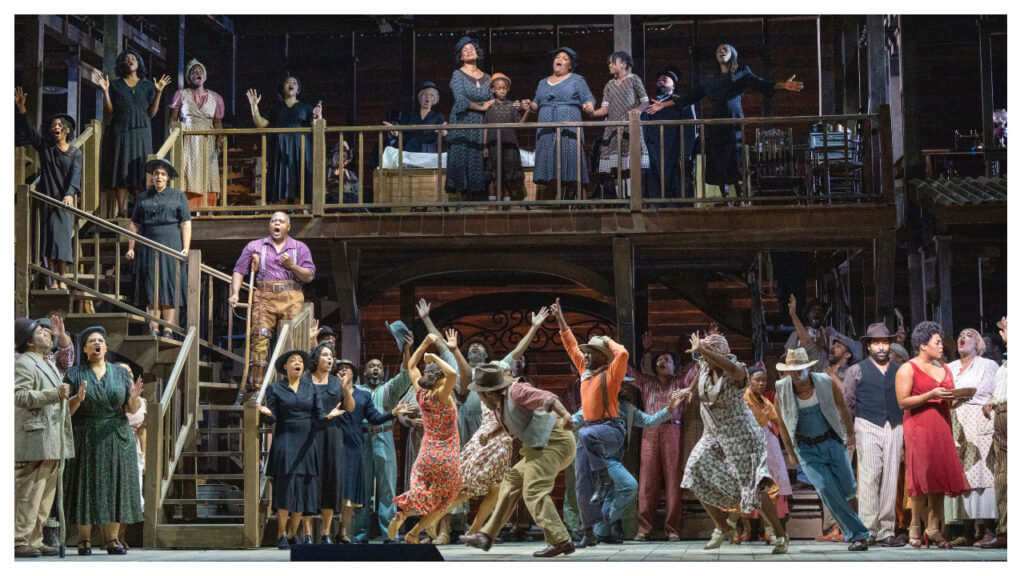
The talents of chorus and corps de ballet were on full display as they formed a stunning cohesion that spoke to the energy of Catfish Row. The opening dice scene carried with it a suitable humor as the onlookers swayed with each roll of the hands, before Robbins’ murder cast things into chaos. Scenes were often established through the tableaux formed by the corps, which helped ground and deescalate the constant movement which comprised a bulk of the work. The result is a celebration where joy and sorrow both flowed to the forefront with powerful expression. Kudos also goes to artists like soprano Brittany Olivia Logan as the Strawberry Vendor, and the coral shirt-wearing dancer whose energy carried him well through his many appearance in the background. Performances like these are truly a testament to the passion and artistry of the company artists, and more than succeeded in bringing in the audience to share these myriad highs and lows.
This season’s run of “Porgy and Bess” lasts until the end of January 2026. With so much to enjoy between the inventiveness of the work, an experienced and energetic cast, and it being one of the last chances to catch renowned mezzo Denyce Graves onstage, this production is undoubtedly one of the best offerings the Metropolitan Opera has put forward in years.