CD Review: Pentatone’s ‘La ville morte’
By Bob DieschburgIs it mere coincidence that Nadia Boulanger’s “La ville morte” and Korngold’s “Die tote Stadt” fixate so obsessively on the past? In both works, the “dead city” is less a place than a psychological condition. Yet whereas Korngold’s necrophilia is filtered through Freudian “psychologie pathologique,” Boulanger’s figures inhabit a Symbolist world of ancestral trauma and fatality.
“La ville morte” reads a a fin de siècle recasting of antique tragedy, its four protagonists propelled–sometimes illogically–toward catastrophe. Adapted from Gabriele D’Annunzio’s play, the libretto revels in forbidden (even incestuous) desire, physical fragility, and taboo, all immersed in Boulanger’s hypnotic synthesis of sensuousness and early neoclassical restraint.
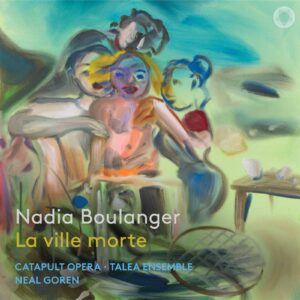
Followers of Debussy, Wagner, Fauré, Franck, or d’Indy will find much to admire. The opera stands as both synthesis and culmination of French musical thought, now revived for the first time on CD by Pentatone and conductor Neal Goren.
Set amid the archaeological ruins of 19th-century Mycenae, the story turns the site itself into a symbolic force. Anne—blind and prophetic—is aligned with Antigone and Tiresias; Alexandre, secretly in love with Hébé, becomes a modern Paris; Hébé recalls Helen and Iphigenia; and Léonard, the most tragic figure, is cast as a latter-day Atreid, Oedipus, and Orestes. Consumed by incestuous love for his sister, he carries the opera’s curse. But for all its learnedness, “La ville morte” remains chamber-scaled, its layering of myths suggestive rather than doctrinaire. Still, the libretto can feel heavy–more overtly so than “Pelléas et Mélisande.”
The undaunted will find an unusually compact score, for which Raoul Pugno–next to Boulanger–deserves almost equal credit. Begun in 1909, it might have reached the Opéra Comique were it not for World War I. Pugno’s death in 1914 and the turmoil that followed doomed the orchestral manuscript, which was irretrievably lost.
To that end, Pentatone conductor Neal Goren has created a performance edition based on Boulanger’s piano-vocal score. His edits (according to the booklet information) trim the narrative—notably by excising Anne’s nurse—and opt for a chamber orchestration.
Musically, Pugno and Boulanger craft a diaphanous sound world. Ripe with impressionistic texture, it relies on non-functional harmonies that co-exist alongside pockets of traditional tonal logic. The effect is one of temporal suspension; it conjures both the ruins of Mycenae and the oppressive gravity of myth. Hébé’s Act three aria, “Vous me voyez, mes sœurs, voyez!,” built on parallel chordal motion, epitomizes this palimpsest in the tension between psychology and archetype.
Goren leads the Talea Ensemble with clarity and restraint. The chamber texture avoids Debussian or Wagnerian overlays, so as to keep Boulanger’s idiom unencumbered. Horn and bass clarinet lend atmospheric detail–heat, dust, stasis–without overwhelming the line.
The cast is superb. Melissa Harvey’s experience in both Baroque and modern repertoire makes her an ideal Hébé: versatile, precise in Boulanger’s non-functional idiom, and alive to the Symbolist shimmer that links Debussy to Poulenc. Her Act three monologue is a highlight.
Laurie Rubin anchors Anne with a dark, steady mezzo; the final shift to a major resolution allows her timbre to brighten from within, as her character miraculously recovers her sight. Joshua Dennis’ nimble, high-lying tenor captures Léonard’s psychological frailty, while Jorell Williams’ baritone serves as a human pulse against the opera’s more ethereal qualities.
Overall, the neuroticism of “La ville morte” may deter the literal-minded, though its fusion of recast tragedy and fin-de-siècle decadence keeps Boulanger’s musical language in constant motion. The performance is exemplary, and I found the Pentatone CD delightful from start to finish. It deserves to stand beside other turn-of-the-century gems, such as Antoine Mariotte’s unjustly neglected “Salomé,” with which “the dead city” has a whole mindset in common.