Latvian National Opera 2025-26 Review: La Bohème
Latvian Soprano Inga Šļubovska-Kancēviča as Mimì Gives Dramatic Performance
By Federico Ginzburg Natalucci(Photo: Latvian National Opera press)
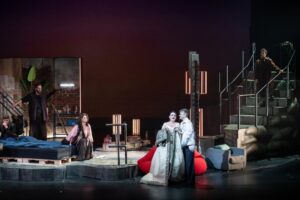
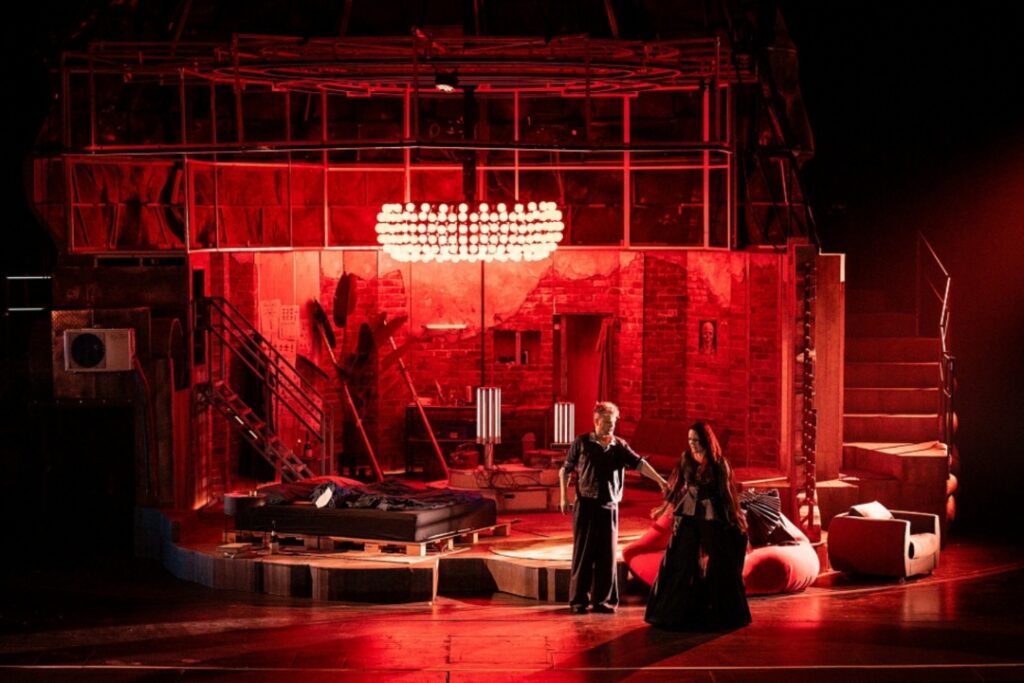
After a month-long closure for renovation works, the Latvian National Opera reopened its doors shortly before the end of the summer season with Puccini’s “La Bohème.” For this return to the stage, the National Opera presented Laura Groza’s production, which reimagines the opera in a dystopian future through a visual language that may recall Blade Runner (1982). Colors and lights abound in a reality that finds the protagonists of Puccini’s drama somewhat lost. This highly visual aesthetic is also infused with elements of contemporary life, as can be seen in the first act, where Mimì approaches Rodolfo in his apartment asking for a phone charger. Likewise, during the aria “Mi chiamano Mimì,” she introduces herself while showing photographs on her mobile phone to Rodolfo.
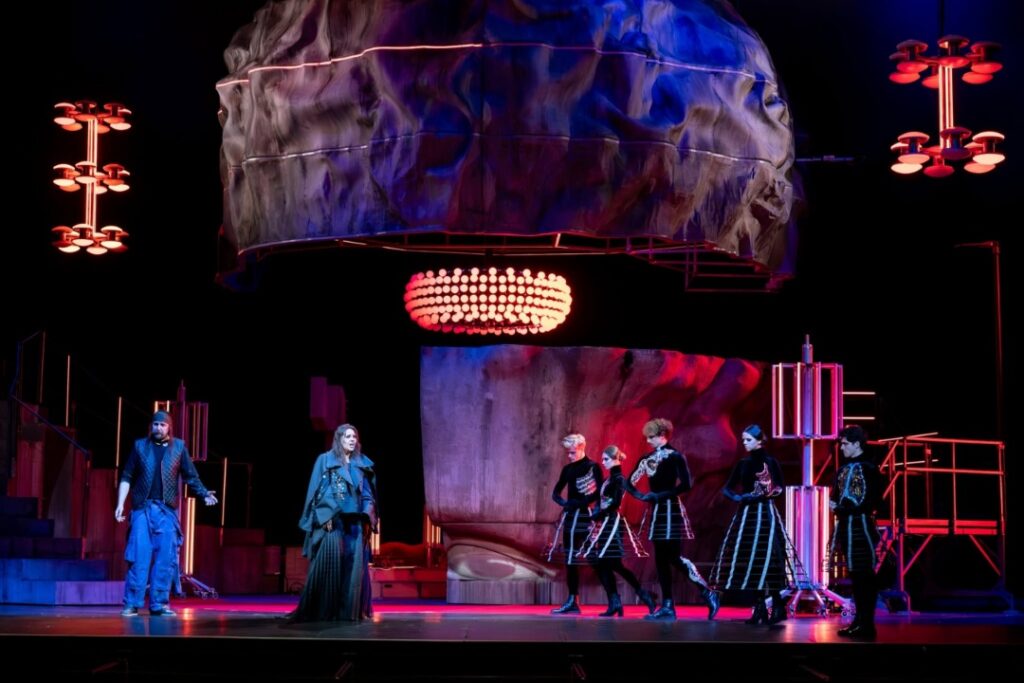
The production reduces its visual intensity in the second act, where the drama comes to dominate the stage more than the previous chromatic spectacle. Particularly interesting was the concept of representing Mimì’s illness through a small group of dancers physically embodying its progression. In the second act, when Mimì overhears the conversation between Rodolfo and Marcello and learns of her illness, the dancers gather around her in convulsive movements, depicting with remarkable precision the anguish that overwhelms her. Perhaps one of the most interesting moments from a theatrical standpoint.
However, taken as a whole, the production resembled a glimpse into a fashion show, prioritizing the eye-catching visual effects of French set designer Fabien Lédé and costume designer Fjodors Podgornijs over the emotional and dramatic essence of the drama itself. The drama appeared to function as a justification for a scenic concept of a very different nature from that of the libretto, one that neither contributed to the dramatic development nor achieved genuine cohesion with it.
(Photo: Latvian National Opera press)
Musical Direction
Musically, the performance was conducted by Maestro Arvo Volmer. The orchestra began with a precise interpretation, with tempi that were at times rather agitated. The woodwind and brass sections distinguished themselves through an impeccable execution of the opening passages of the score, responding confidently to the conductor’s chosen pace.
However, on a broader level, there was a noticeable disconnect between pit and stage. The orchestra, clearly well prepared, did not move together with the singers, and these disconnections weakened one of the key elements of Puccini’s musical language: rubato. This was especially evident during the first act, and particularly in the duet between Mimì and Rodolfo, where one could sense the constant effort to fit the vocal lines into the corset of a relatively stable and conciliatory tempo. This created a persistent sense of discomfort, resulting in moments that felt overly rigid, where the singers never seemed fully comfortable within the pulse. The lack of a flexible atmosphere for the performers prevented the development of a truly living rubato and, consequently, of a fully expressive Puccini. Maestro Arvo Volmer did commendable work in attempting to keep the singers together and bring order to the musical material, but the final result was not entirely successful.
During the second scene, following Musetta’s aria, the tensions between stage and pit were further increased by the addition of the chorus and children’s chorus, resulting in several ensemble displacements that were quickly corrected. Fortunately, by the second act a greater degree of musical solidity had emerged. By reducing the visual impact of the costumes and scenery, the staging seemed to encourage a stronger focus on the essence of the drama, allowing part of Puccini’s tragedy—which until then had remained partially obscured—to be reconstructed. Likewise, a more fluid and organic dialogue began to emerge between the orchestra and the cast. Probably one of the most authentic and pure moments of the evening was the duet between Marcello and Mimì.
The overall impression throughout the opera was that the drama was represented, but it was not alive. The performance fulfilled the basic musical requirements, but the drama itself did not breathe; and as a sine qua non condition, it failed to produce a genuine emotional impact under the weight of the tragedy.
(Photo: Latvian National Opera press)
Cast Highlights
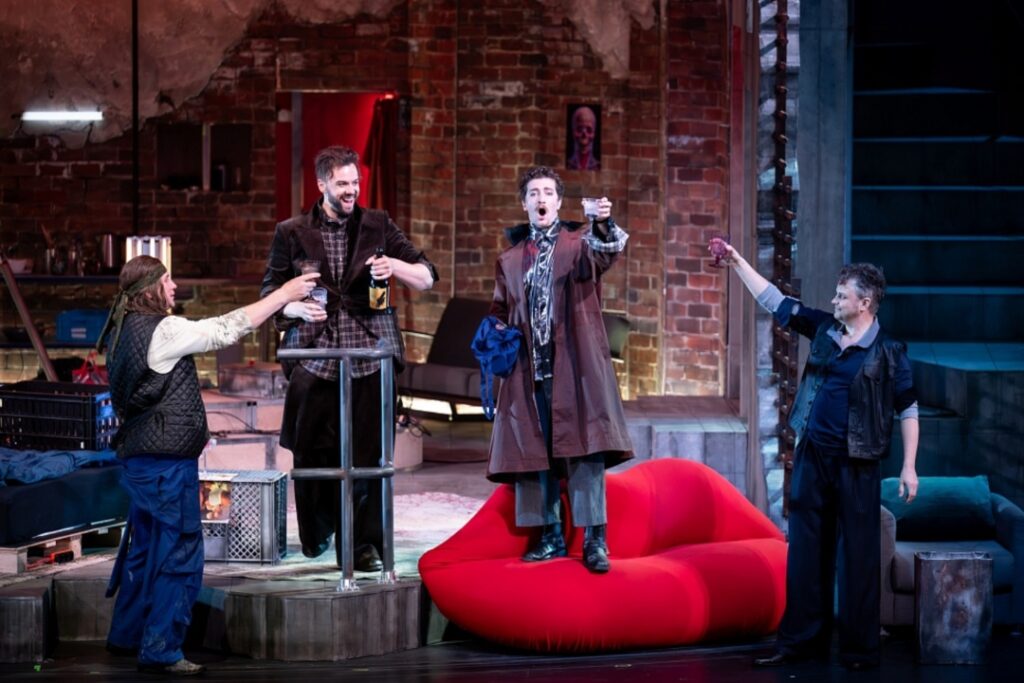
Special mention must be made of Daniils Pogoriless as Schaunard. Possessing great charisma and stage presence, the baritone dominated the role vocally with solid projection and presence, achieving an excellent balance between his theatrical instincts and the vocal demands of the part.
Bass-baritone Rihards Mačanovskis stood out in the ensemble scenes with the Bohemians and especially in the final scene, thanks to a dark-toned voice and effective phrasing.
Jānis Apeinis‘s Marcello was responsible for one of the most remarkable moments of the performance. His second-act duet with Mimì offered something that had been largely absent during the previous act: a genuine balance between the two voices. With good projection, solid phrasing, and a moderate yet effective rubato, the drama finally seemed to awaken during this passage and in the subsequent interventions of the Latvian baritone.
Latvian soprano Katrīna Paula Felsberga delivered a convincing interpretation of Musetta, displaying assured stagecraft throughout. However, the overall context of a stage concept that contributed little to the dramatic development, together with the previously mentioned musical tensions, seemed to affect the singer as well, preventing the character from fully unfolding in all her extroversion.
Vocally, she offered an attractive timbre and vibrato, characterized by a rounded emission and well-executed coloratura passages. Nevertheless, as was the case with several members of the cast, her vocal projection never fully established itself in the hall, as the balance with the orchestra did not always feel organic, preventing the voice from fully asserting itself at times.
(Photo: Latvian National Opera press)
More Cast Details
Ukrainian tenor Dmytro Popov experienced a somewhat troubled first act. In terms of vocal projection, his voice seemed to remain “veiled” throughout much of the act, creating difficulties in projecting over the orchestra and also generating a degree of imbalance in his duet with Mimì.
Likewise, his musical performance did not show its strongest form during the first part of the opera. During the opening duet he often appeared to follow a tempo of his own, and in climactic moments such as “O soave fanciulla” he encountered some intonation problems. However, by the second act his relationship with the orchestra improved considerably, both in terms of tempi and vocal projection, resulting in an enjoyable portrayal of Rodolfo for the final section of the Opera.
Latvian soprano Inga Šļubovska-Kancēviča as Mimì was, without a doubt, the vocal pillar of the performance. With clear projection that consistently rose above the orchestral texture, a rounded timbre, and remarkable vocal skill, she shone throughout the evening.
Despite the previously mentioned issues of tempo and coordination between pit and stage, which limited the dramatic development of the lines in “Mi chiamano Mimì,” the soprano sustained the character with great assurance. Particularly effective was her interaction with the ballet ensemble during the depiction of the progression of Mimì’s illness, an element that contributed significantly to the dramatic construction of the character.
She concluded the opera with a convincing final scene, immersed in the delirium of her final moments of life. The audience’s ovation served as a deserved acknowledgment of the soprano’s contribution, which brought a distinct dramatic dimension to the production.