Komische Oper Berlin 2026-27 Review: Lear
Barrie Kosky Strips Reimann’s Masterpiece to Its Brutal Essentials in Tempelhof’s Hangar 4
By Zenaida des Aubris(Photo: Monika Rittershaus)
There are operas that survive their period, and others that somehow seem to grow into it. Aribert Reimann’s “Lear,” which received its world premiere at the Bavarian State Opera in Munich in 1978—a performance I attended—belongs emphatically to the latter category. Nearly half a century later, its music has lost none of its capacity to disturb. If anything, the work sounds more formidable now: a study of power casually relinquished, desperately reclaimed and finally annihilated.
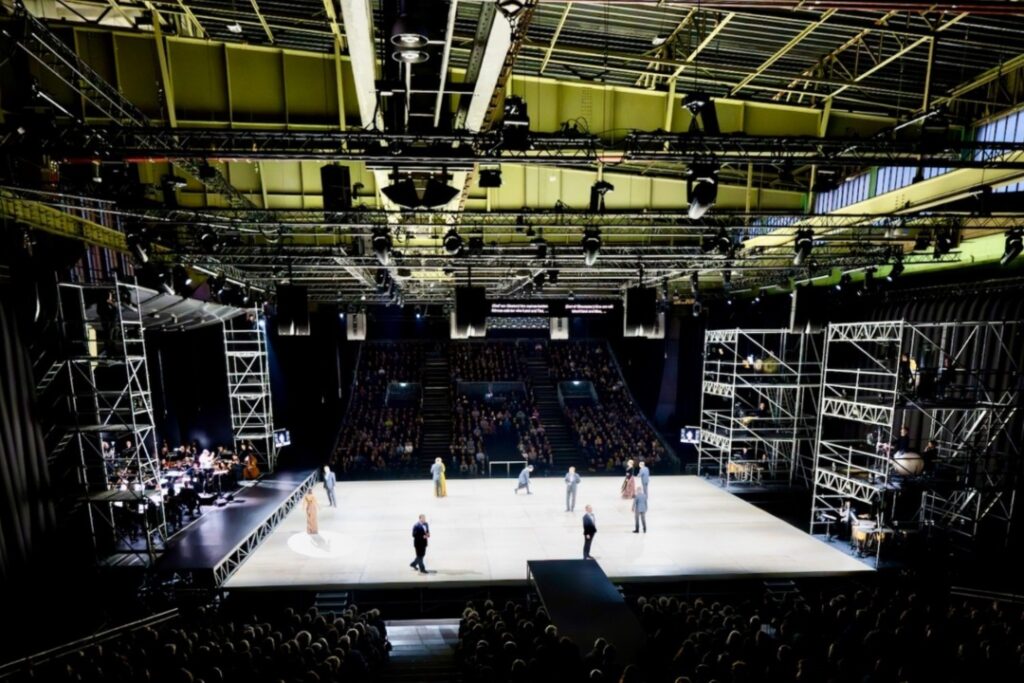
For its season-opening new production, the Komische Oper Berlin returned to Hangar 4 of the former Tempelhof Airport for the fourth production there. This cavernous space is hardly a theater at all. Each production has to create one from scratch: grandstands for some 3,000 spectators, stage, orchestra area, lighting, sound and backstage infrastructure. All performances here require amplification. Yet its technical teams have clearly learned how to turn the building’s potentially problematic dimensions into theatrical assets.
Barrie Kosky and set designer Rebecca Ringst placed a vast white square at the center of the hangar, with the audience facing each other from grandstands on either side. The orchestra occupied one end; at the other, two tall towers accommodated Reimann’s formidable percussion battery. The arrangement transformed the spectators into something resembling a public assembly, an idea Kosky explicitly invokes in the program book: Lear addresses not some imaginary court but, in effect, us.
There was almost nothing else.
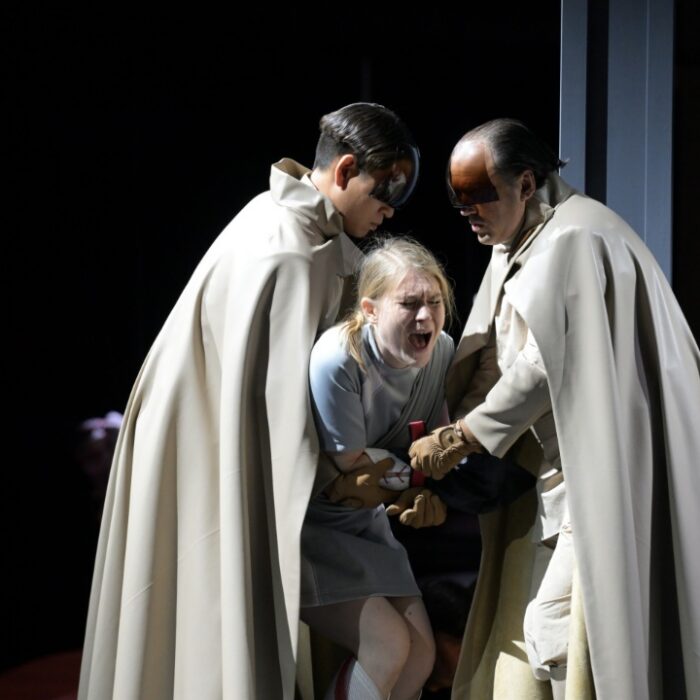
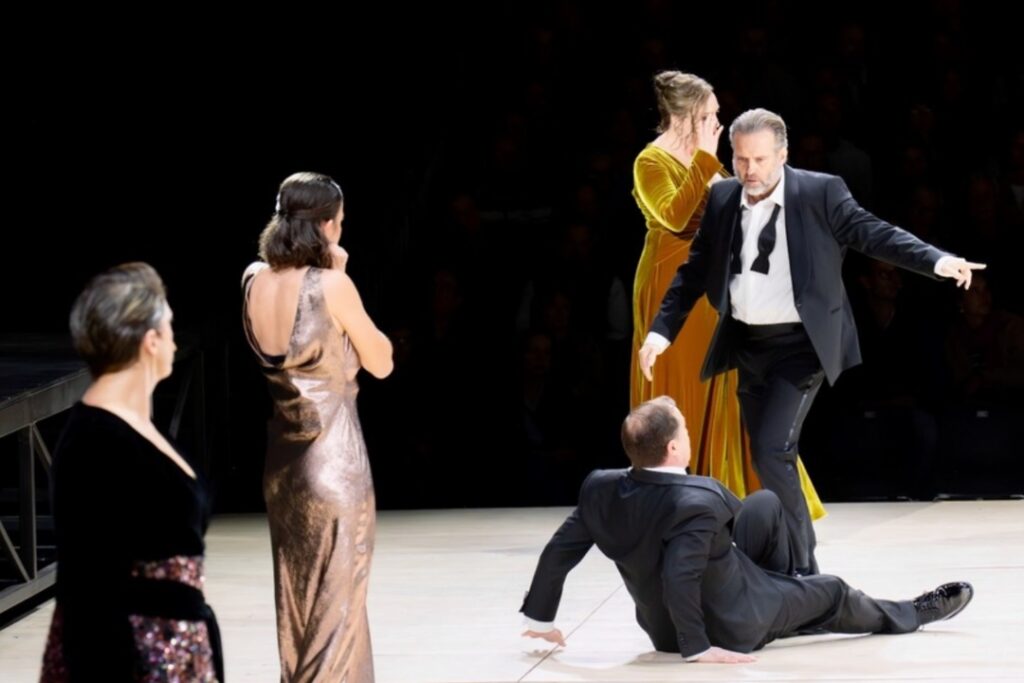
Ringst supplied chairs and movable catwalks that became, as required, tables, pathways, barriers and pedestals. Klaus Bruns’ costumes did most of the work of locating the drama in the present. Lear’s family initially appeared in the polished black-tie uniform of contemporary privilege. By the final confrontation, evening dress had given way to military garb, while Lear himself had travelled in the opposite direction: from immaculate authority to physical exposure, filthy rags and near-nakedness.
Kosky began with geometry. Each daughter occupied her own corner of the white square, as though Lear had already converted family relationships into territorial holdings. The symmetry was almost reassuring. Then Cordelia said no.
That refusal is the fissure from which the entire tragedy opens. Kosky describes Cordelia’s “Nothing” as tearing a small hole in the wall of Lear’s reality, allowing everything concealed behind it—rage, denial and madness—to escape. Onstage, the effect was strikingly simple. Once Cordelia refused to participate in her father’s grotesque auction of affection, the clean geometry began to disintegrate. Territory, family and emotional order collapsed together.
(Photo: Monika Rittershaus)
A Lear for Our Time
Scott Hendricks’ Lear did not begin as a frail old monarch staggering toward mortality. He entered as a confident, vigorous ruler, magnanimously carving up his kingdom and distributing it to his daughters with appropriate ceremony. Kosky makes him a modern tycoon at a shareholders’ meeting: a man in his 50s or 60s who has accumulated enough wealth and simply wants to hand over the business so he can enjoy himself. He is accompanied by the Court Fool, brilliantly embodied by Dagmar Manzel, who, by the very juxtaposition of her body language and movements made Lear’s grand gestures more easily relatable.
That conception made Lear’s error more interesting. This was not initially senility or madness. It was arrogance: the assumption that power could be surrendered administratively while its privileges, deference and emotional authority remained intact.
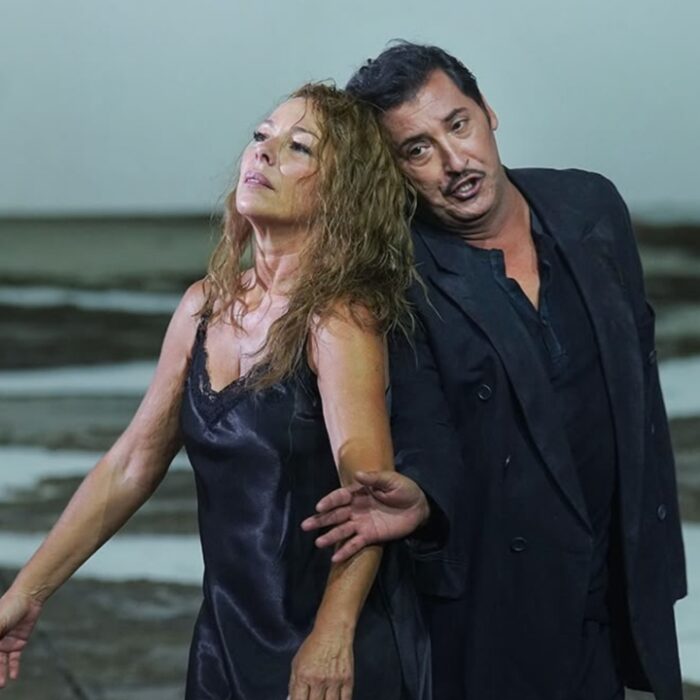
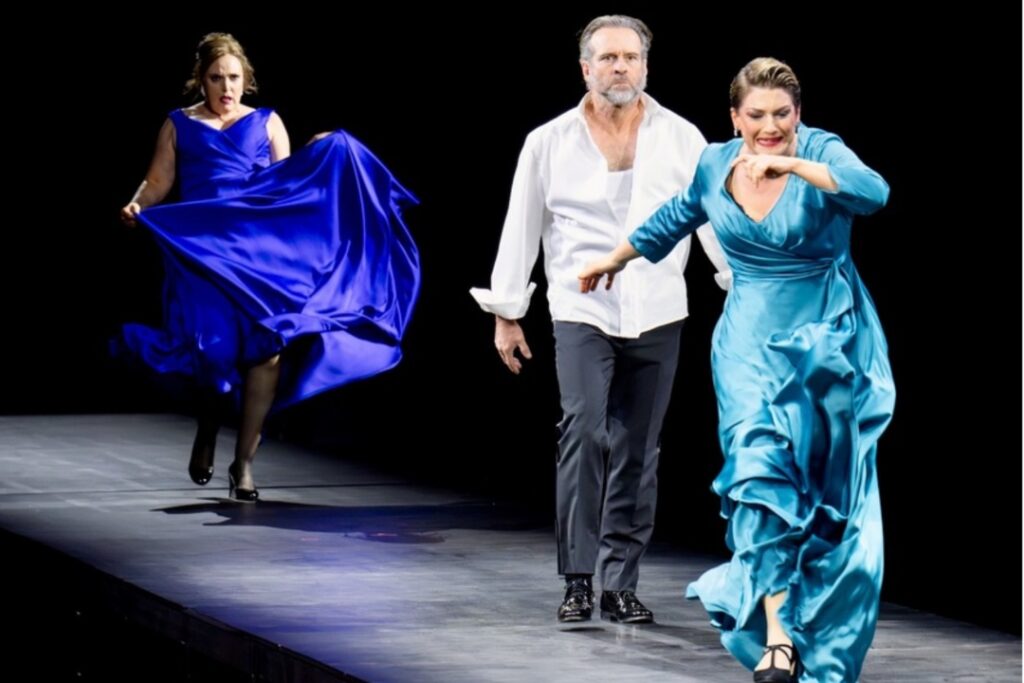
Rosie Aldridge’s Goneril and Nicole Chevalier’s Regan accepted their portions of the kingdom while already suggesting that possession might not be enough. Kosky resisted reducing them entirely to fairy-tale monsters—indeed, he acknowledges that Reimann gives the sisters less psychological dimensionality than Shakespeare does. His production instead differentiated them: Goneril as the controlled inheritor, Regan as the more volatile and sadistic middle child.
Penny Sofroniadou’s Cordelia provided the necessary counterweight. Hers was the most sensitive of the three daughters, but sensitivity did not mean weakness. Cordelia’s refusal is absolute. She will not manufacture an extravagant public declaration of love merely because her father demands one. Lear interprets honesty as insubordination and sends her away to marry the King of France. Only much later did father and daughter find one another again. By then reconciliation could offer emotional recognition, but no rescue. That distinction matters. “Lear” is not a tragedy because love is absent. It is a tragedy because love is recognized too late.
Of the male voices, Aryeh Nussbaum Cohen as Edgar, Brenton Ryan as Edmund, and Günter Papendell as Gloster distinguished themselves with their scenic and vocal interpretations. Nussbaum Cohen brought particular intensity to Edgar’s transformation into the deranged “Poor Tom,” negotiating Reimann’s exposed writing with an arresting combination of vocal agility and dramatic abandon. The score gives Edgar some of its comparatively lyrical writing, especially once he assumes his alter ego, and Nussbaum Cohen made these moments stand out against the surrounding orchestral violence. Brenton Ryan provided a sharply contrasting Edmund: calculating, restless and dangerous, his incisive tenor and physical presence giving the illegitimate son’s ambition an almost febrile energy. Papendell’s Gloster, meanwhile, acquired increasing weight as the tragedy unfolded. His firm baritone gave way to a moving vulnerability after Gloster’s blinding, and his encounters with the disguised Edgar brought an affecting human intimacy to a work otherwise hurtling toward destruction.
(Photo: Monika Rittershaus)
Reimann’s Orchestra as Protagonist
Reimann and his librettist Claus H. Henneberg compressed Shakespeare into 11 scenes, preserving the play’s essential familial architecture while allowing music to carry much of what had been removed from the text. The result remains remarkably strong.
Reimann’s language is certainly not melodic in any conventional operatic sense. Yet to describe “Lear” simply as dissonant is to miss its theatrical intelligence. The vocal writing translates emotional states—hurt, fury, humiliation, vengeance, terror—into musical gesture, while the orchestra supplies something larger: the forces surrounding and eventually overwhelming the characters.
Kosky goes further, describing the orchestral landscape as a character in itself, even as “nature” filling the void left by the striking absence of mothers from Shakespeare’s drama. Whatever one makes of that interpretation, the production demonstrated the first proposition decisively. The orchestra did not accompany “Lear.” It acted upon it.
Nicholas Carter held together Reimann’s enormous apparatus with impressive control, no small feat in a space where orchestra, singers and percussion were physically separated by considerable distances. The latter is an arsenal in its own right: bongos, tom-toms, wood and temple blocks, slit drums, gongs, tam-tams, bronze plates, metal foil, bass drum and much else besides.
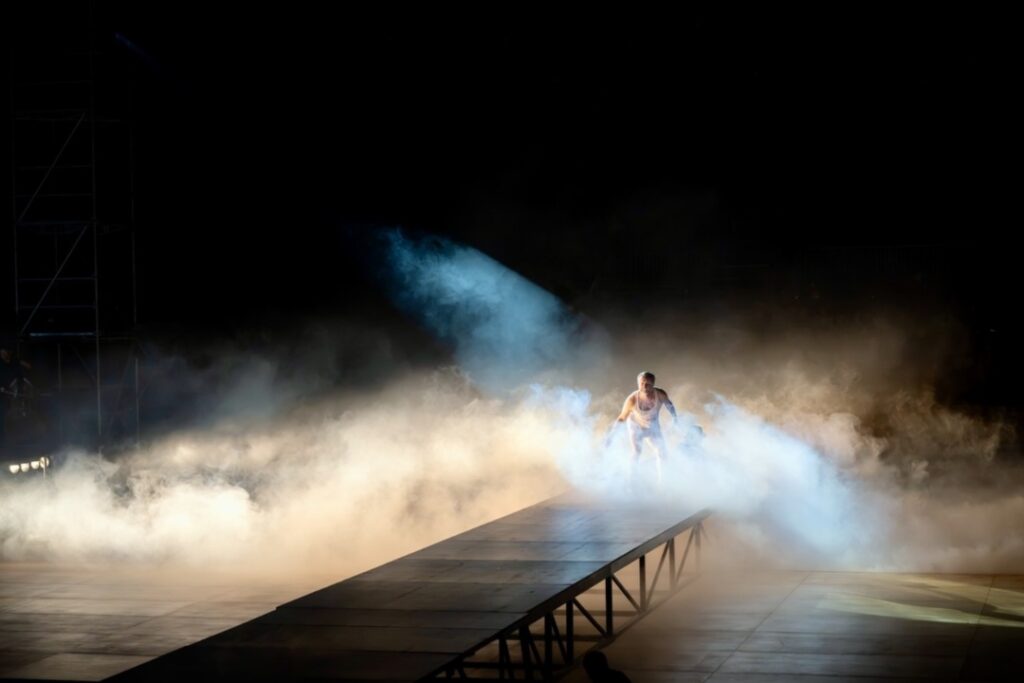
In the storm scene, all of this ceased to be orchestral color and became an event. Reimann constructs the passage as a vast crescendo until the distinction between meteorological violence and Lear’s internal collapse disappears. Carter himself describes the storm as taking place as much inside Lear’s head as outside it. In Hangar 4, with the percussion elevated in towers and sound arriving from different directions, the audience was not so much listening to the storm as sitting inside it – with endless wafts of fog enveloping stage and audience alike. That is precisely where the otherwise problematic Tempelhof space justified itself.
(Photo: Monika Rittershaus)
Nothing Comes of Nothing
Kosky’s radical visual economy also prevented the historical associations of Tempelhof from being illustrated too insistently. The monumental building carries its own history of state power, war and collapse; there was no need to decorate it with additional symbolism. Instead, the blank white square became progressively more contaminated by human behavior.
The evening moved from ceremony to chaos, from evening dress to military uniform, from possession to dispossession. The confident patriarch who began by allocating corners of his kingdom ended with nothing—not even the daughter whose love he had once been incapable of recognizing.
Reimann understood that the cruelty of Lear does not require musical beautification. His score can be abrasive, dense and brutally loud, but it is never dramatically indifferent. At the end, after all that sonic violence, the music retreats into pianissimo. Lear himself becomes almost an echo, dissolving rather than concluding. That final withdrawal was devastating precisely because of everything that had preceded it. Hangar 4 had spent the evening magnifying Reimann’s world—the percussion, the distances, the isolation of bodies on the enormous white square. Then the sound ebbed away.
Forty-eight years after its Munich premiere, “Lear” no longer needs the defensive designation of “contemporary opera.” It has become what few operas written in the second half of the 20th century have managed to become: repertoire. The Komische Oper’s production made a persuasive case for why. Reimann did not merely set Shakespeare to music. He found a musical language for the terrible distance between power and love—and for the moment when a man who believed he possessed everything finally understands what his possession has cost him.
(Photo: Monika Rittershaus)