Internationales Bachfest Hamburg 2026 Review: J.C.Bach’s ‘Amadis de Gaule’
By Mengguang Huang(Photo: Swanhild Kruckelmann)
Gallic Grandeur, Tepid Text: An Unbalanced “Amadis” at the Internationales Bachfest Hamburg
The Internationales Bachfest Hamburg, now in its fourth edition, marks an intriguing evolution in the festival’s identity. What began as a focused tribute to the Hamburg Bach, C.P.E. Bach, has drifted toward a broader celebration of the collective Bach family legacy. The centerpiece of this year’s program—a rare performance of Johann Christian Bach’s “Amadis de Gaule”—was a welcome ambition. However, as the evening unfolded at the Elbphilharmonie, it became clear that this was an unbalanced affair: while the performance was a technical and stylistic triumph for both the orchestra and the chorus, the contributions of the four soloists were notably uneven, ultimately resulting in a missed opportunity for true dramatic depth.
Vocal Struggles: The Textual Deficit
The central challenge of “Amadis” lies in its hybrid identity. J.C. Bach, the youngest son who famously “Italicized” his style, was invited to Paris in a bold attempt to navigate the treacherous waters of French tragédie lyrique. The work rests on the delicate Bel Canto grace J.C. Bach infused into the rigid French framework. The libretto, adapted by Alphonse Devisme from Philippe Quinault’s 1684 original, sought to balance Baroque Magic with burgeoning Enlightenment Sentiment.
It was precisely this delicate balance that the vocal soloists struggled to maintain. While the quartet remained technically secure, they failed to project the full visceral narrative of the text. Here, the delivery too often prioritized vocal safety over the chiseled articulation required for French declamation.
Lenneke Ruiten as Oriane offered a dramatic portrayal that felt occasionally inconsistent. Her performance reached a zenith in Act three scene four where her expression of grief and shock over Amadis was truly superb. Earlier, in the second scene, her delivery of Oriane’s repetitive murmurs and creeping self-doubt felt remarkably authentic and moving. However, this sensitivity to the text vanished during the long confrontation with Arcalaus in the same act. Despite a libretto dense with exclamation marks and high-octane emotion, the recitatives in this pivotal scene lacked infectious energy and remained lukewarm.
As the title role, Ilker Arcayürek provided a bright, warm timbre that suited the score’s lyrical demands. His Act one quest for Oriane carried a poignant resonance, strongly recalling the mythical search of a Monteverdian Orpheus. He was equally successful in the jubilant, festive resolution of the finale. Yet, throughout his complete psychological arc, his Amadis felt static and overly passive—a protagonist to whom things happened rather than one driving the plot. Consequently, his dramatic presence was often eclipsed by the sheer authority of the antagonist, Arcalaus.
Julia Sophie Wagner as Arcabonne was similarly uneven, hampered by a slightly soft vocal tone for the role’s formidable demands. While she found her stride in Act two scene two, conveying a potent blend of fury and lamentation supported by the brass, her momentum dissipated in the subsequent scenes. Her lengthy dialogues to her brother failed to communicate Arcabonne’s profound inner doubt. Most disappointing was her confession of love to Amadis: what should have been a shocking revelation was rendered rhythmically uniform and devoid of dramatic flair.
Opposite her, Krešimir Stražanac provided a more formidable Arcalaus. Though his fraternal authority was tentative at the start, his summons of the monsters was a vocal triumph of robust volume and grit. However, the dramatic effectiveness was undermined by a lack of chemistry in the Act three recitatives with Arcabonne; the explosive sibling confrontation remained tepid, failing to translate the shock of Devisme’s text into a visceral theatrical moment.
Orchestral Mastery and Choral Excellence
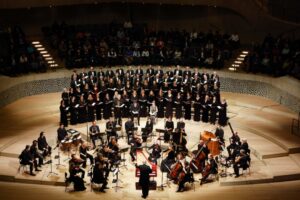
In contrast, the B’Rock Orchestra proved the evening’s most vital asset, capturing the Gallic spirit with impeccable, dignified taste. Under Hansjörg Albrecht, the ensemble reflected the opera’s emotional stakes—fury, hesitation, and self-doubt—with support that was intense but never exaggerated. The strings were particularly vibrant, with a fluid energy transfer between violas and violins, while the highly controlled woodwinds and brass provided a solid foundation without excessive heaviness.
The CPE Bach Chor Hamburg was equally impressive, navigating energetic fugal passages or the more homophonic styles, their execution was stylistically spot-on. However, a missed opportunity lay in the staging: the choir was visible from the outset, stripping away the mysterious invisibility in some scenes requested by the libretto, in which the detailed original stage directions were absent from the provided German libretto. In the Elbphilharmonie, where partitions are porous open-work, the production could have utilized the unique spatial acoustics to achieve a haunting, audible-yet-unseen effect.
Final Thoughts: A Festival in Transition
Evaluating the Internationales Bachfest Hamburg as a whole, it is difficult to ignore a sense of thematic drifting: the current programming feels diluted by some peripheral events tenuously linked to the core mission. This places a heavy burden on centerpiece productions like “Amadis” to define the festival’s core theme. Unlike the rigid binary structure of Italian opera seria—which often separates action (recitative) from emotion (aria)—French tragédie lyrique demands a seamless integration of the two. In this tradition, J.C. Bach’s Parisian opera demands a seamless integration of singing and emotion that requires more rigorous textual excavation than was evident here.