Innsbrucker Festwochen der Alten Musik 2026 Review: Il trionfo del Tempo e del Disinganno
By Mengguang Huang(Photo: Amir Kaufmann)
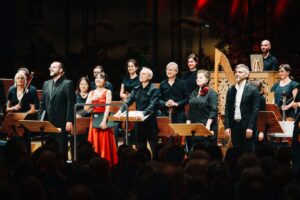
What was originally billed as a grand homecoming concert—part of the Innsbruck Festival’s 50th-anniversary celebrations, which, much like with former music director Alessandro De Marchi, was set to mark the return of René Jacobs alongside his loyal musical partners and the Freiburger Barockorchester—ultimately met with a shift that brought a note of poignant regret to his many devoted followers. With Jacobs unable to perform due to health reasons, his long-standing collaborator, conductor Attilio Cremonesi, stepped into the breach to take the helm.
The setting was the Großer Saal of the Haus der Musik, positioned directly opposite the historic Hofburg palace. The hall’s striking stage background—a vast, two-tier glass wall—framed a view of historic architecture and large trees outside, while its western exposure captured the serene glow of the summer sunset.
This program is familiar territory for the orchestra and soloists alike: Jacobs toured the work with Sunhae Im back in 2018, while the two sopranos and tenor participated in another European and Asian tour last year. Yet, for devoted followers, a shadow of apprehension hung in the air. In our era of ubiquitous digital memory, we inevitably compare live events against past, near-perfect performances stored in our mind’s ear—a dynamic that inherently heightens the tension between expectation and reality.
Illuminating Musical Performances
That anxiety proved entirely unfounded. Cremonesi proved to be a conductor both humble and resolute. Well aware of Jacobs’s towering legacy and the audience’s high expectations, he delivered a deeply sincere address after the final notes, wishing Jacobs a swift recovery. Yet Cremonesi brought a clear vision of his own. The Italian maestro sculpted an interpretation of Handel’s early Roman masterpiece—originally premiered in the aristocratic private palazzi—that crackled with compelling tension. His approach swung masterfully between two poles of dramatic theatricality and the intimate elegance of a fine chamber cantata.
The Freiburger Barockorchester was as breathtaking as always. Aside from a few isolated moments where the woodwinds turned slightly muddy, the orchestra performed near impeccably. From the brilliant dueling violins of the concertmasters to a basso continuo group brimming with inventive passage-work, tasteful fills, and vivid commentary—harpsichord, organ, harp, lute and cello each displayed extraordinary artistry, creating an incomparable aura. Any student of historical performance practice in the hall would have been frantically taking notes on the wealth of detail.
Sunhae Im as Bellezza
Soprano Sunhae Im, a long-time favorite of Jacobs, appears less frequently in Europe these days, but her connection to Innsbruck remains strong, and her popularity across the European audience endures. Dressed in striking red as Bellezza, she took the stage with her signature warmth. For her devoted listeners, the moment she sang, her trademark agile, fluid line was instantly recognizable; despite a touch of initial tightness in her opening aria, she recalibrated swiftly to reach peak form.
In a role she knows inside out, Im charted Bellezza’s psychological journey with directness and clarity, bringing an added sense of relaxed ease, charm, and feminine allure that made the character feel emotionally younger at the work’s outset. Her acclaimed dramatic talents shone through vivid body language and responsive stage gestures—from her initial irritation with the preachings of Tempo and Disinganno to her subtle wavering. Her recitatives were phenomenal, painting vivid atmospheric pictures with supreme textual mastery. Virtually all of her arias proved to be exquisite gems, compelling and deeply rewarding. In the aria “Io sperai trovar nel vero,” her dialogue with the oboe yielded a poignant, winding portrayal of internal turmoil; in “Voglio cangiar desio,” her sighing phrases and sudden emotional shifts left a profound impression. This was a mature artist revisiting familiar terrain with boundless freedom and inner radiance.
Kateryna Kasper as Piacere
Soprano Kateryna Kasper as Piacere made her Innsbruck Festival debut with a daring, risk-taking interpretation. Delivering explosive renditions of the flamboyant arias, she expanded the dynamic contrast between A and B sections of arias considerably beyond last year’s performances. In the da capo (A’) sections, she engaged in radical embellishment—employing chiselled micro-meter changes and sweeping rephrasing—backed by a solid, full-bodied timbre that generated an intense dramatic force. Her psychological portrayal matched Im’s depth: she lured Bellezza with persuasive charm, guiding her across the whole stage to showcase a world of fleeting pleasure.
When she realized her hold on Bellezza was slipping (during the aria “Tu giurasti di mai non lasciarmi”), Kasper poured out her anguish in wide dynamic arcs over the icy, heavily dotted rhythms of the strings, arriving at a choked intensity where speech itself seemed on the verge of breaking down. In the most famous aria recycled later in Rinaldo, her noble delivery and speech-like rhetoric over a brilliant harpsichord accompaniment elevated the music well beyond mere surface beauty. Her exit aria, “Come nembo che fugge col vento”—flanked by the virtuoso playing of the two concertmasters—mirrored the libretto’s tempestuous image of a storm cloud driven off by the wind. Delivering a final, desperate plea that swept through the hall like a whirlwind, it was capped by a flawlessly controlled long crescendo.
The duets between Im and Kasper were a marvel of vocal alchemy—one free and spontaneous, the other solid and lush—bound by a deep artistic synergy and genuine spiritual connection that resonated throughout the hall.
More Vocal Performance Highlights
Tenor Thomas Walker as Tempo successfully shed the slight harshness noted in his performance last year, delivering a more three-dimensional character portrait. Though he retained his foot-stamping gesture in his first aria, he managed to effectively accentuate the darkness of the scene. As the performance unfolded, he moved past simple didactic preaching, infusing the character with a restless drive to persuade Bellezza. In his aria “È ben folle quel nocchier,” he vividly illustrated the turbulent motion of shifting waves.
Countertenor Filippo Mineccia, replacing the originally scheduled Christophe Dumaux, joined Walker in bridging the dramatic and emotional weight of the moral counselors. Mineccia’s approach leaned more operatic, providing a welcome complement to Walker’s more static posture. In his aria “Crede l’uom ch’egli riposi,” supported by delicate woodwinds, he evoked a hypnotic sense of slumber (even if a few pianissimo choices felt slightly arbitrary). During his aria “Più non cura valle oscura,” despite a slightly pronounced breath mark, he captured the vast spatial atmosphere implied by the libretto, creating a genuine sense of consolation.
The quartet of voices, anchored by the orchestra’s grand foundation, sustained long, arched lines that filled the hall, building a palpable psychological pressure around Bellezza without dissolving into clash.
The evening culminated, as it must, in Sunhae Im’s final aria. By then, the sky outside the Haus der Musik had faded into dark blue. Cloaked in a white mantle, Im brought the oratorio to a transcendent close with exquisite restraint and mature authority over the heartbeat-like pulse of the Freiburger Barockorchester.
Beyond individual virtuosity, the performance demonstrated the astonishing expressive force of Handel’s very first oratorio, breathing vibrant, modern life into Cardinal Pamphili’s complex and allegory-laden libretto. Ultimately, the evening was a testament to a group of artists linked by a long partnership with René Jacobs, re-examining a core work in their repertoire to discover fresh possibilities. That artistic willingness to innovate at a mature stage of their careers may well be one of the finest legacies Jacobs has bestowed upon them.