Innsbrucker Festwochen der Alten Musik 2026 Review: Il Pomo O’Doro
Ottavio Dantone Oversees a Production of Cesti’s Extravaganza That Will Echo Down the Years
By Alan Neilson(Photo: Birgit Gufler)
Baroque opera is no stranger to theatrical excess. With its lavish sets, fabulous costumes, spectacular stage effects, and array of mythical heroes, gods and monsters, it could never be accused of understatement. Yet, Antonio Cesti’s 1668 opera, “Il pomo d’oro,” took it all to a new level. This was an opera on a whole new scale, one that pushed all that had come before into the background.
Together with the librettist, Francesco Sbarra, Cesti created a five-act opera, preceded by a substantial prologue, with a running time of over eight hours, in 66 scenes, comprising 47 named solo roles and a chorus. It was originally conceived as a work to celebrate the marriage of Margaret Theresa of Spain to the Hapsburg Emperor Leopold I, but owing to a variety of problems, it was delayed for two years and was instead presented to celebrate the Empress’s 17th birthday.
Such was the scale of the enterprise that a special open-air theater had to be built to accommodate it, and the emperor, who was a keen musician himself, insisted that no expense be spared on the set and costume designs or on its special effects. The enormous undertaking thus became a very expensive one! Over 40 different sets were constructed with complex stage machinery that allowed for spectacular transformations, including collapsing buildings during an earthquake, gods descending from the heavens on clouds, and fire-breathing dragons. The opera moved from the realm of the gods to the darkness of the underworld, from the palaces of princes to ships on the sea. Even by the standards of the time, this was a performance to test the stamina of almost any theater-goer. It was, therefore, decided to add an intermission between Acts two and three and perform it over a two-day period to prevent exhaustion from theatrical overload.
Production Details
To celebrate the 50th anniversary of the Innsbruck Early Music Festival, the company decided to stage Cesti’s extravaganza for its first fully staged production since its Vienna premiere 358 years ago. It also made the wise decision, given a modern audience’s shorter attention span, to stage it over two evenings but with an additional intermission each evening.
Although it was not necessary to build a special theater for the performance, it was still a huge logistical undertaking, requiring 20 soloists, most of whom were required to cover two or three parts, with a chorus and dancers that also had to be integrated into the production, which required a rehearsal period that stretched over two months. There was also the added problem that the music for Acts three and five had been lost. Musical director Ottavio Dantone reconstructed it using existing material from Cesti’s extant operas.
Given the opera’s length, it is probably surprising to learn that the plot is fairly simple. Basically, it amounts to little more than an embellishment of the “The Judgement of Paris” myth, in which Paris presents a golden apple to the goddess he considers to be the most beautiful. Obviously, he was a tad silly to take on such a responsibility, as it was inevitable that he would offend the vanity of the goddesses whom he did not choose and that the consequences would not be pleasant. In fact, Juno and Pallade Athena were extremely unhappy. The earth was plunged into war as a result, causing death and destruction, and worse, a minor upset of domestic proportions in the realm of the gods. Eventually, order is restored when Jupiter, who can no longer bear the squabbling of the goddesses, is forced to intervene. He takes the apple from its current holder Venus and presents it to the Empress Margaret Theresa. Order is thus restored, and the gods return to their business. No harm has been done apart from the death and destruction that has been heaped upon the human race.
Fabio Ceresa & the Production Team Create an Inspiring Staging
It fell to the stage director Fabio Ceresa, along with his team comprising Nikolaus Webern, scenography; Giuseppe Palella, costume design; George Tellos, lighting design; and Davide Riminucci, choreography, to mold this monumental work into a dramatically coherent and visually appealing whole with a clearly developed group of characters, underpinned by a well-thought-through conceptual framework. And they succeeded brilliantly! Not only was each scene sensitively crafted to bring out its dramatic and emotional tensions, it was also carefully developed to promote and support the structural integrity of the work. Moreover, Ceresa proved himself particularly adept in drawing out the full comic potential of the characters and the situations in which they found themselves.
His first decision was to clearly differentiate the world of the gods from that of their earthly minions, the poor humans, who were to suffer the consequences of the gods’ vanity. To this end, Webern created two distinct worlds. The world of the gods was a fantasy world set among the clouds. It was bright, colorful and lavishly decorated, a world that would fit easily with most people’s imagined idea of an airy, classical dwelling suited to the deities of Ancient Greece. Of course, there were a few gods who preferred different living arrangements. Pluto, the god of the Underworld, and his bride, Proserpina, spent their time in an uninviting and menacing cavern to welcome the souls of the dead, while Neptune enjoyed his time beneath the waves in the depths of the seas. The world of the humans was very different. Paris, and his wife, Ennone, lived in a decent-sized and well-equipped but insipid, modern apartment, typical of a middle-class couple, while Alceste and Cecrope, whom Sbarra decided to cast as lovers, which was not the case according to mythology, lived among grim tenement blocks, set in a drab cityscape, which was probably Athens.
Palella’s costume designs were used to accentuate the differences. Generally, the gods were dressed in 17th-century luxurious, aristocratic clothing. Jupiter, for example, had a long curly wig and a yellow tunic with high-heeled shoes that would not have been out of place at the French court of Louis XIV, while the women had long dresses in rich colors. Some of the gods wore costumes to suggest their identity. Mercury, for example, had wings attached to his ankles, and Neptune carried a trident. On the other hand, the humans were attired in uninteresting, dull clothing. Paris wore a range of casual, smart, modern clothes, and his wife had casual tops and dark trousers. Many human characters, particularly from the chorus, wore battle fatigues as they were engaged in the fighting.
The difference could not have been more clearly defined. The gods were representations from another era, namely the Baroque period; they dressed and even occasionally moved like singers on a 17th-century stage. The humans adopted modern attitudes and mannerisms that played down any differences that might exist in their statuses, which was illustrated perfectly in the relationships between the maid, Filaura, and her employer Ennone. One may work for the other, but their relationship was not strictly hierarchical. When the gods were on stage, it was a baroque opera, presented, at least to a degree, in a historically informed manner. But when the humans were on stage, it was a contemporary presentation of life in the 21st century. The audience was exposed to two different worlds. Of course, they often interacted, but apart from the cynical god Momus, who spent his days wandering between both worlds, interacting and commenting on what was going on, the gods usually appeared from above, descending from the heavens on a cloud.
Ceresa used this clear distinction to successfully weave secondary narratives into the work’s dramatic fabric as defined by the primary narrative that was used to drive the opera forward. The shepherd, Aurindo’s pursuit of Ennone had very little directly to do with golden apples or the gods’ squabbles, yet it was neatly elevated to become a discrete story in its own right. Their love story played out without the gods’ interference, although the god Momus could not resist occasional acerbic comment regarding their behavior.
Many scenes took tangential detours, which again Ceresa was able to exploit successfully by relating them directly to one particular world, without the complicating contradictions that would arise in the other. It was not a tedious deconstructionist reading; rather, he embraced the narrative and allowed the spirit of the baroque, with its own values, rules and conceits, to embellish the scenes in which the human world of the 21st century had no place. In Act five, Scene four, for example, Momus and Juno crossed swords, which led to Momus sunning himself on a beach, while Juno, perched on her cloud, poured increasingly heavy torrents of rain on his head, not that Momo appeared to care. Likewise, scenes between Paris and Ennone, set in their apartment, were couched against the drudgery of modern life, which Ceresa successfully enlivened with plenty of comic goings on, for example by accidentally washing and ironing Filaura’s cat. In fact, Ceresa was to successfully exploit the work’s comic potential at every turn, occasionally by referencing current events, as when he had Donald Trump appear at a football match and the referee, the Element of Fire, was forced to show him a red card and send him off! It was a cheap laugh, but the audience loved it.
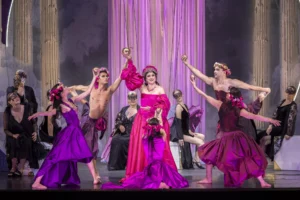
The prologue was used by Sbarra to glorify the Holy Roman Empire by personifying the countries that fell under its dominion: Bohemia, Spain, Hungary and France among others, lined up to praise the qualities of the Empire and its Hapsburg rulers. Ceresa’s masterstroke was to turn it into a beauty pageant so that Miss Sardinia, Miss Bohemia and other countries competed for the title. It was not only amusing to watch the contestants show off their talents and squabble with each other as they competed to be crowned its winner, but it also imaginatively integrated the prologue into the fabric of the opera. In the final scene the gods and goddesses gather together to observe how Jupiter is going to solve the problem of the golden apple. His solution was to strip Venus of her award and hand it to a new winner, Miss Europe, who is draped in the flag of the European Union. The golden apple thus is able to unite the European countries into a single organization; political union and beauty thus combine, and harmony in heaven and on earth is restored. If only reality were so simple!
Dantone Oversees a Dazzling Musical Display
It was the company’s musical director, Ottavio Dantone, who has to be credited with not only the idea of making “Il pomo d’oro” the centerpiece of the company’s 50th annual festival but also of reconstructing the missing music for Acts three and five and preparing the extensive musical forces required to bring the work to the stage.
In his role as the conductor, Dantone elicited a fabulous reading from the Accademia Bizantina, in which the musical momentum was always aligned sympathetically to the onstage drama and characterized by a lively elegance, textural clarity and sensitivity to the emotional quality of the text.
One of the most impressive aspects of the performance was the consistency of the soloists. From the more well-known to the relatively new, each singer produced sensitively crafted performances of a high quality, uninhibited by the fact that many had to present themselves in two or even three significantly different roles. However, whether cast in a single major part or numerous minor roles, all engaged enthusiastically and quite brilliantly to create beautifully defined characterizations.
The Vainglorious Gods
The three goddesses vying for the golden apple, Juno, Pallas Athena and Venus, were given larger-than-life, emotionally strong, and egotistical characters that often mixed deep emotions with superficial posturing. The winner, Venus, costumed in a beautiful, red dress, was essayed by soprano Jone Martínez, who in a series of arias produced a dazzling vocal performance, illustrated beautifully by her Act two, Scene nine aria, “Ah quanto è vero,” for which she produced a sensitive, graceful rendition that drew attention to her vocal beauty and ability to adorn the line. In Act four, Scene six, she created quite an impression, positioned among the stars. She showed off her vocal versatility with her attractive embellishments and delightful passages of coloratura.
Mezzo-soprano Sophie Rennert was a particularly haughty, demanding, and often angry and vindictive Juno, as she led the charge against Venus. It is a role that requires a high degree of expressivity and versatility along with the sensitivity to create a strong, nuanced characterization and Rennert nailed it. She possesses a wonderful technique that enabled her to embellish the voice with subtle and bold colorings, introduce neatly placed emphasis and deliver complex lines full of passionate intensity. In Act five, Scene three she allowed her anger and frustrations to boil over at Jupiter’s lack of action in resolving the problem of the golden apple, and it proved to be one of the vocal and dramatic high points of the performance: in a series of recitatives, arias, and ariosos, she unleashed a ferocious tirade against her husband, culminating in her hurling her shoes at him. The frustrations, rage and violence coursed through her voice to create a frightening portrait of a woman on the verge of hysteria.
Pallas Athena, who also happens to be one of Jupiter’s daughters was played by soprano Shira Patchornik, who produced a fabulous picture of an entitled, spoilt goddess, desperate for further accolades and praise. She possesses a versatile, bright, and attractive voice with a stunning upper register, which she used to deliver a series of stunning arias, including the three arias “O mio caro io sono offesa,” “Cosi dunque cosi,” and “Si si pur, ch’alla fine,” all of which focus on her feelings of anger and rage at not being awarded the golden apple. In each case, she gave voice to her obsession with spectacular vocal effects, incorporating spirited passages of coloratura, lively embellishments, and audacious leaps to display her wholly negative emotions of defiance, rage and need for vengeance.
One could almost hear the pain in Jupiter’s voice at having to deal with the three goddesses at each other’s throats. Baritone Giacomo Nanni played the role as a strong, assertive, and confident god, but who preferred to keep a safe distance from family squabbles; he was the brother and husband of Juno, the father of Pallas Athena and of Venus. He made it really obvious that he did not want to be involved in all the nonsense about the golden apple. His delivery of recitatives was secure and forceful and possessed emotional depth, while his arias also displayed an added nimble agility. Nanni was also cast as Aeolus, the keeper of the winds, whom he portrayed as a gangster with his four lieutenants, the four winds, whom he characterized as a proud, swaggering mafioso who loves money.
Soprano Jiayu Jin captured the attention of the audience with her bright, light, and sparkling voice as she danced nimbly across the vocal line with ease and versatility, crafting delicate ornamentations as she went. Whether in the role of the goddess of love, Amore, the goddess of youth and vitality, Hebe, or as the god of the west wind, Zephyrus, her attractive voice lit up the heavens.
Mezzo-soprano Ester Ferraro had the pleasure of setting the drama in motion as Discordia when she cast the golden apple among the guests of party, to which she was not invited. She created a confident, clearly defined characterization of a vengeful, jealous, and vicious goddess, who lived up to her name. Her singing was confident and forceful, exhibiting sensitively placed inflections and the focused use of her colorful palette. There was, however, always an undertone of the comic that raised her characterization above the mundane, which she fully exploited in her essaying of the role of Eufrosine when she arrived on stage very, very slowly riding on the back of a turtle, only to be overtaken by an old woman on a Zimmer frame. She also played the role of Alecto, one of the Furies.
Momus is the god of insults, mockery, and blame. Bass Rocco Cavalluzzi, who was cast in the role, certainly embraced the spirit of the character to its full potential. He was a cynic par excellence; nobody was safe from his criticism, and he enjoyed every minute of it. Often amusing, he had the audience laughing along with his antics and barbed comments, but he was not a sympathetic figure at all. Almost uniquely, he moved freely between the world of humans and gods, interacting with those who crossed his path, and rarely in a positive manner. Most of his comments were for the benefit of the audience, for whom he deliberately hammed up his behaviour to mock those around him. Recitatives were generally more important to his overall impact than his arias, and this showed in his performance. His ability to coat his recitatives with varying degrees of disdain, cynicism, and dismisive contempt was very impressive, and the clarity of their delivery was excellent. Of his many arias, however, very few were particularly notable, and they tended to recount similar negative attitudes and emotions, devoid of positivity and brio, even if they were well-presented. The one exception being his comic rendition of the Act five, Scene four aria “Venga pur fiera tempesta,” in which he defied Juno with his usual show of contempt and bravado that he neatly embellished.
Soprano Neima Fischer made a very strong impression in the role of the Queen of the Underworld, Proserpina, catching the attention with her smooth delivery, clarity of expression, and delightful timbre, which she illustrated beautifully in her opening aria “E dove t’aggri.” She adorned the line with delicate embellishments and a mournful heaviness, she lamented her time spent among the tormented souls of Hades. Later in the performance, she was cast in very different roles. In Act two, as an angry Tisiphone, one as the Furies and in Act four she appeared as a silly, gossiping Aglaia, one of the supposedly Three Graces.
The role of Pluto, Proserpina’s husband and god of the Underworld, was played by bass José Coca Loza, whose authoritative, deep, roughly carved recitatives gave him the necessary gravitas to impose himself while creating the necessary heavy atmosphere that lay heavily over his realm of the dead. His rendition of the aria, “Purtroppo ineguali,” reinforced this image with his dark, heavy phrasing, embellished with a staccato coloratura. As the ferryman, Caronte, in Act two, he played out a humorous scene in which he welcomed the coming war as there had not been many souls passing his way recently. And, in the radically different role of the Priest in Act four, he showed off his vocal versatility, spinning out long lines, beautifully phrased and overlaid with an attractive tone, that stood a long way from his depiction of Pluto.
Tenor Žiga Čopi possessed a pleasing, sweet voice that was able to draw in the listener. Recitatives were neatly developed, and his singing was beautifully embellished with pleasing ornamentations. He was cast as both the god of the south wind, Austro, whom he convincingly portrayed as one of Aeolo’s mafioso lieutenants and as the god Mars, most notable for his tempestuous relationship with Venus, which had a husband-wife dynamic that switched rapidly between love and conflict. This was perfectly captured in their duet “Un simil concetto.”
Countertenor Danilo Pastore, cast in three roles, showed skill in developing distinct characters. He seemed to be really enjoying himself as the god of the rivers, Volturno, posing as one of Aeolus’ mafioso henchmen, as he destroyed a model of the Twin Towers while dressed in an Arab costume. As Pasithea, one of the three graces, he was anything but graceful. He hammed up the comedy and was a suitably furious Megaera. His singing for all parts was energetic, slightly showy, but expressively strong.
Bass Balázs Bán acquitted himself well with a humorous portrayal of Bacchus, a relatively small role, whom he played as a drunk.
Countertenor Paul Figuier was cast in two mythic roles, neither of whom were actually gods. In Act four, Scene nine he made an appearance as the element Fire. It is a small role, yet one with the opportunity to present a nuanced portrait of someone trying to deny a request from power; his fears and the terror he felt were palpable in his voice as he held his ground and pleaded his case in the aria, “No, mia Diva, no, no, no,” which also allowed him to show off his excellent intonation and ability in ornamenting the vocal line. In Act two, Scene four he played the role of the cup bearer to the gods, Ganymede, a young prince that had been abducted by Jupiter. Although a role of little dramatic consequence, it incorporates a quite delightful duet, “Mio re, che favori,” that he sings with Jupiter, in which Figuier and Nanni’s voices combined quite beautifully. Their different colored timbres created an exquisite contrast.
The Humans Suffer as the Gods Squabble
Baritone Mauro Borgioni made a brilliant impression in the role of Paris. In the first Act, he convincingly presented the prince as a loving and loyal husband, devoted to his wife, Ennone. He performed with an emotionally warm and lyrically strong vocal performance. He was a man who walked with a swagger, content with his life. The duets with Ennone were splendidly crafted. Their voices combined beautifully; his attractive, secure, and firm baritone, together with her colorful, expressive, and sensitive alto, wove delicate, intricate, sweet lines that reflected their deep love. His subsequent betrayal of Ennone in Act two was therefore all the more shocking, as he represented himself with the casual nonchalance of a ladies’ man. His aria “O del ben, che acquisterò,” allowed him to show off the romantic quality of his voice as his thoughts turned towards his meeting with Helene. In the role of Eurus, the god of the east wind, one of the gang of mafiosi, he seemed to enjoy himself, toying with the idea of detonating a nuclear bomb.
Ennone was played by mezzo-soprano Mathilde Ortscheidt, who produced a highly emotional reading in which her suffering at being abandoned by Paris was clearly presented. Cesti focused on this aspect and wrote numerous arias interspersed with recitatives that had her repeating this emotion again and again, although with various gradations of pain and from slightly different perspectives. While each aria was beautifully delivered, they did become a little repetitive. Although there was little to choose between them, it was probably her Act five aria, “O perfido, e ingrato,” that most perfectly captured her sense of emptiness, in which she crafted long, baleful, sensitively colored lines to illustrate her increasing depair. Fortunately, her seemingly never-ending outpouring of pain was bookended by the love of Paris in Act one and the love of Aurindo during the opera’s closing Scenes, which allowed her to show off a more positive, brighter side to her singing.
Tenor Alberto Allegrezza could have taken his interpretation of Filaura, Ennone’s maid, straight from a Rossini farce. Showing no deference for anyone, including the gods, he whooped, hooted, and yelped his way through the performance, overreacting and hamming up the comic potential of his character to his heart’s content. He was an early incarnation of a buffo character, which also included passages of quick patter delivery! He enjoyed mocking those around him, particularly Aurindo, who was the butt of many of his jokes, which he often coated with a healthy dollop of cynicism. Although he regularly overstepped the mark, he always managed to retain the audience’s sympathy.
Bass Federico D.E. Sacchi, cast as the sea god Neptune, cut an impressive figure with his sea green costume and obligatory trident. He possessed a voice with a forceful and engaging presence that suited the sea god’s tempestuous nature. However, it was as Cecrops, the mythic king of Athens, that he made his biggest dramatic impact, both as a warrior, fighting to uphold Pallas Athena’s standing, and as a lover to Alceste. His love duet with Alceste, “Cari Affetti,” in which the pair declared their undying love, was an expressively moving piece, although there appeared to be an emotional distance in their voices and he certainly appeared to be more comfortable leading his troops in the aria, “Pugneremo,” backed by an uplifting chorus.
Alceste was given a nuanced reading by contralto Margherita Maria Sala. Deeply in love with Cecrope, she was to suffer greatly by his decision to go to war for Pallas Athena and thus slides into a state of despair, which she gave voice to in the aria, “O sposo, o sposo mio.” However, she quickly rallies and makes the decision to take up arms and follow him to war and defiantly calls upon Pallas Athena to give her the strength to fight in the emotionally powerful aria “O gran Diva de’ guerrieri,” in which her newly discovered passion filled her voice. Sala also performed the relatively small role of the winged messenger Mercury, in which she successfully showed off her fine technique, notably her ability to infuse the voice with contrasting colors and in bringing a subtle expressivity to her singing.
The shepherd Aurindo had no chance of winning Ennone’s love, but despite every obstacle, including Filaura’s brutal mocking, he kept persevering and eventually won her heart. The role fell to the countertenor Rémy Brès-Feuillet, whose delicious phrasing, firm tone, and calm manner were ideal for the part; he suffered his setbacks with a naive determination and rarely overreacted. His recitatives were expressive and emotionally strong, while the arias were underpinned by the beauty of his voice. His Act three aria “Speranze che dite?” in which he mused on the power of hope in winning over Ennone was a delight, showing off his ability to craft delicately adorned lines replete with hopeful inflections.
Countertenor Filippo Mineccia produced a courageous, forceful portrait of Cecrope’s ally, Adrastus, whom he portrayed as a spirited warrior, looking very much like a typical freedom fighter. He possessed a bright, versatile voice that he used expressively to characterize the role, which he illustrated with a joyous rendition of his aria “Or voi donzelle” in which he praised the virtue of a group of women. He was also cast in the small role of Apollo that amounted to little more than a single aria.
The beauty pageant from the prologue, comprising contestants representing countries from across Europe and America, was cast from the soloists. The significant role of the appropriately named Hyman, was also played by Mineccia, who was suitably vacuous, while his sidekick was played by Jin, the goddess Amore.
The chorus, NovoCanto, was given a number of parts, ranging from sailors and soldiers to a variety of accompanying gods. They dispatched the roles convincingly, often with each member acting out an individual part rather than as an anonymous member of the group. Their singing was neatly balanced to complement the soloists and orchestra.
As the final notes of Cesti’s extravagant masterpiece died away and the final curtain fell, one could only reflect on the scale of the enterprise that had just been witnessed, on the ostentatious sets and costumes, on the wonderful music and brilliant singing. The audience roared its approval as the soloists, chorus, dancers, directors, and production staff took their bows. This was theater at its very best and I felt privileged to have been present for one of only three performances.