Innsbruck Early Music Festival 2025 Review: Ifigenia in Aulide
A Standout Performance From Carlo Vistoli Leads An Excellent Cast
By Alan Neilson(Photo:Birgit Gufler)
In 1718, the Venetian composer Antonio Caldara and the librettist Apostolo Zeno premiered their opera “Ifigenia in Aulide” for the imperial court in Vienna to celebrate Emperor Karl VI of Austria’s name day. This summer, over three hundred years since its last staging, the Innsbruck Early Music Festival brought together a stellar cast under the musical direction of Ottavio Dantone for a new, fully staged production, directed by Anna Fernández and Santi Arnal, who refer to themselves as Companyia Per Poc.
The narrative of the opera is set against the background of the Trojan War. Agamennone has killed a deer, sacred to the goddess Diana; even worse, he then went on to claim that he was a better hunter. Offended by his actions, she now seeks revenge by demanding the sacrifice of his eldest daughter, Ifigenia. To ensure he complies, she stills the seas, preventing the Greek fleet from sailing to Troy, which proves intolerable to the Greek army, which is desperate to experience the glory of war, and thus exerts pressure on Agamennone to comply. However, in an unlikely turn of events, it turns out that Ifigenia is not actually Agamennone’s child, and the gods demand the death of Elisena in her stead, who takes her own life.
The simple plot offers many possibilities for emotional outpouring, which is further supplemented by an entangled love interest, in which Elisena, helped by Teucro, is determined to replace Ifigenia in the affections of the hero Achille.
The Directors Present an Imaginative Fusion of Ideas
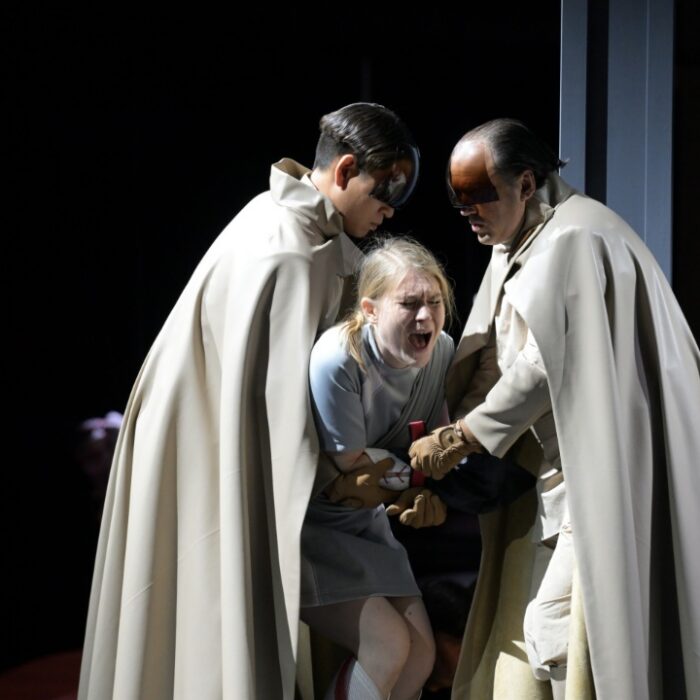
Companyia Per Poc, responsible for the direction, concept and costumes, was aided by set and costume designer Alexandra Semenova, and together they produced a staging that was colorful, active, messy, chaotic, beautiful in parts, insightful yet opaque, and visually gripping at times, although on occasions verging on the ridiculous. At the end of the opera, one had very mixed emotions about their creative ideas. Certainly it was thought-provoking and successfully presented the narrative, but it was not exactly satisfying: there was too much that irritated. The reason behind their presentation was made clear in their program notes, which allowed the reader to at least understand what was being attempted.
At the heart of their vision is the desire to create the ‘magical quality’ that makes a theatrical performance a ‘unique and unrepeatable experience’ through ‘a fusion of artistic disciplines.’ Although music remains at the heart of an opera performance, they aimed to exploit the visual possibilities through ‘set design, costumes, puppets,’ and dance, bringing to the stage a ‘magical and unreal atmosphere’ to ‘elevate the experience.’ They also seek to provide each of their productions with ‘its own aesthetic, a kind of stylish beauty.’ The problem was that there were so many ideas in play that they often jarred with each other and detracted from the overall presentation.
Semenova’s colorful single set was visually attractive, adaptable, and worked very well. It consisted of a large frame decorated with ancient Greek motifs that enabled the cast to enter and exit, with a changeable background used for altering the scene, such as a harbor or a palace. Simple props were wheeled on and off the set. The costumes had a common aesthetic, consisting of modern-day shorts, a woolen-type fleece with classical connotations and an ancient Greek military helmet that differed slightly for each male character. The women wore long robes, mainly in two colors, again hinting at the classical world. If the staging had stopped at this point, it would have looked fairly convincing, if not particularly exciting — but it did not stop!
On top of this background, Companyia Per Poc piled on their ideas, in which some were more successful than others but together were, at times, chaotic and irritating. Dancers, dressed in modern casual sportswear, appeared during set changes and sometimes accompanied the singer during an aria. Their purpose appeared to be nothing more than to stimulate the senses and add to the spectacle. Cardboard animals that looked as if they had just jumped out of a cartoon booklet chased each other across the stage, held by the dancers, obviously in a reference to the hunt. It looked absurd. Then there was a beautiful model of a peacock and colorful birds on poles, again held by the dancers, flapping around a fountain. Often stagehands, in modern dress, would walk onto the stage with banners held high and stand rigid as the singers performed. At the beginning of Act One, there were two tents positioned onstage in which the light allowed a shadow play to take place on the canvas. And on it went. There was just too much going on to accept, regardless of whether or not each idea in itself was successful.
It was the introduction of puppets onto the stage that was the most controversial. Elisena carried around a three-quarter life-sized puppet of herself dressed in the same costume. Even when singing, she was twirling her puppet about. Its appearance could not be ignored! None of the other characters had a puppet during the first half of the performance, and it set the mind racing in different directions in an attempt to discern a meaning. In the second half, Ifigenia and Clitennestra each received their puppet. None of the male characters did, and the thoughts multiplied. It did eventually become clear that it was the goddess Diana pulling the strings. But why did Agamennone not have a puppet? Was he not also a victim of the goddess’ whims?
It was all just too much to take in during one sitting of a work that no-one in the audience had seen staged before.
Dantone Oversees Brilliant Interpretations from the Singers and the Orchestra
Dantone produced a detailed, elegant performance from the Academia Bizantina, which possessed a pleasing textural clarity and rhythmic vitality that was closely attuned to the emotional and dramatic qualities of the score and successfully promoted the singers’ excellent interpretations.
Ifigenia is a character rocked by extreme events that would plunge even the most balanced human being into emotional turmoil. Soprano Marie Lys brilliantly captured the full depth and range of Ifigenia’s emotions in five beautifully and sensitively crafted arias. In the Act One aria, ‘Addio, infido: addio per sempre,’ for example, she unleashed passages of frantic coloratura and heavily accented lines while coating the voice with a veneer of anger as she vented her feelings of anxiety and rage at Achille, whom she believes has betrayed her. In a very different aria, she voiced her deep sadness and pain at having to say farewell to her father with a moving rendition of the Act Three aria ‘Più del cielo, e più del fato,’ in which she forgives him and tries to free him from his torment. Throughout her emotional rollercoaster, Lys rarely allowed the emotions to boil over, ensuring that Ifigenia retained her dignity throughout.
It was a splendid performance. However, the role of Ifigenia was not one that offered Lys many opportunities to show off her vocal talents to the full. Maybe with the exception of the aria ‘Addio, infido: addio per sempre’ and the prologue, dedicated to Emperor Karl VI, there were few occasions in which she could indulge in the vocal effects in which she excels, and which are always a delight to the listener.
Countertenor Carlo Vistoli’s rugged and swarthy appearance, along with his noble bearing, made him perfect for the role of the warrior hero, Achille, for which he produced a standout vocal performance. Vistoli possesses an expressive, versatile voice that is comfortable singing dramatically powerful music, requiring strong dynamic and colorful contrasts, heavy accenting of the vocal line, and emotional force. Yet, he is equally adept at singing lyrically attractive music, in which the focus is on the beauty of the melody. His recitatives were expertly crafted to bring out their full meaning along with their musical quality, which managed to lift them above the drama by providing them with an aesthetically pleasing aspect. Likewise, his arias were beautifully delivered, catching Caldara’s pleasing melodies while bringing out their dramatic importance, which was perfectly exemplified by his rendition of his aria ‘Passerò.’ Having been accused by Ifigenia of betrayal, Achille turns on Elisena and voices his rage in no uncertain terms, as he infused his anger into every word he sang without compromising the aesthetic quality of the piece. His final aria, ‘Sposa, addio: ma questo, o cara,’ was particularly impressive, as it allowed him to show off his fine technique, vocal beauty, and versatility with a bravura coloratura display, detailed ornamentations, and attractive phrasing.
Tenor Simon Vanberg produced an attractively, clearly sung performance as Agamennone, although his interpretation tended toward understatement, which was reinforced by his aloof demeanor. It was easy to sit back and enjoy his interpretation, in which his delicate phrasing and correct presentation lay easily on the ear, but it lacked emotion. He was too passive and seemed content to stay within his comfort zone. Then again, he was the king, and his reading did provide him with the required necessary distance.
The role of Clitennestra is centered almost entirely on her relationship with her daughter, Ifigenia, and it was far more important to her than her relationship with her husband, Agamennone. Given the trials to which Ifigenia is subjected, it is, therefore, no surprise that Clitennestra is a role of high emotion. Mezzo-soprano Shakéd Bar, tasked with playing the part, possesses a distinctive, versatile voice, which she used expertly to develop her character. There was so much to enjoy about her performance, particularly the emotional depth that she was able to bring to her five arias. In Act Three, Clitennestra, in a state of rage, confronts her husband in the aria ‘Preparati a svenar e figlia e madre,’ attacking him for not saving their daughter, who is about to be sacrificed. It was a thrilling piece of singing, in which Bar harangued her husband to act, accenting the vocal line with desperation and anger and unleashing a swirling coloratura. Later in the act, she gives voice to her pain in the reflective aria ‘Ah! Che, se fossi estinta,’ in which her grief-stricken voice rang out. Likewise, her recitatives were carefully rendered to fit her emotional state, which also happened to show off the beauty of her voice.
After her excellent performance in the title role of “Arianna a Creta” at last year’s Innsbruck Early Music Festival, the fast-emerging soprano Neima Fischer returned to play the part of the devious, manipulative Elisena. Fischer possesses an alluring, limpid voice with a wonderful, secure upper register that is able to entrance the listener. While dealing easily and confidently with the demands of the role, her vocal beauty and calm demeanor made it easy to forget Elisena had been corrupted by her desire for Achille and was driven by base impulses. In her first aria, ‘A vista del crudele,’ she used the allure of her beautiful timbre and sensitive phrasing to seduce Teucro into allying himself with her plans, in what was a very convincing rendition. Even when angry, as in her aria ‘Vergogna e dispetto,’ in which she reflects on her vicious behavior, for which she blames her love for Achille, the underlying sense of calm is always present. Her beautiful phrasing, seamless passaggio, sensitive embellishments, and pleasing coloratura all coalesced to deceive the listener into identifying with the sound of the voice rather than the words expressed.
Tenor Laurence Kilsby produced an impressive performance in the role of Ulisse. He has a compelling presence, which allowed him to impose his character onto the narrative. His acting was animated, which he embellished with a flamboyant air. He possesses a well-supported, warm, attractive tenor that allows the beauty of his arias to bloom. In both arias and recitatives, he paid close attention to the meaning of the text, which gave them a depth that a more superficial understanding can often miss, which was perfectly illustrated by his first aria, ‘Veggo gia che ai greci legni,’ in which his clear articulation and sensitive phrasing neatly captured his desire to fight the Trojan foes and bring glory to the Greek army. In the aria ‘È debolezza,’ he showed off his thoughtful approach through his subtle use of dynamic and colorful contrasts and the employment of well-placed accents to fill out the text. Recitatives were expressively strong, well-articulated, and delivered with an imaginative flair.
Normally, one expects to see countertenor Filippo Mineccia playing the role of a single-minded psychopath or a character motivated by evil: roles he is, indeed, very good at interpreting. It was very interesting, therefore, to see him playing the role of the basically decent sea captain, Teucro, who has the misfortune to love Elisena and is seduced into her plans to split Achille from Ifigenia. Any reservations about his ability to play such a role evaporated during his first aria, ‘Non ho cor cosi spietato,’ in which he captured his character’s nature with a sensitively fashioned reading that included a delicately crafted coloratura — very different from his normal delivery — as he reflected kindly on Elisena’s rejection of his love. Although Elisena leads him into some dark areas, which he marked with more animated, forceful singing, he always managed to suggest Teucro’s underlying decency in what was a nuanced and sensitively crafted reading.
Baritone Giacomo Nanni, cast in the relatively small role of Achille’s confidant, Arcade, produced a strong, clearly defined performance, in which he took the opportunity to show off the quality of his forceful, flexible voice. Recitatives were delivered articulately and carried their meaning clearly. Although he had only two arias to sing, both captured the attention with his ability to infuse the line with emotional depth.
Overall, the production had much to offer and can be judged a success on all fronts. True, some of the directorial decisions of Companyia Per Poc were not always successful, but their experimental and imaginative approach had much to admire, which is definitely preferable to a comfortable, safe production that follows a well-trodden path, which may entertain on a superficial level but does little to stimulate reflection. The production will be remembered, first and foremost, for its wonderful music, especially the splendid singing from its excellent cast, overseen by the director Ottavio Dantone.