Finnish National Opera 2025-26 Review: The Morning Star
World Premiere of Fagerlund’s Uncanny Glow of Meaning
By Zenaida des Aubris(Credit: © Ilkka Saastamoinen)
Sebastian Fagerlund‘s new opera, based on Karl Ove Knausgård’s novel “Morgenstjernen” in Swedish or “The Morning Star” in English, inhabits that rare territory where literature, music, and visual spectacle converge to create something genuinely original — unsettling and beautiful at the same time.
Gunilla Hemming’s libretto doesn’t so much adapt Knausgård’s labyrinthine 666-page narrative as distill its essence into a meditation on mortality and transcendence, compressing the novel’s sprawl into just over 30 pages. The story concerns a moment in the lives of ten characters in Bergen, Norway — what Knausgård calls “a chorus of voices.” They all lead ostensibly banal lives, but each is beset by private crises: a career disappointment, a health scare, a crisis of faith, a retreat into gaming or alcoholism. And then strange things begin to happen, in parallel with the appearance of a bright star. The characters start questioning their lives, searching for meaning in their everyday realities. This resonates with a broader cultural Zeitgeist — a collective disorientation that ultimately leaves us wondering what is, or will be, happening to us.
Musical Details
Fagerlund’s score is a study in restraint. The music unfolds with melodious ease, often dreamlike, occasionally veiled in mystery. It is highly relatable, deeply moving, and even uplifting — encouraging in its desire to reach an altered state that mirrors the stream-of-consciousness storyline. For much of the opera’s duration, the composer resists the operatic impulse toward heightened drama, instead allowing his ten protagonists to drift through their interlocking narratives with the same quotidian rhythm Knausgård captures on the page. Only in the final moments does Fagerlund unleash a dramatic crescendo — a surging, ambiguous climax that leaves us suspended between apocalypse and renewal. Is this the world ending, or something new being born? No unambiguous answer is given. But the instrument chosen to give the morning star its voice is telling: a waterphone — a percussion instrument played with a bow, producing an ethereal, high-pitched sound that mingles with the upper register of the strings. The soundscape thus created veers, quietly but unmistakably, toward hope.
It is evident that stage director Thomas de Mallet Burgess has worked extensively with each of the ten protagonists, helping them inhabit the psychological reality of their characters. As he notes, “singing and acting at the same time is a hugely complex mechanism” — and the cast met that challenge with conviction.
Production Highlights
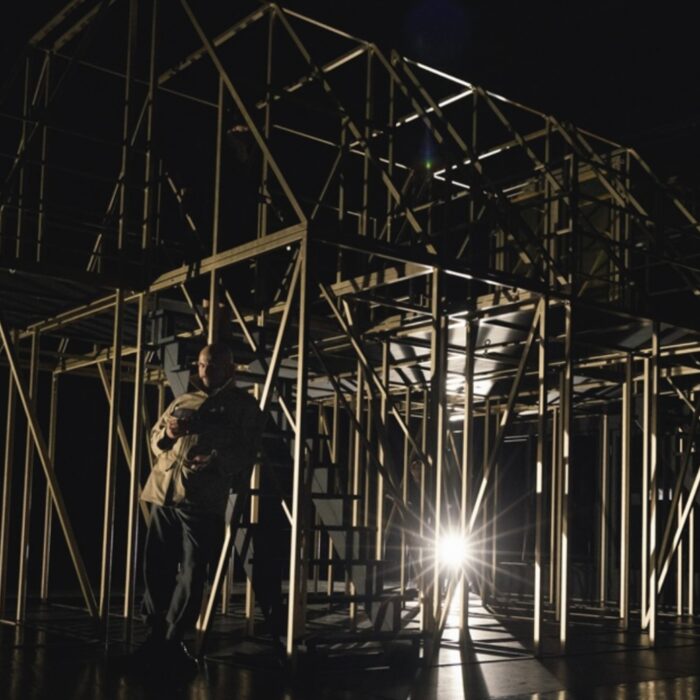
The production design by Leslie Travers achieves a visual poetry equal to the score’s atmospheric subtlety. Travers recreates the boulder-strewn forests of Bergen, but with a disorienting inversion: full-grown trees hang suspended from the rafters, roots reaching skyward, as though we are viewing this world from some other realm entirely. This is not the dark, forbidding forest of fairy-tale menace but something more contemplative, even consoling. Around an inner sculptural, island-like space, a circular conveyor belt bisects the largest boulder — an element that doubles, convincingly, as a clock face, given the centrality of time to the work’s themes. On this moving belt, the protagonists enact their daily routines, trapped in mechanical repetition even as celestial mysteries unfold above them. The device functions both literally — as the treadmill of modern existence — and metaphorically, evoking the cyclical nature of human striving.
Since the story is set in the contemporary world, costume designer Tracy Grant Lord has opted for an informal sportswear aesthetic, with deliberate exceptions: a human-bird figure with an enormous wingspan, inhabiting a liminal, in-between space; an Erda-like woman dispensing prophecy clad in a white toga. And thirdly and most strikingly, a group of children who materialise throughout the opera, functioning as a kind of Greek chorus reimagined for our uncertain age. They question, they observe, and they embody innocence — dressed in white costumes adorned with delicate baby reindeer-like headdresses, creatures poised between the earthly and the ethereal, witnesses to a transformation they cannot yet comprehend. In their presence, we sense the slow disintegration of the civilized, rational world we thought we knew.
Stellar Cast
Bass-baritone Johan Reuter as the embittered journalist Jostein brought rich vocal steadiness to a role that challenged him across the full compass of his vocal range. His crisp articulation and committed presence gave his character dramatic depth. Jenny Carlstedt brought a plush lyric mezzo to the role of the pastor Kathrine, singing with resolute authenticity, drawing out warmth and showing no hesitation in surrendering tonal elegance to convey the anguish she feels as she questions her faith. Helena Juntunen lent nurse Solveig’s music an extraordinary radiance, thanks to her gloriously vibrant soprano and the way she allowed the text to unlock a wide spectrum of tonal colors.
Baritone Tommi Hakala took on the role of the divorced father Egil, with much of the music written uncomfortably high, yet despite the punishing demands, his top was impressively free and clear. Arne, husband to Tove, was sung by Niklas Björling Rygert in a sturdy, assured tenor with effortless breadth, while Minna-Leena Lahti sang Tove, a woman suffering from a psychosis, with a warm soprano that blended beautifully with the winds and harp written for her part.
Mari Palo embodied Turid, a case worker at a psychiatric care home, with a silken soprano, yet where the role required it, she was equally willing to abandon all polish when confronted with the visceral horror of losing a patient. Soprano Iris Candelaria was the eccentric Artist with a pleasing high soprano, while Nicholas Söderlund sang Kathrine’s jealous husband Gaute in a powerful baritone. Jere Hölttä’s vivid, projecting tenor was a genuine asset to the ensemble as Ole, the depressed son of Turid and Jostein.
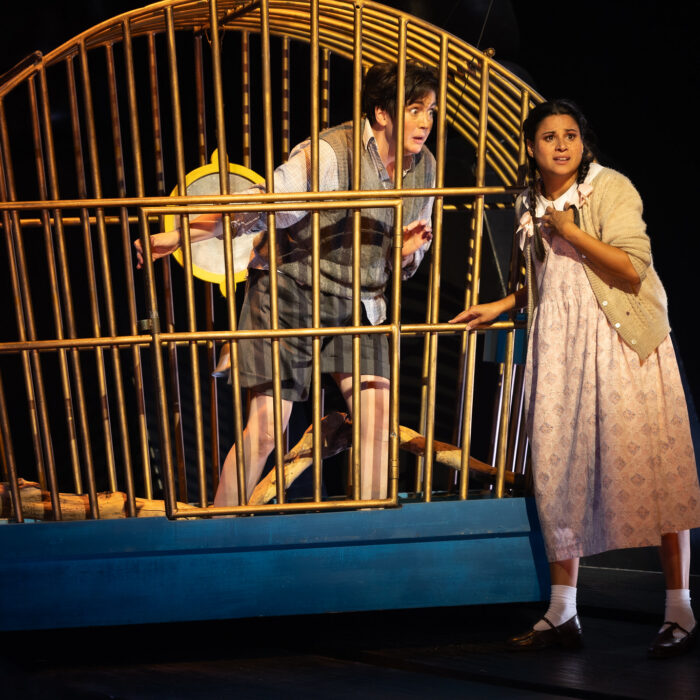
Bass Janne Sihvo’s remarkably fine and well-rounded bass interpreted patient Ramsvik’s part, as he and Solveig recognize each other. Fagerlund has the two young children’s roles of Ingvild and Viktor taken by spoken child actors, and these were handled with admirable confidence by Martta Ainali and Otava Merikanto. The remaining roles in this expansive cast were all delivered with poise.
Fagerlund’s score was admirably served by the musicians of the orchestra under Hannu Lintu’s baton. Lintu proved to be an assured steward of this new score, and his players responded to him with remarkable cohesion, with the strings, woodwinds and brass sections navigating the diverse harmonics with ease. The chorus, prepared by Mauro Fabbri, added dynamic and dramatic presence and depth.
In the final scene, a large digital clock — which had been displaying broken digits — stopped, now legible, at 11:59. The message could scarcely be clearer: the last minute has arrived. There is no single, directive moral here. Rather, Fagerlund and his creative team invite the audience into a world where everyone must draw his or her own conclusions — about one’s own life, about the environment, about the deeper questions of meaning that humanity has always, and continues, to face.
One can only hope this opera finds its way to many more stages around the world. Its themes are universally adaptable and understandable. “The Morning Star” is touching, poignant, and genuinely thought-provoking — a rare achievement in contemporary opera.