Festspielhaus Baden-Baden 2026 Review: La Bohème
By Andréas Rey(Photo: Michael Gregonowits)
On August 23, for a one-off performance, the Baden-Baden Festival presented Puccini’s “La Bohème” in a concert version conducted by Marco Armiliato, featuring tenor Benjamin Bernheim as Rodolfo, and sopranos Carolina López Moreno as Mimì and Sandra Hamaoui as Musetta.
It is highly likely that this production will be long remembered, not only because of the Bernheim’s flu – which forced him to apologize for having to stop the performance due to a loss of vocal range before withdrawing altogether – but also thanks to the quality of the cast as a whole and the orchestra.
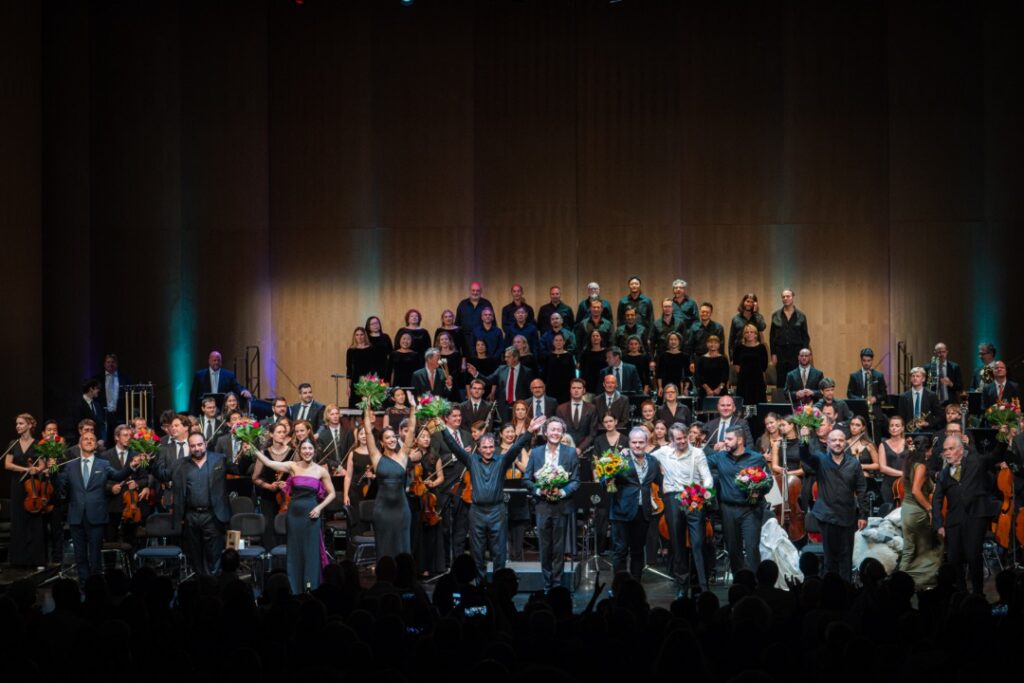
Indeed, the performance was nearly cancelled due to Bernheim’s illness, but by the purest of coincidences, the American tenor Andrew Owens, who was in the audience, took over the vocal part of the role of Rodolfo, singing from the edge of the stage, while his Suisse counterpart acted the role in silence in front of the orchestra. Credit where credit is due: he saved the show.
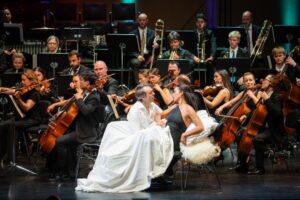
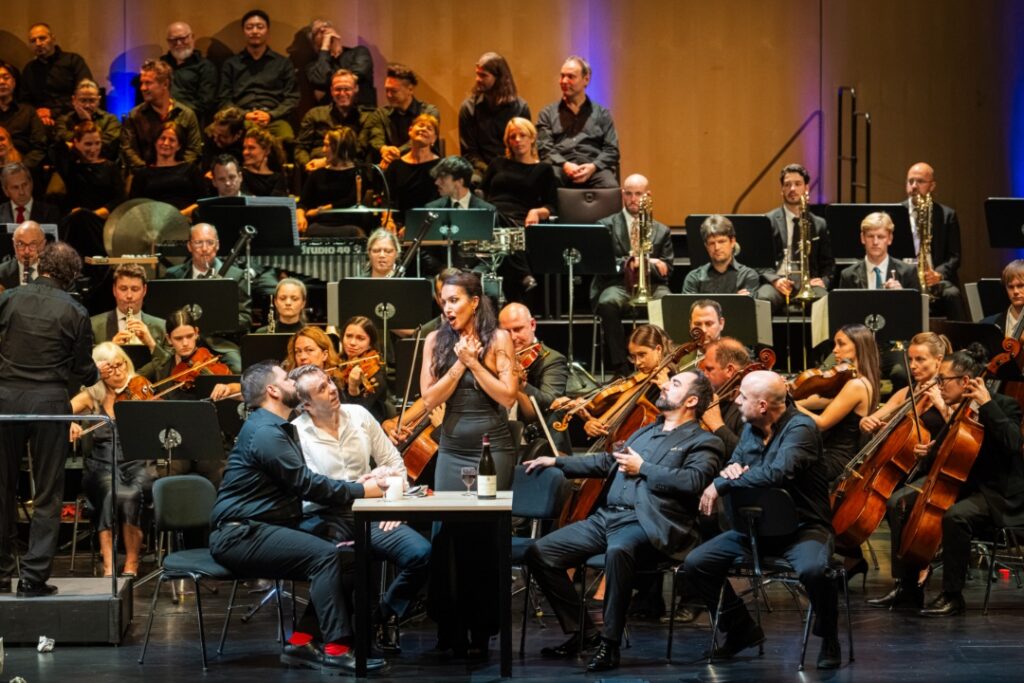
The choice of a concert version, without sets and with almost no props – a few chairs, next to nothing of costumes, a few baguettes, a bottle of wine and a book – focused the audience’s attention on the sextet of main characters, and consequently on the performers playing them here.
(Photo: Michael Gregonowits)
The quartet of poor friends – Marcello, Rodolfo, Schaunard and Colline – was well-balanced here, with none of the performers stealing the limelight. This allowed the baritones Lodovico Filippo Ravizza as Marcello and Biagio Pizzuti as Schaunard to showcase their powerful yet not overly grave timbres, while Andrew Owens’s virile Rodolfo was also well received. The opening comic scene, in which they ridicule the landlord Benoît, foreshadowing Mimì’s death while she is not yet known, was performed here with naturalness, camaraderie and humor. The camaraderie between the friends remained one of the major strengths of this production. The voice of bass Gianluca Buratto as Colline was particularly striking, especially during his aria in the final Act, “Vecchia zimarra, senti,” in which he bid farewell to his coat. Almost cavernous in tone, it powerlessly laments the devastating effect of Mimì’s death on the group of friends, conveying the helpless humanity of the artists and the philosopher.
Andrew Owens’s voice, took on a sort of sprechgesang quality, lent his Rodolfo a slightly more mature air than his fellow characters in poverty; as if heralding the poet’s future maturity. It was also regrettable that Rodolfo’s first aria, “Che gelida manina!,” was not included; this not only rendered the structure of the score somewhat unbalanced, but would also have allowed him to be appreciated even more, given that he otherwise has only the duet in the second Act at Momus’s with Mimì to showcase his talents.
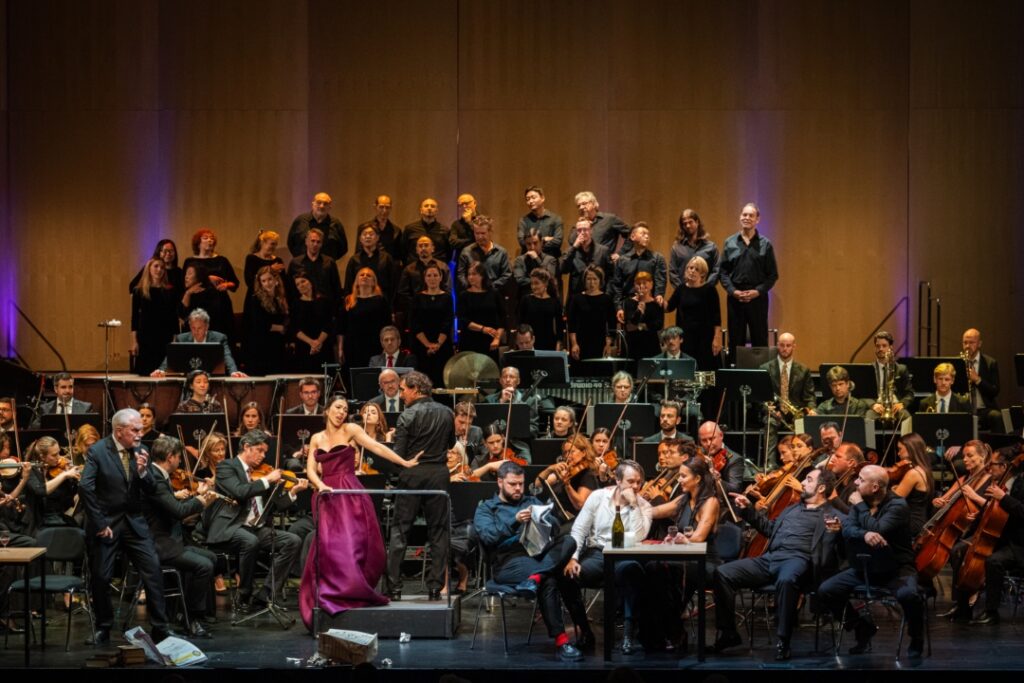
Is it due to the Bernheim’s illness that this production seemed distinctly dominated by the soprano voices in its vocal section? Each audience member will be the judge of that. Be that as it may, soprano Carolina López Moreno as Mimì, while lacking in suppleness and tenderness, mastered her arias very well, right from the opening “Sì. Mi chiamano Mimì,” during which she magnificently unfolded the grand, dreamy sweep of “ma quando vien lo sgelo.” She similarly handled the final Act very well – a tragic mirror of the first – and particularly the encounter with Rodolfo, during which her breath waned, grew weary and faded away. She would nevertheless benefit from making her portrayal of this poor teenage embroiderer – who died because there was no way to save her – more humble, rather than striving to imbue the role with unduly lofty dimensions.
(Photo: Michael Gregonowits)
Just as Carolina López Moreno’s Mimì was impressive, soprano Sandra Hamaoui’s Musetta was deeply moving. She portrayed her not only as coquettish, proud and frivolous, but also as loving and anxious. The audience will remember the authenticity of her arguments with Marcello in their duets, and her mocking performance at the Café Momus. But above all, in the final Act, her humanity shone through, confirming what she had previously hinted at without emphasizing it. The progression from her “Marcello mi vide… Non mi guarda, il vile!” in the second, through the argument in the third, to her ‘Madonna benedetta, fate la grazia a questa poveretta’ in the final Act was very well executed.
Would the production have benefited from casting Sandra Hamaoui as Mimì and Carolina López Moreno as Musetta? It is possible, but it would certainly have lost something by separating these two singers, given that the interplay of their voices — so close yet not identical — so effectively highlighted the parallels between the characters.
Apart from the cast, the conductor’s highly interesting approach must also be acknowledged. Contrary to the usual practice of placing Puccini solely within the Italian tradition – while by no means detracting from his essential contribution – the conductor here also drew on his Wagnerian influence, both to convey and express the narrative of the score and to give it a personality of its own. The Wagnerian influence could be be heard, first of all, in the way the diversity of the instruments were brought to the fore – the brass and percussion were particularly well crafted in the second Act – then in the carefully crafted sensuality of the strings in the first Act, and, above all, in the treatment of the leitmotifs, notably Mimì’s theme. This, while not alienating the listener, revealed a different way of listening to Puccini’s masterpiece.
(Photo: Michael Gregonowits)