Deutsche Oper Berlin 2026-27 Review: Mittwoch aus Licht
Stockhausen Takes to the Skies in Susanne Kennedy’s Bewildering Cosmic Ritual
By Zenaida des Aubris(Photo: Julian Roeder)
What exactly is an opera? Karlheinz Stockhausen spent much of the last quarter of the 20th century providing increasingly improbable answers to that question. “Mittwoch aus Licht,” composed between 1995 and 1997, contains a world parliament debating esoteric love, an audition for an orchestra whose musicians are scattered through space, a string quartet performing in four helicopters and, finally, an intergalactic conference involving a camel who runs for president and defecates pellets of wisdom and wealth. Stockhausen’s musical language is far from Verdi or Beethoven, but accessible to contemporary ears.
For its German premiere at the Deutsche Oper Berlin—and the season opener with a new indendat, Aviel Cahn—director Susanne Kennedy, visual artist Markus Selg and sound designer Florent Derex approached this already eccentric material not by trying to make it more comprehensible but by plunging still further into its strangeness. Conductor Maxime Pascal–possibly by not being visible—seemed more of a general coordinator, in charge of keeping everything tight and precise.
Mittwoch forms the “Wednesday” installment of Stockhausen’s almost 29-hour long “Licht: Die sieben Tage der Woche,” seven operas organized around the archetypal figures of the angel Michael, a primordial Eve and Lucifer embodying man and woman, good and bad. Their characteristics are represented musically but not physically. Yet conventional narrative is almost entirely absent. Instead, its four Scenes—Welt-Parlament, Orchester-Finalisten, Helikopter-Streichquartett and Michaelion—operate as autonomous rituals involving communication, competition, technology, transformation and, repeatedly, the possibility of bringing irreconcilable things together.
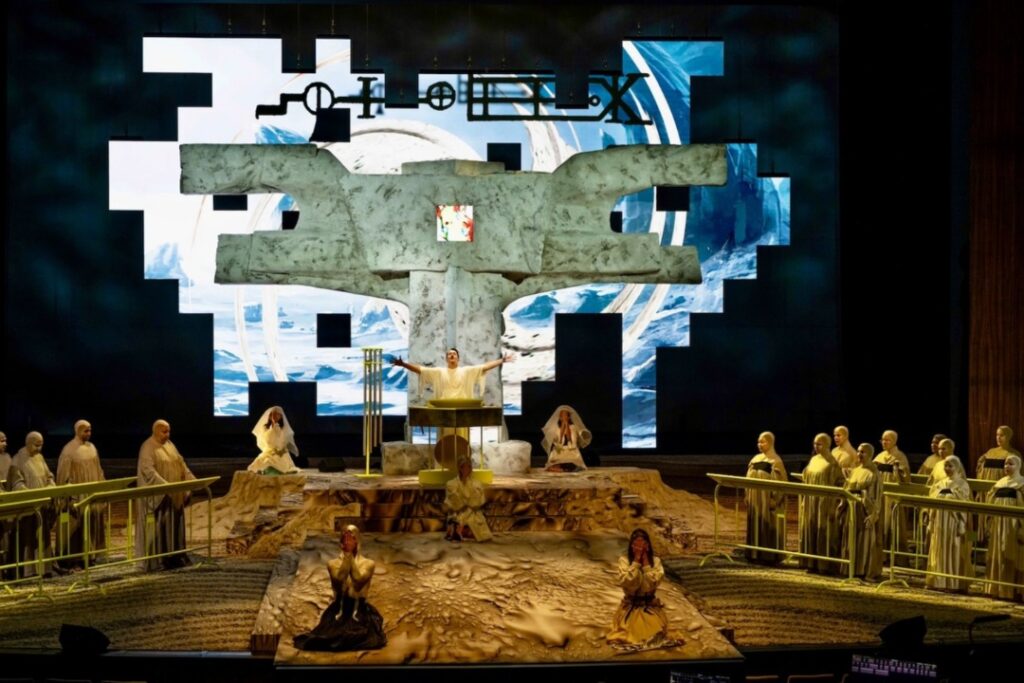
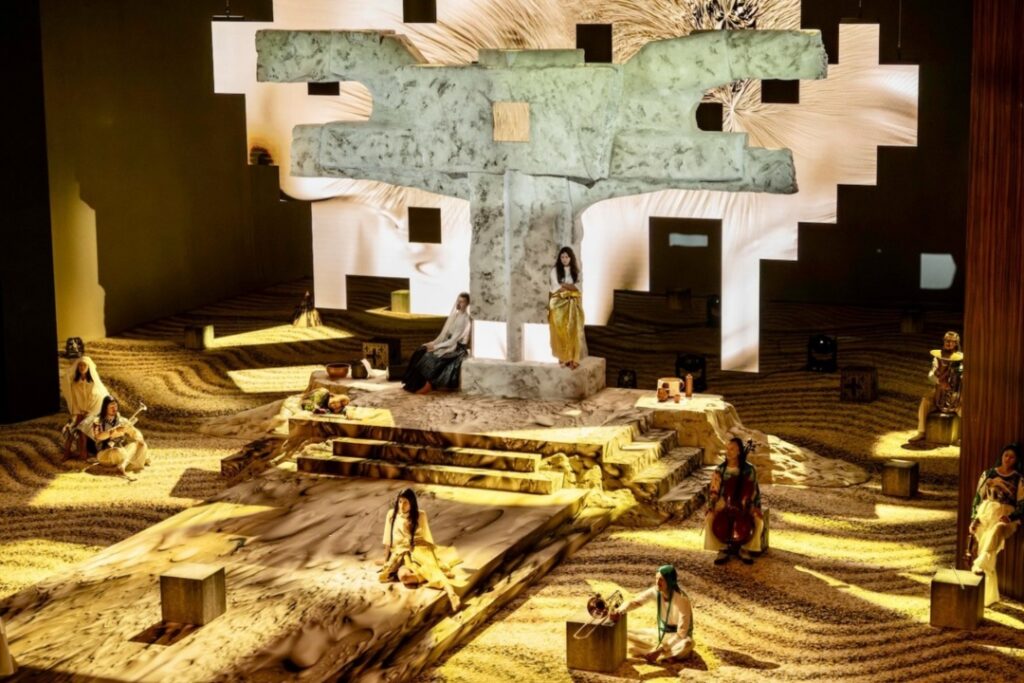
Selg’s one set for all four scenes resembled some abstract pre-Columbian altar stranded in a desert, while an enormous video backdrop continuously generated and transformed images behind it. Andra Dumitrascu’s monochrome flowing costumes underline the desert motif. Warja Rybakova and Selg were responsible for the video, which became one of the production’s dominant elements. Constantly mutating forms and perspectives of objects and landscapes—the visual surface was never still. Initially hypnotic, it gradually became oppressive. Stockhausen’s score already demands a high degree of concentration from its audience. By refusing to allow the eye a moment’s rest, the production frequently competed with the music rather than illuminating it. There were times when one longed simply for the screen to stop moving.
(Photo: Julian Roeder)
Parliament in the Clouds
In the first Scene, Welt-Parlament, delegates convene to discuss that most manageable of political subjects: the nature of love. Stockhausen has them communicate in an invented musical language, turning parliamentary procedure into an elaborate choral ritual.
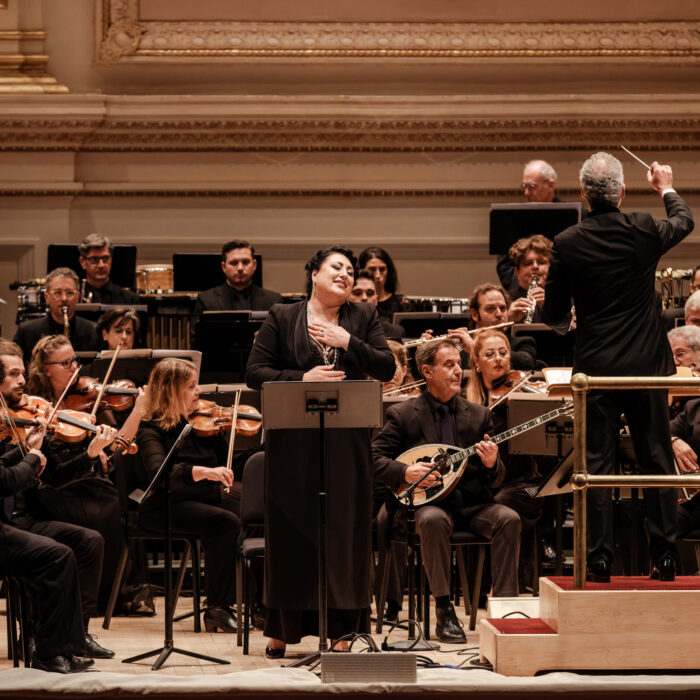
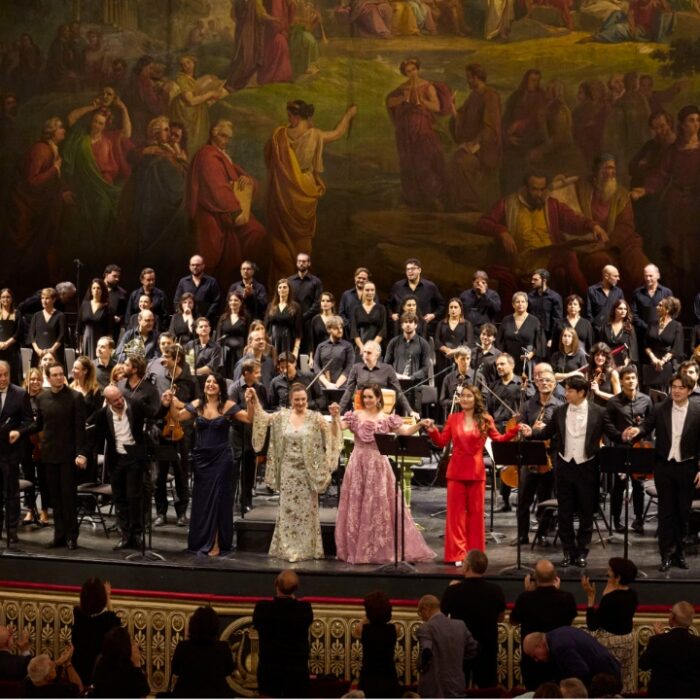
The Chorus of the Deutsche Oper Berlin became one of the evening’s strongest protagonists. Under Jeremy Bines, who conducted the scene while embodying its President, the chorus handled Stockhausen’s intricate vocal demands impressively. Kennedy moved the singers with deliberate, almost ceremonial slowness from one configuration to another. Their collective presence gave physical substance to music that can otherwise seem determined to evaporate into abstraction.
This stateliness also established one of the evening’s recurring tensions. The performers behaved as if engaged in ceremonies of enormous significance, while the actions themselves hovered somewhere between mysticism and absurdist theater. Stockhausen asks his audience to take the cosmic and the ridiculous seriously at the same time.
Kennedy understood that contradiction and, wisely, did not attempt to resolve it.
Orchester-Finalisten dispersed the instrumentalists of Le Balcon around the auditorium rather than containing them within a conventional pit. Individual musicians became performers as well as players, effectively auditioning for an imaginary celestial orchestra. Under Maxime Pascal, who presided over the larger musical architecture of the evening, Stockhausen’s spatial conception emerged clearly. Sound did not merely come from the stage; it occupied the building.
(Photo: Julian Roeder)
Helicopters Without Lift-Off
Then came the event everyone had been waiting for: the Helikopter-Streichquartett.
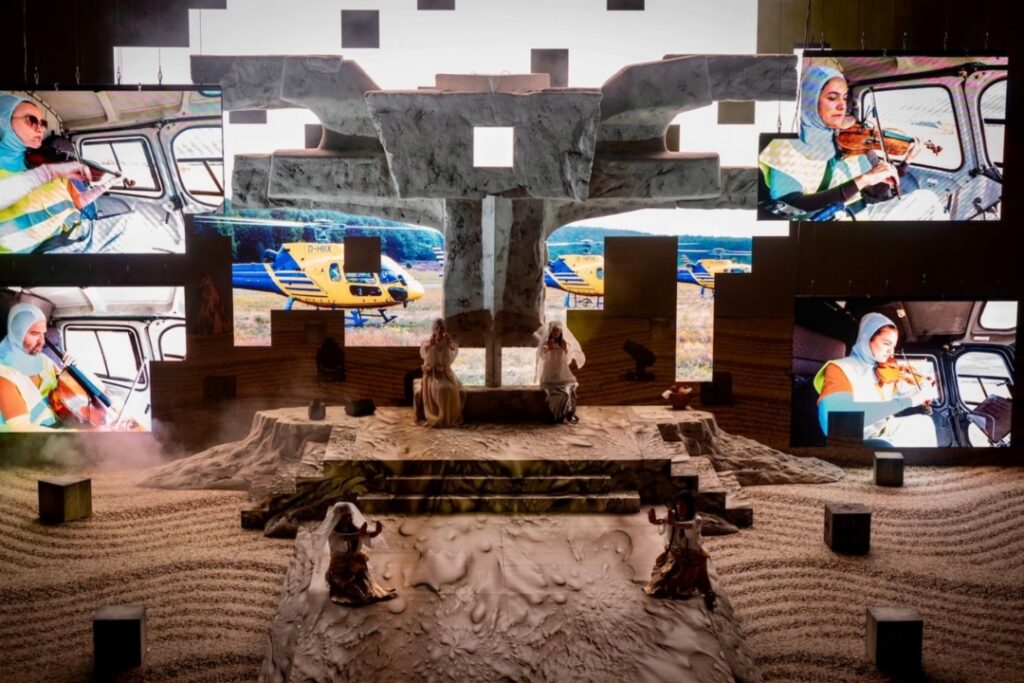
It remains one of the most notorious ideas in late-20th-century music. Four members of a string quartet are placed in four separate helicopters. Their playing is transmitted simultaneously with the sound of the rotor blades, while video feeds allow musicians and audience to remain connected.
The logistical achievement was considerable. Anna Matz (violin I), Monia Rizkallah (violin II), Kirsikka de Leval Jezierski (viola) and Arne-Christian Pelz (violoncello), members of the Deutsche Oper Berlin orchestra, undertook Stockhausen’s airborne experiment. Yet theatrical notoriety and theatrical effectiveness are not necessarily the same thing. Seen only through four separate, synchronized video cameras, the spectacle of the musicians flying somewhere above rural Berlin quickly lost its novelty—especially stretched out over about 20 minutes without any real melody, just a handful of repeated notes became monotonous, while the helicopters themselves, for all the extraordinary effort required to put musicians inside them, provided less dramatic excitement than their reputation promised.
The paradox was almost comic: perhaps the most technically complicated section of the evening produced one of its least compelling theatrical results. Stockhausen’s concept remains audacious. But audacity has a shelf life. What once seemed an outrageous assault on the definition of chamber music can now oddly feel like an elaborate technological demonstration whose means are more interesting than its musical end.
(Photo: Julian Roeder)
Enter the Camel
Fortunately, “Mittwoch” had one more card to play, and it was a camel.
Michaelion, the fourth and final Scene, is an intergalactic assembly anticipating Michael, populated by singers, instrumentalists and a creature called Luzikamel—a manifestation of Lucifer that eventually undergoes transformation in the form of a full size, plush camel with human legs.
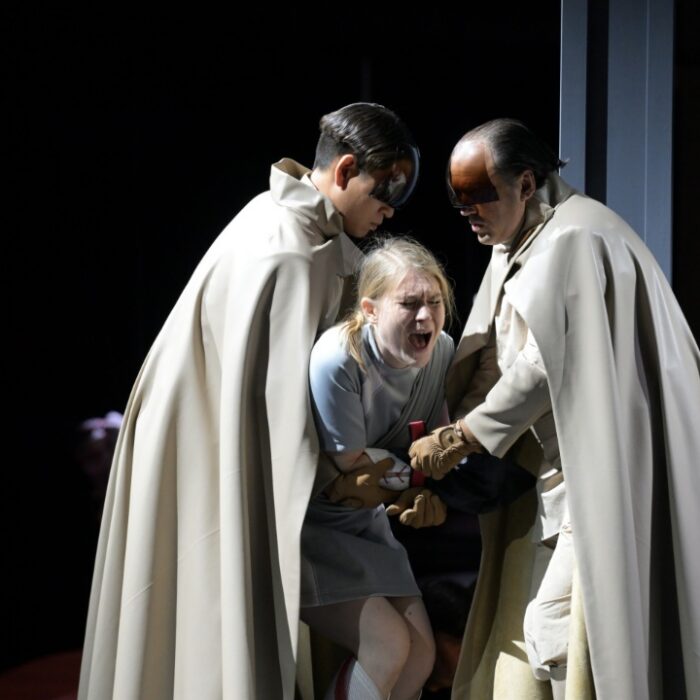
This was by far the most absurd—and consequently the most entertaining—part of the evening. Luzikamel entered the political arena, ran for president and expelled colored pellets variously announced as being endowed with wisdom and wealth before finally assuming human form. By this stage any attempt to apply conventional operatic logic had become futile. Kennedy embraced the lunacy, allowing Michaelion to hover between sacred ritual, science fiction, political satire and cosmic cabaret.
Theater of the absurd had lurked beneath the entire evening, but here it finally surfaced without apology.
And perhaps this was where Kennedy came closest to Stockhausen. His cosmic mythology can appear forbiddingly solemn on paper, yet there is something wonderfully preposterous about it. “Mittwoch” imagines a universe in which parliamentary procedure, helicopters, electronic sound, mysticism, instrumental virtuosity and a defecating camel can belong to the same metaphysical system.
Whether they make a coherent opera is another question.
Pascal and the musicians of Le Balcon approached the work with formidable discipline, as did the Deutsche Oper chorus and the many performers distributed around the auditorium. The sheer coordination required was remarkable. Stockhausen’s spatial music depends upon exact relationships between live performance, electronics, amplification and location, and the evening rarely betrayed the machinery required to make it happen.
Yet technical accomplishment could not entirely disguise the work’s longueurs. Without conventional narrative, “Mittwoch” depends upon the fascination of each successive sonic and theatrical event. Some exerted a peculiar hypnotic power; others simply lasted.
Kennedy and Selg responded by supplying an almost continuous visual counterpoint, but their solution created another problem. The restless video imagery often seemed anxious that Stockhausen’s music could not hold our attention unaided. Ironically, the production became most persuasive when it trusted the performers and the music.
“Mittwoch aus Licht” may not persuade everyone that Stockhausen discovered opera’s future. But more than 25 years after its completion, it remains a monument to the scale of his imagination. Few composers would have conceived an opera requiring four helicopters. Fewer still would have followed them with a camel running for president. That combination of megalomania, mysticism, technical ingenuity and deadpan absurdity is what makes Stockhausen interesting.