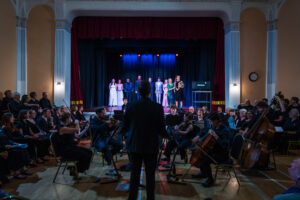
Cumbria Opera Group 2026 Review: Carmen
By Mike Hardy(Photo: Chris Tribble)
I’ve been fortunate to review many operas from the most prestigious houses in the world but nothing engages me more than getting to see performances staged in provincial areas, far away from any major theaters, by those who wish to bring the wonderful world of opera to the masses, perpetrating the glorious art for those unable to get to mainstream venues.
Cumbria Opera Group
Described as “Truly a Hidden Gem,” the Cumbria Opera Group is celebrating ten years since its inception, and its very ethos is embroiled in striving to “bring world class opera to Cumbria, and to educate young Cumbrians in the arts.”
“We believe that opera is relevant and necessary in the contemporary arts scene, and should happen everywhere, regardless of rural isolation or existing access,” said Joe Davis, conductor, head and founder of the group.
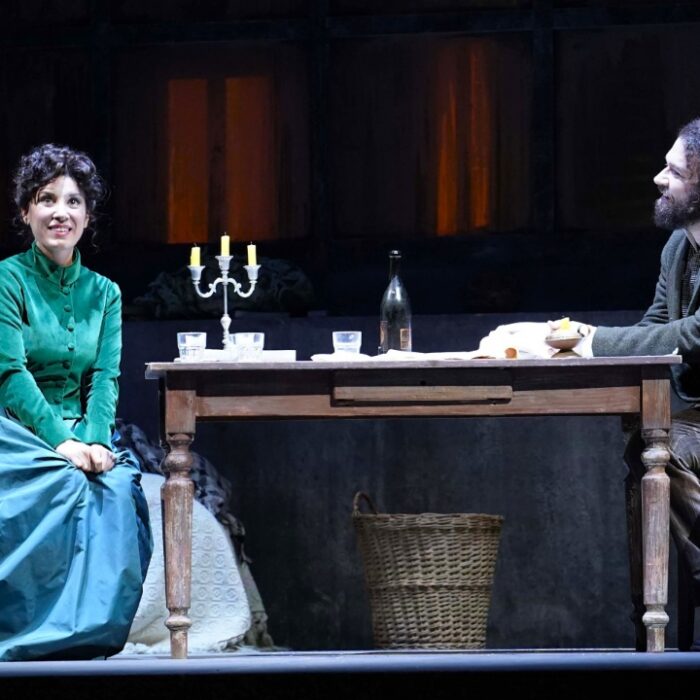
As part of its decennial season, Cumbria Opera recently performed what they described as a ‘semi-staged’ performance of Bizet’s “Carmen,” comprised of purely Cumbrian artists. Whilst this enabled the group to display their vast vocal talents, without true direction, staging or dramatical acting; it proved, for me at least, to be somewhat deficient.
As the engine of the group, Joe Davis is a force to be reckoned with. He sports an impressive résumé as Assistant Conductor of the English Symphony Orchestra, Musical Director of the UK Proms in the Park Orchestra and several other senior positions within orchestras throughout the UK.
Earlier this year, I was fortunate enough to review his “Mahler Symphony No.8” a rarely staged choral masterwork requiring a huge orchestra, eight soloists, a children’s choir, and an adult chorus divided into 16 parts, making it notoriously expensive and difficult to stage. I described him as a “sight to behold…intensely focused and animated throughout.”
I was equally fortunate to catch part of the rehearsals for this “Carmen,” where his dedication and passion for the music shone through. It was equally clear that the gathered orchestra, chorus and solo artists hold him in some reverence. His often humorous interactions with them, aided by his witty asides, seemed to motivate them further in wishing to fulfill his desired vision.
Cast Highlights
Headlining the performance was Cumbrian born Jess Dandy in the titular tole, described as the foremost British contralto of her generation. Her vocal range includes an astonishing lower register, malt-rich with resonance and with a caressing timbre. The upper register is clear and incisive and only the very top notes lack the penetration and power of a soprano. Her “Habanera” was accomplished and she produced some beautifully soft lines in the “Seguidilla.”
Don José was sung by tenor Cameron Mitchell, an Opera North regular. I was given the impression he was laboring at times, a distinct wobble and coarseness in the voice in evidence. His keynote aria, “La fleur que tu m’avais jetée” appeared to be somewhat rushed through with the top notes thin and ineffective.
The final Act encounters with Carmen, however, proved sturdier and he mustered some genuine passion and vocal clarity.
The role of Escamillo was sung by baritone Jonny Hill appeared slightly at odds with the required, alpha-male imperiousness of a toreador. Additionally, his pleasant demeanour inflected his voice so that it lacked the brusqueness and commanding authority required. His “Votre toast, je peux vous le rendre,” the keynote Toreador Song, was accomplished but rather insipid.
Lyric soprano Kirsty McLean sung a quite wonderful Micaëla; her third Act “Je dis, que rien ne m’épouvante” was emotive and impassioned, and probably the highlight of the evening.
As Le Remendado, tenor Andrew Woodmass-Calvert was a positive, breath of fresh air. He sung with a nice, polished, clarion instrument and I was left wanting to hear him sing more.
Likewise, Faye Bowness and Charlotte Thomson were quite splendid as Frasquita and Mercédès, respectively, more so when singing together in harmony.
Baritone Sam Weakley sung a commendable Zuniga, having a suitable stentorian voice.
Musical Details
The chorus were quite stunning, exemplifying to perfection how choristers play an integral and most essential role in productions. The Cumbria Opera Group chorus was superb, producing evocative waves of beauty for such a small ensemble. The strings were particularly exquisite, along with Alistair Burton being notable on piano.
If I have seemed particular critical of the performers, it is purely because their lack of direction and staging over-exposed them.
To strip Georges Bizet’s “Carmen” of its physical, staged theatricality is to fundamentally misunderstand its mechanics as a psychological thriller. When presented as a purely sung concert piece, or flattened into continuous recitative, the work loses its gritty, conversational realism. We are left with a beautiful parade of Spanish-infused hit tunes, but we lose the breathless, ardent drama of the piece.
Carmen herself is the ultimate drama queen whose existence relies very much on a flamboyant presence. She exudes sexuality, a strong, determined, resolute woman whose every living day is a theatrical drama. She is compelled to dance, to seduce, to fight. She can do none of those things while standing motionless on stage. Like a tigress behind the glass enclosure of a zoo; her beauty can be admired but she needs to be seen in the wild to be fully appreciated.
She needs to cajole and needle Don José with a naturalistic, conversational venom that singing alone cannot fully capture. In turn, Escamillo needs to strut his stuff and enrapture her. Don José needs to battle with Escamillo. More saliently, he needs to plead and beg with his lost Carmen in the final scenes, to at least give some comprehension for his final awful deed. Without the visual vocabulary of the staging and the stark realism of expression and acting, the characters risk shrinking into sterile, operatic archetypes, robbing the tragic finale of that visceral shock.
In a purely sung performance of “Carmen,” the ear is undoubtedly feasted, but the heart and very soul of the drama is starved.
That said, the efforts of this amazing opera company are to be lauded at every turn. It epitomizes to perfection my own personal ethos, and that of OperaWire, for whom I am proud to write: “To shine a spotlight on all the amazing people nurturing and developing the art form today.”
I asked Joe Davis to sum up their first ten years of the group: “We’re so proud of what we’ve achieved in our first ten years. Over one hundred education workshops, three county-wide Festivals, a Young Artists’ Scheme, and the launch of a Cumbria Opera Scholarship that supports young Cumbrians’ studies at Conservatoire or University. Thousands of Cumbrians have been to our productions now, many of whom had never been to an opera before!”