CD Review: Joe Cutler’s ‘Sonata for Broken Fingers’
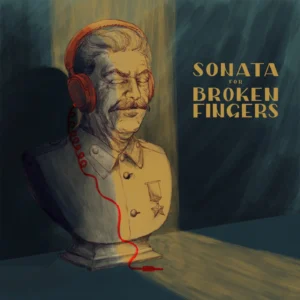
By Bob DieschburgTaken literally, a “Sonata for Broken Fingers” is—if anything—something of a paradox. On second thought, one might even find it cynical rather than merely facetious; yet on a political—or more broadly moral—level, the phrase suddenly acquires a dystopian quality: music, or art, under oppression. That is the starting point of Joe Cutler’s eponymous music theater piece, released on CD and online by the Birmingham Record Company and NMC.
Inspired by the life of pianist Maria Yudina, “Sonata for Broken Fingers” takes as its premise an apocryphal episode related by none other than Dmitri Shostakovich via an intermediary: Stalin, in 1944, was supposedly so enthralled by Yudina’s rendition of Mozart’s “Piano Concerto No. 23” that he asked for a copy of the performance. Little did he care that it had been a radio broadcast, and that, to satisfy the dictator, Radio Moscow–in an overnight session–had Yudina record the piece from scratch.
Joe Cutler and his librettist, Max Hoehn, fictionalize this unlikely episode from Stalinist Russia. Their protagonist–renamed Maria Maximova–has not only been reigned in for her non-conformist defense of “formalist composers;” when she is taken from the psychiatric hospital to record Stalin’s musical desideratum, she is also revealed to have two broken fingers–a metaphorical addendum, so to speak, to the heavy toll artists pay under totalitarian regimes.
Maximova’s story is told very much like a modern-day thriller. Narrated by an authorial voice–Maximova’s own–it unfolds through flashbacks, scenic shifts, and dramatic juxtapositions. Most poignantly, for instance, “Sonata” juxtaposes Maximova’s return to the Serbsky psychiatric hospital with Stalin’s utterly profane death (“Ah… shit!”).
The crossover elements—in both music and dramaturgy—are undeniable, and the work is unlikely to be considered operatic in aspects other than its chamber-piece scale. Its component parts align it more with music theater or even audio books; for Cutler’s score works just fine without a stage, as it creates its tense radiophonic sound.
The latter is dominated by brittle strings, percussive flashes, and breathy winds interspersed by a collage of looped piano figures. That is not to mention its speech-heaviness which, linguistically, draws on too many stereotypes. Catchwords like “comrade,” “elite,” “Politburo,” or “Trotskyite” are omnipresent, confrontationally so, despite their ironic undertones. They highlight the libretto’s ambiguous stance between political thriller, psychological drama (think a modern day “Tosca”), and dark comedy.
Similarly, the protagonists are cast both with and against tradition: Stephen Richardson, in the part of Stalin, moves in the operatic tradition of dark-voiced villains (the real Stalin reportedly had a low-pitched, though slightly nasal voice); yet, his fragmentary lines, his speech and mutter turn Cutler’s dictator into an almost bureaucratic, disembodied anti-portrait, both intangible and profane.
A stupendous narrator, Claire Booth appears constrained by the fragmentary nature of her part as Maximova. This is no Tosca—no grand heroine, whose music charts an emotional arc. Instead, there is relatively little to work with other than shards of text and musical gesture.
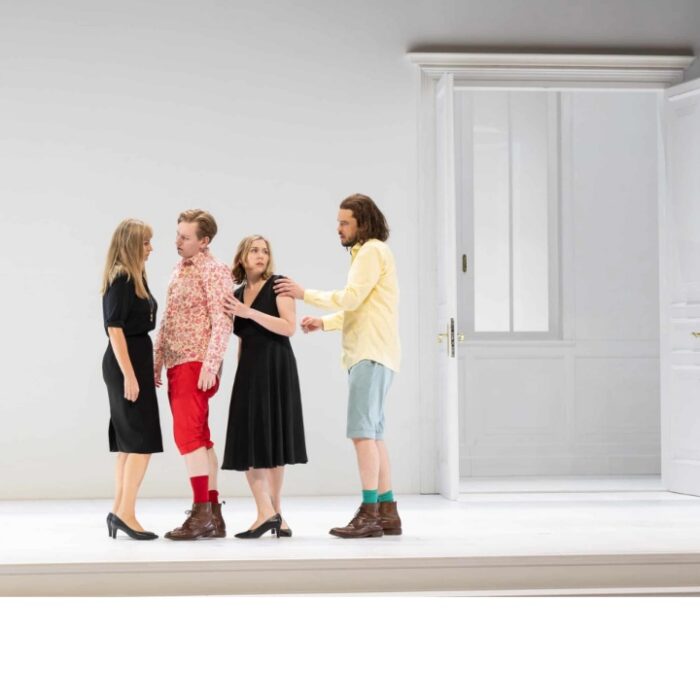
Christopher Lemmings confers to the part of Gleb dramatic aplomb, as he faithfully captures the spiraling anxiety related to his assignment as programmer from Radio Moscow. Lucy Schaufer and James Cleverton complete the cast of four, while Sian Edwards conducts with a balanced, even sober hand. She highlights the score’s pristine craftsmanship; yet the overall effect hovers in the same indeterminate middle ground by which “Sonata” refuses to adhere to any genre in the conventional sense. A hybrid, it is blatantly logocentric, with all the limitations of its emotional distance and texturally narrow soundscape.