Birgit Nilsson Festival 2026 Review: Baritone Luthando Qave in Recital
Luthando Qave Crossed Musical Traditions With Warmth, Clarity, and Command
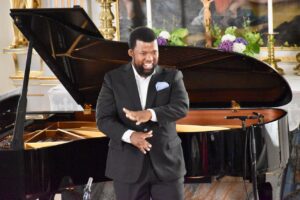
By Zenaida des AubrisAs the 2026 recipient of the Birgit Nilsson Stipendium, baritone Luthando Qave gave a recital at Västra Karup Church in Båstad on August 7, 2026, accompanied by pianist Magnus Svensson. The setting carried particular resonance: this was Birgit Nilsson’s own parish church, closely connected to her earliest experiences as a singer and the venue that she appeared in most. Many of those attending this recital surely had known and heard her personally.
Qave assembled a wide-ranging program that moved from opera to musical theater, German Lied, Swedish song, and the musical traditions of South Africa. Such variety can easily leave a recital feeling fragmented. Here, however, Qave’s warm baritone, excellent diction, and direct engagement with the texts supplied a consistent thread. Svensson provided a responsive foundation as the program moved across languages and styles, giving his own sensitive solo interpretation for Claude Debussy’s “Reflets dans l’eau” (1905).
Songs of Water and Identity
In keeping with the festival’s theme, “The Sea,” Qave opened with John Ireland’s “Sea Fever,” allowing the text’s restless pull toward open water to establish the evening’s central motif. Jerome Kern’s “Ol’ Man River” followed, its broad melodic current offering a different vision of water: not escape, but an indifferent witness to human hardship.
The transition to Franz Schubert’s “Die Forelle” was audacious — a leap from an American musical theater standard to one of the most familiar German Lieder. Qave managed the change of idiom with ease. His clear articulation and close attention to the words kept the song buoyant while avoiding an overly mannered account of its playful surface.
The recital then turned toward South Africa. In Phelelani Mnomiya’s setting of the traditional Zulu poem “Yim’lo” (“Is This Me?”) and Sibusiso Njeza’s “Wamuhle Mzantsi Afrika” (“How Beautiful You Are, South Africa”), Qave’s sound acquired particular authority. The songs’ search for beauty, redemption, and identity seemed intimately aligned with an artist whose own life has spanned countries and musical cultures. His sonorous delivery gave the music dignity without sacrificing immediacy.
Operatic Weight
For the operatic portion, Qave selected “Ah! Pescator, affonda l’esca” from Amilcare Ponchielli’s “La Gioconda” and Gérard’s monologue, “Nemico della patria,” from Umberto Giordano’s “Andrea Chénier.” Both selections allowed him to display the more dramatic dimensions of his instrument. His crisp Italian diction sharpened the characterization, while the baritone took on greater weight and intensity. “Nemico della patria,” in particular, called for more than generalized power: its political bitterness and self-reproach demanded an interpreter capable of finding unease beneath the declamation.
Qave concluded with Gustaf Nordqvist’s “Till havs” (“To the Sea”), based on a poem by Jonatan Reuter. The song remains closely associated with the great Swedish tenor Jussi Björling, making its appearance in a baritone recital both unexpected and poignant. Qave replaced tenorial brilliance with warmth and breadth, and the song appeared to strike an emotional chord with the audience.
Established by Nilsson in 1969, the annual Stipendium awards SEK 250,000 (approximately USD 26,000) to support a singer’s continued artistic development. Qave’s recital honored that purpose. More than a display of versatility, it presented an artist moving confidently among traditions while retaining a recognizable musical identity of his own.
Categories
News