Bayreuth Festival 2026 Review: Rienzi
Tireless and ageless, Andreas Schager surpassed himself as an explosive Rienzi
By Christina WatersThe phenomenon that is super tenor Andreas Schager tore the house down on August 19 performance of Wagner’s third, and rarely performed opera Rienzi.
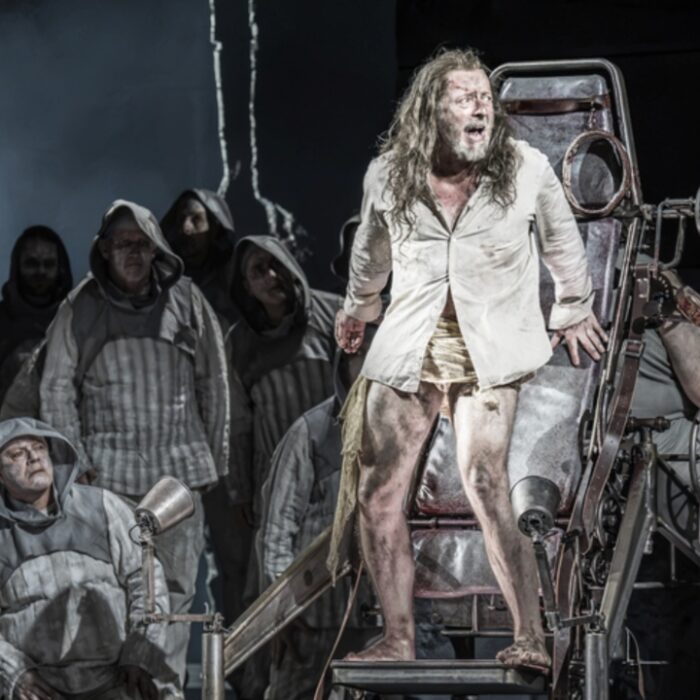
Athletic is Schager’s signature acting style, but on this night he outdid even himself (in any of his Wagnerian incarnations, from Siegfried to Parsifal). And the fabled voice somehow lasted throughout over three-and-a-half hours of non-stop singing. Yes, he relied upon his insistent, high decibel superpower and yet there were moments of pliant gentleness in which the ageless tenor seemed to reach into a freshness that bordered on the supernatural. Schager’s authoritative enactment of such a punishing role will surely remain the standard for any who attempt it in the future.
And in exchange, the audience simply would not let him leave the stage, demanding countless curtain calls. Thunderous applause, accompanied by the Festhalle ritual of stomping of feet, eventually led to a full house standing ovation. Something I’ve never seen in over a decade of Bayreuth experiences.
Schager was not alone in vitalizing this stunning revival of an opera Wagner hoped would rival the work of his mentor Meyerbeer. He had company. In this historic revival of Rienzi, selected to showcase at the Festival’s 150th anniversary, the directors Alexandra Szemerédy and Magdolna Parditka waded deeply into the swamps of regietheater and came up with a winning concept. The task was formidable: to somehow package the “unrestrained extravagance” that Wagner demanded of himself into a spectacle relevant to, and digestable by modern audiences.
Rienzi, which famously was Hitler’s favorite opera, is the confusing, and much-re-written (by Wagner himself) chapter in the possibly real life of a Roman tribune in the 14th century. In Szemeredy/Parditka’s interpretation, Rienzi is a true man of the people who, upon political appointment becomes obsessed with power, turned on his own populace, and ultimately felled by his own monomaniacal corruption. He is also enmired in personal “issues” involving his siblings. More on this later.
The directors brilliantly mapped our internet world onto the old world morality tale of dictatorial overreach and the visual result was spectacular.
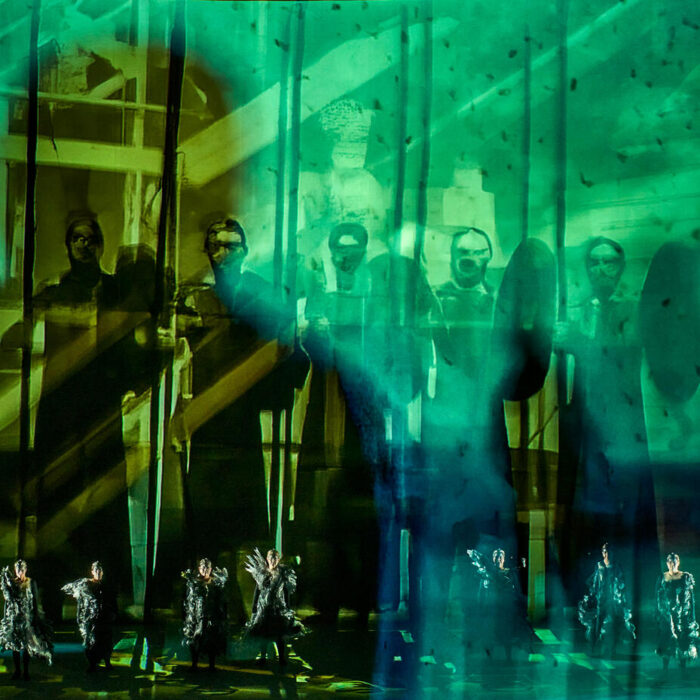
A highrise tower of interlocking apartments, interlaced with stairways, was punctuated with ongoing video feeds, some pre-recorded, most live, of a surveillance world in which everyone lives by cell phone reassurance. Indeed cell phones were in every hand of the huge chorus who achieved perfection in terms of energy, dextrous choreography, and superb aural dynamics. Make Rome Great Again! slogans abounded, underscoring obvious 21st century analogies.
Kudos to Choral Director Thomas Eitler-de Lint and his huge ensemble. But with apologies, let me add that Rienzi’s dozen required choral interludes drained energy from every scene in which they occurred.
Politics and Desire
As the well-known overture played, we saw up high in one of the upper apartments Rienzi and his sister Irene, sung by Gabriela Scherer, in the grips of sexual desire, while their little brother languishes in the next bedroom. The child is clearly ill, and while his older siblings dally, succumbs to his illness. This backstory establishes two reasons for the intense bond between Rienzi and Irene — incest and the tragic loss of their younger sibling. Already Wagner signals his recurring motif of sibling romance, to be continued with Sigmund and Sieglinde, Brünnhilde and Siegfried.
During Act one’s political contest the rivals for Roman power, Orsini, sung by Michael Kupfer-Radecky, and Colonna, a sonorous Andreas Bauer Kanabas, attempt to whip up votes from the crowds. But the charismatic Rienzi wins the election, updated in this production with live video interviews, crowds of adoring fans, and endless selfies. Irene, who acts as her brother’s consort, is also courted by a Roman patrician Adriano, performed by American soprano Jennifer Holloway. And soon the three become rivals for each other’s affections, as well as the shifting mood of the Roman citizens and nobles.
By heightening the relationship among these leading players, upgrading the trouser role of Adriano into a full-on lesbian love affair, the directors helped to create a compelling subtext that kept the opera from becoming a one-man show.
In Holloway’s Adriano, Schager enjoyed a worthy adversary. The dramatic soprano’s command of the stage whenever she moved or sang was every bit a match for the self-absorbed Roman tribune as he savored his swift ascent to dictator. Holloway completely inhabited her crucial role from the very start, and kept growing into Adriano’s expanded psychology as the opera unfolded. Played with elegant butch swagger, Holloway’s Adriano convinced us of her yearning for Irene. Yet as the threesome grew more contentious it became clear that Scherer’s Irene was an inadequate object of all this emotional fuss.
Holloway’s aria in Act three, the only identifiable aria in this long piece of multiple styles, was dramatically burnished and emotionally textured. Her need for Irene, and her enmity toward Rienzi were tangible. Her powerful stage presence provided the foil Schager’s dominance needed. And the audience responded with showerings of bravissimi during the night’s many curtain calls.
Scherer, whose soprano infrequently rose above the thunderous orchestra, seemed unable to muster the technique to address the musical ornamentation of her part. But the directors didn’t help. Her character was given little motivation to move, or even hold the stage with confidence, and one couldn’t help wondering just why the two strong antagonists were so smitten by her. During the final act, when Rienzi’s messianic ravings turned to madness, Scherer seemed to fumble even her final shocking act of stabbing her beloved brother to death. Writhing in death throes, Schager was more animated than even his sibling assassin.
Languishing throughout the central story of Rienzi, his rise to power and Adriano’s curse on his reign, were the secondary characters. As the tribune’s rivals, Colonna and Orsini, Andreas Bauer Kanabas and Michael Kupfer-Radecky had little to do and little to sing. Kanabas’resounding bass initially suggested what he might do with a larger role, but had little room (perhaps due to editing) to unleash much more. Kupfer-Radecky, who performed well, struggled to be heard above the roar of chorus and orchestra.
Beyond Ballet – Wagnerian Amuse Bouche
Act two included the required ballet, added by Wagner to expand the already excessive texture of this melodramatic grand opera. And in a genius coup de theatre the directors here inserted a charming pantomime offering a capsule-smorgasbord of Wagner’s operas, all of them, portrayed by a motley cast of children, ragtag actors, cardboard swans and rainbow bridges et al. against a backdrop of the Festival operahouse itself. As they paraded before us seatedin the Bayreuth Festhalle, Rienzi and his invited guests of Roman citizens watched the spectacle from a facing amphitheater. One theater facing another, as art imitates life, the pastiche of capsulized scenes all the while conducted by a child dressed as a miniature Wagner. The inspired diversion prompted genuine relief and delight.
The opera entered its third act with a new mood. Rienzi’s triumphs have morphed into his newfound addiction to power. The set had turned menacing, populist costuming became dark and militaristic. And here, in dazzling set design—monochromatic black and white—bold touches of red subtly, yet clearly referenced the posters, flags, and uniforms of the Third Reich. Rienzi orders arbitrary executions, and soon Adriano makes plans to remove him from endangering Rome any further. Holloway’s aria in Act three, the only one in this long piece of multi-stylistic musical outpouring, was dramatically burnished and emotionally textured. Her powerful stage presence provided the foil Schager’s dominance needed. And the audience responded with showerings of bravissimi during the many curtain calls.
Supertitles please!
Supertitles would have been helpful throughout, especially given the audience’s unfamiliarity with this rarely-mounted opera. Too many martial waltzes and so many incessant choral outbursts began to fatigue the entire enterprise, aiding to the only intermittent legibility of the action. As ingenious as the Bauhaus-adjacent sets were, the music kept insisting upon the mid-19th century, while the visualization thrust us into a sterile future. Sonic and visual dissonance abounded. Somehow Schager’s heroic endurance kept it all robust and watchable. Even mesmerizing, especially given the staggering set design, which pulled apart at two key moments to reveal a long central staircase toward several exceptionally well-conceived video panoramas. This central stairway became not only the symbol of Rienzi’s ascent, and downfall, but acted as a runway for the indefatigable Schager. During almost five hours the Heldentenor must have run, clawed, scampered, spun, and strutted up and down the torturous stairway a dozen times. While singing!
The final act opened with some of Schager’s loveliest work. Tenderly, Rienzi mourned the loss of the little brother whose death seemed to have triggered the subsequent messianic obsession. Just when it appeared that he was physically and vocally drained, Schager summoned a pure, clear legato from the very top of his tessitura. That bit of magic powered the final hour of an incredible evening.
From crowd pleaser, to benevolent ruler, to autocrat, then self-appointed savior, and finally to martyr, the brief rise and fall of Rienzi was the stuff of many 19th and 20th century theater pieces, operas, plays, and ballets. Yet with rich key performances, and an inventive directorial vision, this anniversary Bayreuth production transcended its own stylistic clutter and textural girth to attain moments of coherence. It was, against all odds, a triumph. Choosing psycho-drama over heavy-handed political symbolism, the directors nonetheless made clear the warnings contained in Wagner’s vision of the last tribune.
Touted as an orgy of musical styles, and bloated symbolism, Rienzi overcame its historical reputation. In the covered pit the orchestral magic drove through it all, from Mozartian trios to keening soliloquys to massive choral landscapes, offering glimpses of the Wagner to come. Themes from “Walküre” and “Siegfried” peeked through here and there.
Nathalie Stutzmann kept control of her superb orchestra, with only occasionally moments of surpassing the voices onstage in both tempi and volume. The precision and timbre of the horn section was on full display. And here the fabled house acoustics were shown to full crystalline effect. Even if the occasional volta in time signature created emotional whiplash, Stutzmann’s musicians convinced us to go with the flow. Church bells, an organ, bells, whistles, off-stage choirs, apocalyptic marching bands, Rienzi had all this, and more.