Bayreuth Festival 2025 Review: Lohengrin
An Electrically-Charged Production Gracefully Lights up the Bayreuth Stage
By Tony Cooper(© Enrico Nawrath)
A well-loved conductor at the Bayreuth Festival, Christian Thielemann, who made his début on the Green Hill in 2000 overseeing a dynamic performance of “Die Meistersinger von Nürnberg,” served Bayreuth as its music director from 2015 to 2020. Therefore, it is good to see him back this year conducting “Lohengrin” which he originally took charge of in 2018.
Maestro Thielemann chalks up history at Bayreuth, too, by becoming the second conductor (after Austrian conductor/composer, Felix Josef von Mottl, who died in 1911) to conduct the ten canonical operas by Wagner regularly performed at the Bayreuth Festival. Recently, he took up the post of general music director of Staatsoper Berlin taken over from Daniel Barenboim, who, incidentally, shaped Staatsoper Berlin’s artistic programme over three glorious and exciting decades.
Born in Chicago in 1979 to Israeli parents, Yuval Sharon chalks up history at Bayreuth, too, by becoming the festival’s first American director. And what a début! His electrically-charged and imaginative production of “Lohengrin” is nothing but brilliant in its staging and concept keeping good company, I feel, with the likes of Hans Neuenfels’ rat-infested production of “Lohengrin” seen in 2011. Both productions challenged the boundaries of opera direction which, hopefully, is now finding favour with Bayreuth’s traditionally-minded audience.
A recipient of the Götz Friedrich Prize for Best Opera Direction for John Adams’ “Dr Atomic” (Badisches Staatstheater Karlsruhe, 2022), Sharon teamed up with the celebrated husband-and-wife team of Neo Rauch (sets) and Rosa Loy (costumes) whose design elements to this ground-breaking production are a visual feast that were interesting but equally disturbing as the plot itself.
Born in Leipzig in the 1960s, Rauch – whose work focuses on bold subject-matter probably reflecting the influence Socialist Realism had on him as a young man – gathered his thoughts together and inspiration for the sets from listening to the score of “Lohengrin” while working in his studio.
And not too dissimilar to Sebastian Baumgarten’s 2014 production of “Tannhäuser” punctuated by Dutch artist Joep van Lieshout’s industrial-based set dominated by “The Technocrat,” an obsessive installation representing a waste-recycling plant/chemical factory, highlighting the point that Wagner felt threatened by the technology of his day (especially biotechnology) which he thought harmful to humanity and nature in general.
Therefore, Rauch’s set design took inspiration from Wagner’s solid viewpoint that electrical power was especially mysterious to 19th-century society as it was a completely unknown force of nature subject to speculation. Wagner’s thinking, too, was that man was becoming controlled by machines and that society of the future might become little more than a soulless machine itself. Food for thought!
Food for thought, too, wraps up the actual story of “Lohengrin,” based on a well-loved German legend written by an unknown German author, relating to other traditional and fairy-like stories that belong to the “Knight of the Swan” tradition, a medieval tale about a mysterious rescuer who comes in a swan-drawn boat in defence of a damsel in distress, his only condition being that he must never be asked his name. Therefore, the fairy-tale elements in “Lohengrin” are strong with the ‘Good’ represented by Lohengrin and Elsa of Brabant and the ‘Bad’ by Ortrud and Friedrich von Telramund.
I felt a nod was given to the fairy-tale legend by Sharon as the central characters were suitably adorned with diaphanous wings (made of thin semi-transparent cloth) but here represented by flying insects and like all insects, attracted to light, eventually becoming their downfall. There’s lots of light in this production to bug them, too. Those worn by Elsa, though, would have perfectly fitted the part of the Fairy Queen in Gilbert & Sullivan’s “Iolanthe.”
The original scenario of “Lohengrin” – centred upon the Flemish city of Antwerp on the banks of the river Scheldt in the 10th century – is reinterpreted by Sharon who forges new ideas that work well. For instance, the city’s Gothic-built cathedral becomes a cathedral of modern-day technology: in this case an electric power-generating plant set among a vast mountainous waterfall landscape: industrialization versus nature!
Rosa Loy’s costumes, detailed to the nth degree, fitted well this fine production. For instance, the peasants are clothed in traditional Flemish dress while ruff collars (as worn by 17th-century Flemish aristocrats) adorn the nobility. Really, some of the characters could easily have jumped from a painting by Anthony van Dyck.
Receiving its première in Weimar on 28th August 1850, “Lohengrin” was conducted by Wagner’s great champion and future father-in-law, Franz Liszt, who timed the date of the performance to coincide with the birthday of Johann Wolfgang von Goethe who had lived in Weimar.
Wagner, of course, wrote the libretto, based largely on the medieval poem, “Wartburgkrieg,” but he was not present at the performance (which wasn’t successfully received by all accounts) as he had to flee Germany on account of his political involvement in the Dresden uprising of 1849.
Interestingly, Sharon’s production was only favourably received on its first showing in 2018 with a bit of booing here and there. But that’s power to the cause at Bayreuth. However, the biggest ‘boo’ was aimed at the French tenor, Roberto Alagna, who pulled out of the title-role literally days before the start of rehearsals.
Quickly filling his boots, Polish tenor, Piotr Beczala, making his Bayreuth début, did a damn good job of the wonderful opportunity afforded him. Therefore, deservedly so, he’s back on the Green Hill this year. His performance in the title-role is extraordinary. His voice, his stage appearance are perfect for the role while Finnish bass, Mika Kares (who made his Bayreuth début in 2023 in the role of Hagen in “Götterdämmerung” reprising it again this year) truly stamped his credentials on Heinrich der Vogler, King of Germany.
Not looking princely or regal whatsoever, Lohengrin appears on stage in the guise of a maintenance electrician in a production that often turns up a surprise or two. Kitted out in a light-blue trousers and shirt to match he arrives not as a knight-in-shining armour in a grand and ceremonial way but lands on top of an electric power-generating plant by means of a silver-coloured drone (that’s what it looked like to me) announced by a streak of white lightning and seen through the clock-face of the plant’s tower with the hands modeled in the style of flash lightning which, in fact, also mirror his sword. Perhaps the image of the clock acted as a countdown to his eventual unmasking in the last act when, regretfully (and sadly) he returns to Mont Monsalvat owing to his identity being busted.
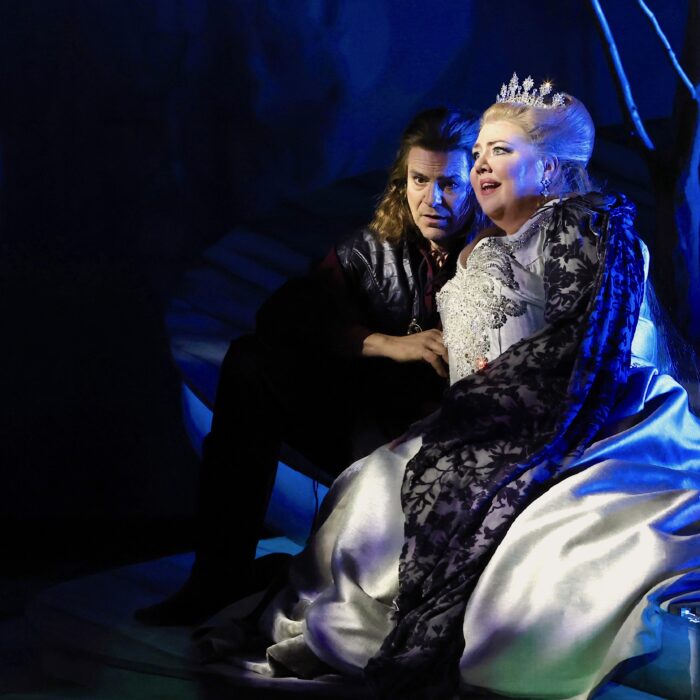
However, when we first meet the love of his life, Elsa von Brabant, radiantly sung and acted by South African soprano, Elza van den Heever, the poor victim of an intrigue by Count Telramund and his hurtful and dreadful wife-come-witch, Ortrud, she’s being dragged to the stake by a couple of Satanists for her Christian beliefs.
And following the famous aria, “Elsa’s Dream” – describing the handsome young knight who comes to her aid in time of need – that moment of absolute glory comes in the best tradition of Flash Gordon. She’s saved in the nick of time by her unknown Electrical Hero in an amazing white neon-flashing light sequence that floods the stage in an extravagant piece of theatre thus providing a magical touch by lighting designer, Reinhard Traub, whose overall lighting scenario focuses on a shrouded-blue set, a primary colour greatly favoured by Wagner.
The sword fight coming at the end of Act one produces another extravagant piece of theatre while showing off the large Festival Chorus (dressed in similar vein to characters found in a Pieter Bruegel painting) to good effect while Sharon’s expertise in crowd scenes is brilliantly and skillfully handled.
Gathering slowly together round a roped-off area in the shape of a boxing ring, the peasants are seen pushing and jostling for the best position to watch the combat between Telramund and the Stranger Knight while aerialists re-enact the scene unfolding beneath them thereby adding a colourful and extra dimension to the overall stage picture. The latter-named, of course, wins the day but magnanimously spares his opponent’s life with the scene ending on a high with the chorus, so well trained by Thomas Eitler-de Lint who has taken from Eberhard Friedrich, in full voice championing the victor.
The opening of act two focuses on the disgraced couple, Telramund and Ortrud, forcibly arguing the toss with one another over Elsa performed by two formidable singers who know the drill so well – Ólafur Sigurdarson and Miina-Liisa Värelä – commanding the stage and choked by envy, aggression and anger. By their very nature, they’re a nasty deuce.
As turbine halls are cathedral-like in structure and appearance, they possess extremely long ‘naves’ therefore the pomp and ceremony of the bridal procession worked exceptionally well in such a setting. And in preparation for the bride’s entrance, flower petals are spread here, there and everywhere making a ‘perfumed’ path for the long walk. But being obsessed about the origin and name of her future husband, it proved a procession of doubt, despondency and desperation for Elsa.
Walking proud and grand, however, the groom is adorned by a silver-coated breastplate and a pair of long thin wings (biting nasty insect? pretty dragonfly?) while Ortrud is seen beavering away adding poison to Elsa’s dilemma concerning the identity of her future husband.
And just at the crucial moment of the wedding ceremony, Ortrud appear ominously once more asking those fatal (and vital) questions with this dramatic and convincing scene amplified and brought to boiling point by Christian Thielemann driving members of the Bayreuth Festival Orchestra and, indeed, members of the Bayreuth Festival Chorus, to a powerful and inspiring performance that thrillingly closed the act on a skilfully mixed note of doubt, joy and confusion.
Just as Lohengrin comes to Elsa’s aid in a shaft of burning light saving her from bondage and the burning stake, the situation is completely reversed on her wedding night as in the confines of the wedding chamber, gaudily and dominantly decorated in a bright-orange colour (the official livery of the House of Orange) she becomes his captive. Still too curious as to his identity, Elsa plies him with a series of awkward questions but, having none of it, the Silent Stranger suddenly acts even stranger and forcibly engages in the fetish of bondage. He ties her to a mast with an electric piece of cord in a flush of passion and sexual excitement.
And the mast that she’s tied to eventually gives way to a quick burst of electrical energy as if breathing new life into her. Now a self-determined and confident young women dressed in a bright and smart orange-coloured long-flowing dress with a pack-back to match, she exercises modern-day women, dumps Lohengrin fair and square, to live a new life. The end of her dream. The end of his torture.
Altogether, Sharon conjures up a tale of female empowerment in his realization of “Lohengrin” observing that the female characters propel most of the action. He delivers a sure-fire ace at the end of the opera, too, by crazily drifting away from the libretto thereby offering a bizarre twist to the plot in as much as Elsa and Ortrud are spared their life while everyone else drop like flies.
Perhaps they sailed too close to the wind and perished in blinding white light. Who knows? Elsa’s long-lost brother Gottfried (the young duke of Brabant) is turned into a swan by the evil magic of Ortrud but in another twist of the plot he reappears as a Green Man – in the guise of an insect-catcher or, perhaps, in disguise as Telramund? I’m still thinking about it.
In many respects, “Lohengrin” is most probably the most beautiful and romantic score Wagner ever penned and in the playing of the well-loved Prelude, based almost entirely upon the theme of the Holy Grail, Christian Thielemann captures so well the very essence and beauty of the score which Wagner romantically (and accurately) described: “Out of the clear blue ether of the sky there seems to condense a wonderful yet at first hardly perceptible vision and out of this there gradually emerges, even more and more clearly, an Angel Host bearing in its midst the Holy Grail. As it approaches earth, it pours out exquisite odours, like streams of gold, ravishing the sense of the beholder. The glory of the vision grows and grows until it seems as if the rapture must be shattered and dispersed by the very vehemence of its expansion. As the flames die away, the Angel Host soar up again to the ethereal heights in tender and everlasting joy.”