Bayerische Staatsoper 2025-26 Review: Die Walküre
By Ossama el Naggar(Credit: Monika Rittershaus)
The burden of immortality
Few opera houses can claim the historical authority of Munich in matters Wagnerian. It was here, after all, that “Das Rheingold” and “Die Walküre” first reached the stage, and any new Ring mounted by the Bayerische Staatsoper must inevitably negotiate not only Wagner’s score but also the immense weight of tradition. Tobias Kratzer’s new “Die Walküre” (seen on July 1), succeeds because it attempts innovation through a profound interpretation of the text and eschews gratuitous iconoclasm for mere shock value, as Kratzer allows the psychological logic of the libretto to generate the production’s imagery. The audience was never left to decode allegories; instead, every scenic gesture appearing to emerge naturally from the emotional landscape of the characters.
The first act was remarkable for its intimacy. Hunding’s house became not merely a dwelling but the physical manifestation of domestic tyranny. Every detail contributed to a portrait of a marriage hollowed out by ritualised violence. Sieglinde’s instinctive anticipation of Hunding’s demands, her habitual gestures of submission, and the almost liturgical atmosphere surrounding his household created an environment in which oppression had become second nature. Kratzer understands that Wagner’s incestuous love story only achieves its shattering force, and to an extent the public’s understanding, when the surrounding world has become morally unbearable.
Kratzer’s direction of actors was consistently exceptional. Relationships unfolded with extraordinary precision. Siegmund and Sieglinde did not simply fall into one another’s arms; attraction developed hesitantly through shared recognition, fleeting glances and gradually accumulating trust. Their discovery of one another possessed genuine dramatic inevitability. By the close of the first act, “Winterstürme” seemed less a lyrical interruption than the inevitable flowering of two souls who had finally encountered freedom. This directorial choice made the staging of the opera’s first act among the strongest ever seen.
Another winning aspect of the production was the juxtaposition of the Norse gods with contemporary mortals. The everyday familiarity of Hunding’s bourgeois home made Sieglinde’s suffering very real, more cinematic than theatrical. The coup de maître was linking the mortals to the gods through religion. The presence of a Marian shrine in lieu of the oak tree at the family’s dining room and another altar in the garden dedicated to the Virgin Mary/Fricka confirmed the relevance of the gods in the life of humans. Even more clever was the use of video to bring up memories such as scenes from the childhood of the twin siblings, including one where little Siegmund is shown Notung by his father. The adult Siegmund does not extract the sword from an oak tree but rather retrieves it from among a collection of swords and guns locked up in a cupboard in Hunding’s home.
Astutely, Kratzer had the second act take place in Hunding’s dwelling, as if Fricka and Wotan were inspecting the premises. Fricka appreciatively collected the ram that Hunding’s had sacrificed in her honour. She then butchered the animal, the director’s way to confirm Fricka’s authority and inherent violence.
The second act broadened the scale without sacrificing psychological specificity. Wotan emerged not as an omnipotent patriarch but as a ruler crushed beneath the contradictions of his own political theology. Kratzer revealed the tragedy of a god trapped by institutions of his own making. The confrontation with Fricka became a devastating study in constitutional crisis. She was neither shrew nor moralising obstacle; rather, she articulated the legal order that Wotan himself had established and could no longer escape. The scene acquired a tragic dialectic worthy of Greek drama, in which every participant was simultaneously right and fatally compromised.
The siblings escaped in a car with plates having the number 1870, a clin d’oeil to the year the opera was premiered in this very theatre. The car broke down in the forest in front of a burnt out hut that we understand was the home the siblings used to live in once upon a time. This desolate scene became appropriately where Siegfried met his end. Michael Bauer‘s use of light made this setting particularly effective and lugubrious.
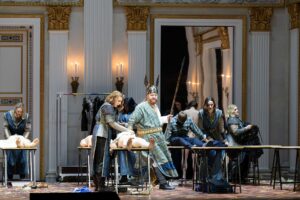
Though it greatly appealed to the public, the final act was the least appealing as far as staging. In a humorous wink to Francis Ford Coppola’s 1979 film “Apocalypse Now,” we were shown a video of the Valkyries in a helicopter flying over Munich during the “Ride of the Valkyries”. Several Valkyries stride through the city collecting fallen men who qualify for hero status and for Wotan’s army. Understandably, this scene dazzled the audience but it felt rather artificially superimposed. The rest of the act taking place at a copy of the very Bayerische Staatsoper’s Nationaltheater was both appropriate and effective. The Valkyries were stagehands in one of the opera house’s workshops performing funereal rites on the fallen heroes before dressing them as warriors. Finally, putting Brünnhilde to sleep at the Nationaltheater was a clever idea with witty implications.
One interesting aspect of the production was both Brünnhilde and especially Wotan’s struggle with immortality. In the third act, the long scene between the two echoed a vampire’s lament; the lack of meaning of life if it is not finite. Once rendered mortal, Brünnhilde bleeds when cut by Wotan. In contrast, Wotan vainly attempts to bleed by cutting himself, as if desperate for mortality as an escape from the burden of mortality,
Musically, Vladimir Jurowski confirmed once again that he has become one of today’s foremost Wagner conductors. His reading rejected monumental rhetoric in favour of relentless dramatic momentum. His tempi breathed naturally, were never hurried, yet nor were they indulgent. Throughout the evening one sensed an acute awareness that Wagner’s endless melody was built not upon static sonority but upon perpetual harmonic motion. The Bavarian State Orchestra responded magnificently. One scarcely knew whether to admire more the burnished nobility of the brass, the astonishing transparency of the woodwind writing, or the remarkable elasticity of the strings. Jurowski achieved an orchestral texture of uncommon clarity in which even densely scored passages retain chamber-like definition. Leitmotifs emerged organically from the orchestral fabric rather than being underlined for their own sake, allowing Wagner’s immense symphonic architecture to reveal itself with compelling inevitability. Jurowski’s management of dynamic scale was particularly impressive. The “Todesverkündigung” unfolded with breathtaking restraint, while the closing pages attained profound emotional grandeur without ever descending into sentimentality.
The casting achieved an unusually high degree of dramatic cohesion. American bass-baritone Nicholas Brownlee offered a Wotan of uncommon complexity. Vocally, the instrument combines youthful amplitude with remarkable textual clarity, but it is the intelligence of the characterisation that proved most memorable. Brownlee avoided every temptation towards declamatory grandiosity, a common pitfall in this role. Endowed with excellent diction and clear phrasing, he manifested his authority in his second act’s opening phrase “Nun zäume dein Ross, reisige Maid” and terrified in the third act’s “ Wo ist Brünnhild’, wo ist die Verbrecherin?” and yet he brought one to tears in “ Leb’ wohl, du kühnes, herrliches Kind!” This Wotan is a ruler who understood, long before admitting it to himself, that his own project had failed. The great monologue was less a display of authority than an extended confession, unfolding with devastating cumulative honesty.
Finnish dramatic soprano Miina-Liisa Värelä, admired as an effectively moving Leonore in “Fidelio” in Toronto and as the conniving Ortrud in Bayreuth’s production of “Lohengrin,” was an excellent Brünnhilde, if not in the same league as Brownlee’s Wotan. An excellent actress, she charted the gradual awakening of moral consciousness with exquisite sensitivity. Rarely has one sensed the Valkyrie‘s transformation through her encounter with the lovelorn Siegmund. Long before Wotan’s punishment, this Brünnhilde had already acquired a high degree of humanity. On the negative side, her diction was often muddled, which matters greatly in this role. In the second act, she delivered all the high notes but seemed tentative. In the third act, she was much more in her element. Värelä‘s voice had thrilling reserves of power for the great climaxes, yet what impressed even more was her capacity for nuance. The transition from divine obedience to compassionate independence became the emotional centre of the evening, making the final farewell all the more affecting.
Irene Roberts was a revelation as Sieglinde. Amazingly, the American singer was a mezzo until recently and had sung roles such as Amneris, Carmen, Rosina, Kundry and Venus. The mezzo antecedents may explain the great warmth in her voice. Hearing her bright high notes, one can hardly conceive that Roberts was once a mezzo. Her bright soprano is sensual, capable of conveying her rapture in her duet with Siegmund. Her voice contrasted beautifully with Värelä‘s in their scenes together Her singing combined luminosity, warmth of tone with exceptional textual responsiveness, while dramatically she avoided every trace of operatic victimhood. A supreme actress, she magnificently portrayed the abused wife through little gestures, such as looking down, anticipating her husband’s needs and frequent recoiling.
Swedish tenor Joachim Bäckström proved an ardent and intelligently lyrical Siegmund, his phrasing consistently attentive to Wagner’s long melodic paragraphs. He impressed with his clear phrasing, bright high notes and expressiveness. His scenes with Roberts achieved precisely that elusive quality Wagner required: erotic ecstasy inseparable from existential recognition.
Among the supporting roles, Estonian bass Ain Anger provided a genuinely frightening Hunding, whose menace derived less from overt brutality than from absolute certainty in his own righteousness, the prototype of a political fanatic or a religious zealot. An impressive Fafner in David McVicar’s “Ring” at La Scala, Anger managed to convey his weakness despite his brutality.
With her recent Ortrud, Brangäne and Kundry in Bayreuth, Russian mezzo Ekaterina Gubanova is increasingly becoming a Wagnerian icon. Her Fricka was magnificent, sung with imposing authority but also profound dignity. Her arguments emerged not as jealous complaints, but as the lucid defence of an ethical order collapsing under the weight of Wotan’s exceptions. It was a relief not to experience Fricka as the oft portrayed nagging virago.
What finally distinguishes this “Walküre” is its refusal to simplify Wagner’s moral universe. Kratzer neither celebrates nor condemns his characters. Gods, heroes and victims alike remain caught within systems larger than themselves, struggling toward freedom without ever fully escaping history, law or inherited belief. Such complexity is entirely faithful to Wagner’s tragic imagination.
Munich has produced many distinguished Wagner performances over the decades, but this “Walküre” possesses the unmistakable feeling of a production destined for longevity. It combines theatrical intelligence with profound musical insight, spectacular visual imagination with minute psychological observation. As the second installment of Kratzer’s unfolding Ring, it augurs an immensely promising tetralogy. If the remaining dramas achieve a comparable synthesis of intellectual seriousness, emotional truth and musical excellence, Munich may well have created one of the defining Ring cycles of our time.