Baden-Baden Festival 2025 Review: Don Giovanni
By Andréas Rey(Photo: Michael Bode)
For its final production of the year, the Baden-Baden Festival presented Mozart’s “Don Giovanni” from December 19 to 21. It was conducted by Iván Fischer with baton and on the plateau, because the conductor, like Karajan before him, also directed the staging.
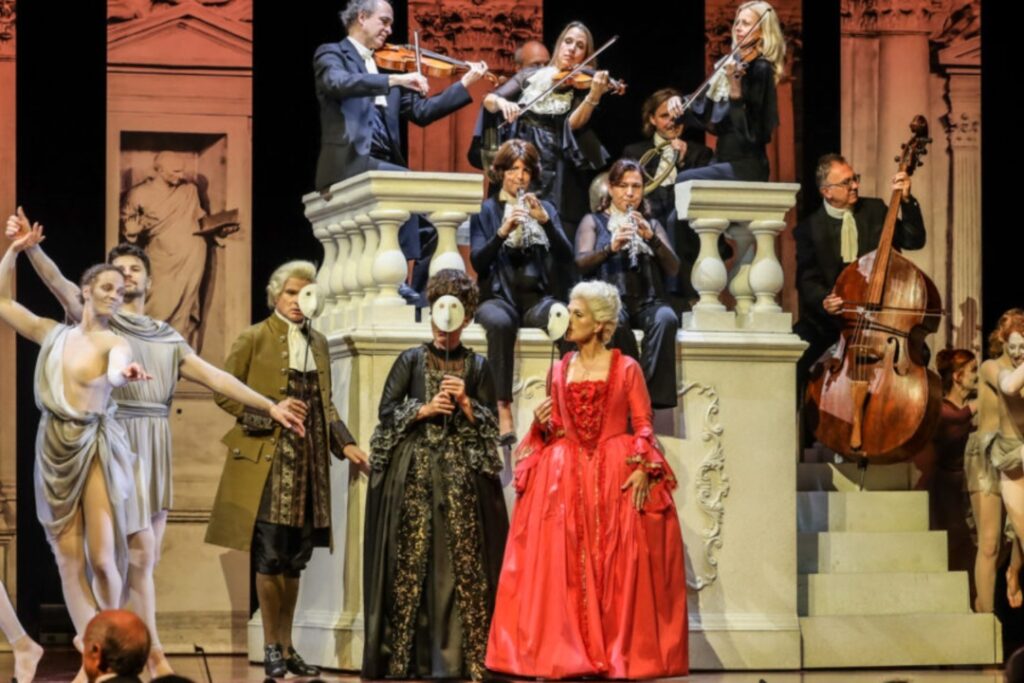
The foremost quality of this production was undoubtedly the silky smoothness and harmony of the orchestra, which played a great Mozart symphony. And who would be saddened by a three-hour Mozart symphony? It was organized with the winds around the conductor and the strings at the back, giving it a perfect balance between the sections and a luminous homogeneity. Unlike other more modern conductors such as Teodor Currentzis, who bring a particular vision or perspective to their orchestra, Iván Fischer’s conducting tended towards the very classical style of Karl Böhm, revealing the beauty of Mozart’s lacework in a white light. Nevertheless, while this seemingly simple approach revealed the refined elegance of Mozart’s music from the opening, at times it bordered on obliterating the narrative aspect of the work during the drama.
(Photo: Michael Bode)
Production Details
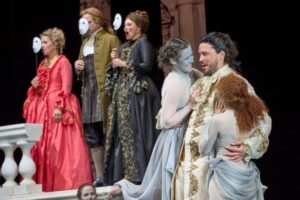
The staging was classical. The costumes were designed by Anna Biagiotti and the characters looked as if they were in the 18th century. Like many contemporary directors, Iván Fischer omitted in the opening scene that Don Giovanni tried to rape Donna Anna in her sleep the night before, as she recounts after the first meeting between Donna Anna, Don Octavio, and Don Giovanni, explaining why Don Octavio feels a distance between Donna Anna and him in the second act. However, he clearly showed the second tentative with Zerlina in her underwear, during the celebration of her wedding party at his palace.
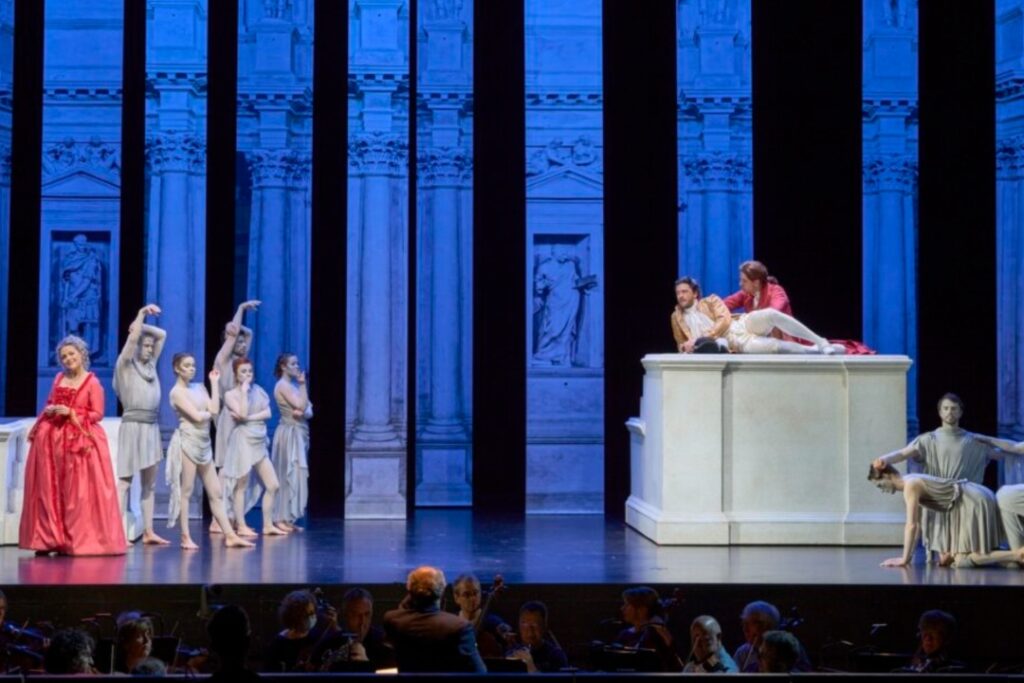
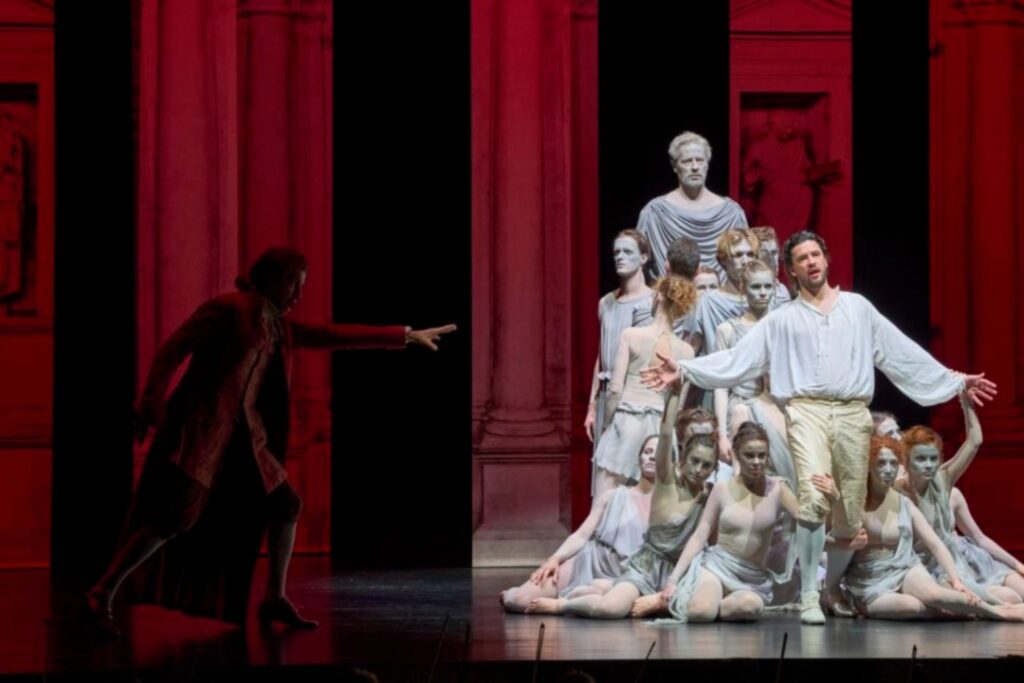
This staging also used the theme of statuary, on the one hand in its decor with painted canvases of sculptures at the back of the stage, and with two large pedestals on the stage, and on the other hand, and above all, with the characters who, sometimes posed like sculptures in a park, sometimes singing and dancing in the choruses, and sometimes serving as stagehands, draped in ancient times. This was undoubtedly the most annoying aspect of all the staging. They sometimes emphasized what the scene already pointed out, sometimes embodied, for the female characters, the seducer’s possible past conquests, without specifying then what the male characters represented, and sometimes acting as stagehands.
Another issue was with the Commendatore. In the opening scene, he was an old man leaning on a cane, thus losing his aura, even though he already embodied the authority that Don Giovanni clashed with throughout the opera. As a statue in the second act, he did not move forward and did not shake hands with the seducer, contrary to the libretto. The cemetery scene, where Leporello saw him nodding his head, was played behind a pedestal. The audience only saw his head and needed to see more.
It was also regrettable that the final scene, in which the characters said what they intended to do after the seducer’s death, was removed, transforming the end of the opera into a kind of happy ending, whereas the libretto’s ending is much less happy (Donna Anna postponing her marriage to Don Octavio for a year, Donna Elvira going to a convent, Leporello being unemployed, and the couple, Masetto and Zerlina forced to grow up, traumatized by their association with the womanizer).
(Photo: Michael Bode)
Musical Highlights
The strength of this production was in the voices and performances of the male roles. Italian baritone Andrè Schuen, known for his Schubert lieder, portrayed Don Giovanni as a determined seducer, not without elegance, whose masculinity needed no emphasis to be imposing. It is regrettable, however, that he was unable to fully express the character’s madness and delirium during the aria “Finch’han dal vino.” He remained too restrained, reasonable, and reserved in his singing.
The Leporello of Italian bass-baritone Luca Pisaroni, whose comic vice delighted throughout the performance even when it seemed exaggerated, followed the opera’s buffa vein, while his colleague followed the seria vein. Like him, his voice had a natural projection and articulation, making his arias as fluid as his recitatives, and moving with ease from one to the other. His catalog aria “Madamina, il catalogo è questo” was as amusing as it was amused. It was, however, regrettable that he felt compelled to stick his tongue out at Donna Elvira at the end. But each of the scenes in which he was accused in Don Giovanni’s place showed the ease with which he played his role.
The Masetto of Mexican bass Daniel Noyola possessed the fluid naturalness that is quintessential to Mozart. His aria “Ho capito, signor sì!” revealed the jealous, angry, and fearful character.
But the most pleasant surprise in this production for the male voices was undoubtedly the Don Octavio of Swiss tenor Bernard Richter, whose smooth, velvety, enveloping timbre seduced the listener and gave an unexpected and welcomed weight to the character, who was otherwise the least interesting in this opera. Each of his arias was like a little recital moment.
(Photo: Michael Bode)
It was unfortunate that the voices of Donna Anna and Donna Elvira only truly shone from the second act onwards. The orchestra, whose volume was not particularly loud, almost completely drowned them out during the first act. The Swedish sopranos Miah Persson and Maria Bengtsson displayed fragility but not fragile voices. They were almost translucent, with restrained tenderness and perspiration, as in the arias “Mi tradì, quell’alma ingrata” and “Non mi dir, bell’idol mio.” The emergence of these voices from the darkness made the second act the more beautiful of the two. The Zerlina of Italian soprano Giulia Semenzato, was undoubtedly the most remarkable of the singers. She was very impressive. Her robust timbre allowed her to be heard as soon as she entered on stage, her aria “Giovinette Che Fate All’amore” immediately captured the audience’s attention. She embodied a stronger than usual Zerlina who knew how to be seductive, charming, and tender towards Masetto and allowed herself to be seduced by Don Giovanni.
The duets with Donna Anna or Donna Elvira and Don Octavio, Leporello or Don Giovanni were somewhat uneven during the first act, and more balanced in the second, with the singers’ voices prevailing over those of the female singers, particularly during the first duet between Don Octavio and Donna Anna, “Fuggi, crudele, fuggi! ” while those with Zerlina were more balanced and therefore more enjoyable.