ABAO Bilbao Opera 2025-26 Review: Werther
By Mauricio VillaABAO-Bilbao opened 2026 with a production a Massenet’s masterpiece, “Werther,” with the Spanish tenor Celso Albelo stepping in after the sudden cancelation of the tenor cast for this role.
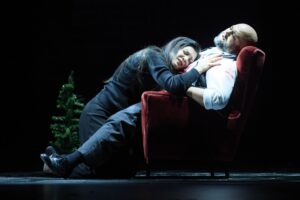
The stage director Rosetta Cucchi presented a metaphorical production with showed hyperrealistic sets: like the living room at the first act or the library on the second act with symbolic elements present during the whole show at the front stage. A couch where Werther appears during the prelude seating with the wooden box containing the guns at the stage right, and two large trees on stage left. The proscenium space (where these elements were placed) symbolized Werther’s emotional state and therefore the character goes to this space when the unstable mind of the protagonist tortures him. While the centre of the stage focuses on the action of the scenes mixing realism and metaphorical in a perfect communion. For the final scene the tree is dead and lies on the stage. The action is set in an atemporal time period being very close to today’s audience. The acting was very detailed and realistic, avoiding the cliché outburst which are usually performed while portraying Werther’s character as gravely mentally ill.
Celso Albelo as Werther
Tenor Celso Albelo as Werther showcased his extraordinary vocal qualities including his dark metallic timbre, astonishing legato, extensive tessitura and impressive projection. This made him ideal for this difficult character. Werther sings the majority of the opera and it’s constantly written in the higher part of the passaggio zone: between F sharp and A natural. Albelo’s bel canto background enabled him to surface such a high tessitura effortlessly and delivered powerful ringing high notes as well as beautiful dynamics.
He sang his entrance aria, “Je ne sais si je veille,” with explosive emotions coloring every phrase with excessive euphoria and delineating the big mental struggle of the protagonist. With a perfect French style and diction, he sang the long poetic lines with incredible breath support, delivering several ringing high A naturals in “a l’air dun paradise,” and finishing with a strong G in “de tes rayons,” while using an exquisite mezza voce for the line “O calme solennel.” He was powerful and ardent as well as poetic, sorrowful and lyrical. And this is the reason why this role is so difficult: Lighter tenors lack the power and drama, while more powerful voices struggle with the high tessitura. Albelo emitted another explosion of emotion in “O spectacle idéal d’amour,” as he sees Charlotte with the children and falls madly in love with her. He was extremely moving and emotional for the duet, “Il faut nous séparer,” showing the exaggerated sweetness and joy that Werther feels, navigating again through the hard tessitura effortlessly, coloring every line and creating a constant contrast between the explosions of emotions sang in forte with beautiful mezza voce. He delineated an incredible crescendo during “Rêve! Extase! Bonheur!” starting in a soaring pianissimo while growing into a forte high A flat during “à son tour les contemple un moment!” where his voice was present above the fortissimo of the orchestra. He sang with deep sorrow and emotion “Moi j’en mourrai! Charlotte!”
In the second act, the tenor sings two arias “Un autre est son époux!” which is a constant outburst of rage, impotence and self-damage that Albelo sang with thrilling emotion using his powerful strong voice. He sang the second aria, “Lorsque l’enfant revient d’un voyage,” going through an amazing dramatic arch which goes from sadness and abandonment to desperation, as he begs God to take him with him in “Appelle-moi!” delivering a top ringing B natural. One could observe the tenor’s interpretation and the breaking down of the character, which kept growing and getting stronger, as Werther finished the act in his coach, hitting his head violently with his hands and rubbing the gun against his face.
Albelo’s interpretation in the third act was terrific. He sounded dangerous, accusative and aggressive, to the point that what I felt during his interpretation of the famous aria “Pourquoi me reveiller o souffle du printemps?” was anger. I have never seen or heard this aria sang with such extreme emotion, the high A sharps were desperate screams from a tortured soul. The tenor received a strong ovation after the aria. He kept growing for the short duet with Charlotte, where he became ardent and abusive.
Werther’s final scene was, for me, the highlight of Albelo’s performance. He managed to keep the voice with a dying sound throughout the whole scene, by singing in mezza voce, giving air to some notes and delivering some plain lines (without vibrato). It is quite demanding and challenging to sing fifteen minutes with this expressiveness, while lying on the floor or against the coach the whole time. Albelo was extremely moving as he managed to express the happiness his character feels because Charlotte finally declares her love to him, kisses him, caresses him and then dies in her arms.
It is known that Albelo has an exceptional instrument and technique, but he proved his emotional acting skills in such a complex character, which one might consider today as bipolar, going from extreme happiness and ecstasy to deep sorrow and pain. He delineated clearly the deterioration of the character’s mind, avoiding verismo cliché effects which is where most tenors fail, either they are over acting, or their interpretation is too plain and lacks emotion. Celso Albelo as Werther is probably one of the best right now.
Annalisa Stroppa as Charlotte
Charlotte was portrayed by mezzo soprano Annalisa Stroppa. She has a dark velvety timbre with a stable vibrato and total control of her large vocal range. The role of Charlotte is very well written as Massenet keeps the voice inside the stave for the first two acts where she sings just a few lines, giving the mezzo soprano the chance to warm the voice up on stage before her long scene in Act three. Charlotte’s first scene in act three was where Stroppa showed her powerful dramatic voice. Her strong lower register during the low C’s in “tu frémiras! tu frémiras!,” and her top ringing high G’s and A naturals for the final section of this scene. Her third act duet with Werther was a palette of contrast in feelings, from denial, to love, to abandonment and regret where the mezzo delivered strong and dramatic high A naturals and A sharps, coronating the scene with the hair rising line, “Dieu! comment m’est venu ce triste courage, d’ordonner cet exil et cet isolement?” in a terrifying fortissimo. Despite the high tessitura of the last scene which demands constant ascensions to A flats and A naturals, the difficulties lie in the acting and Stroppa was very moving and convincing as she finally declares her love for Werther while she prays and begs for his salvation denying the death of the protagonist. Stroppa’s interpretation showed an incredible amount of guilt, as Werther’s distorted mind somehow blames her for committing suicide.
More Musical Highlights
The rest of the characters of this opera are delegating basically to supporting lines or brief interventions. Even the character of Albert, which is crucial for the conflict of the plot (as Charlotte promised her mother on her death bed to marry him) barely sings a few lines during the first three acts. Angel Odena was a convincing Albert with his dark and powerful baritone voice. Sophie was sung by Lucía Iglesias. She accomplished perfectly the demands of this role with her light timbre and her soaring sustained A naturals. Josu Cabrero and José Manuel Díaz were funny and interactive in their respective roles of Schmidt and Johan. Enric Martínez-Castignani was a solvent Le Bailli in his short intervention during the first act.
Carlo Montanaro began with extreme dramatism and strength during the first bars of the opera, anticipating the tragedy that would develop in the opera. He alternated easily to the colorful and melodic “nature” leitmotiv. His work was in constant contrast between darkness and lightness, extolling all the timbres and details that Massenet wrote in his score. He managed to obtain a perfect balance between the orchestra and singers. They not only could be heard at all times but mixed with the orchestration expressively. It was a brilliant the collaboration of the Bilbao Symphony Orchestra and the children’s choir, Leioa Kantika Korala.
Celso Albelo triumphed as Werther in a short notice replacement, accompanied by the exceptional Annalisa Stroppa and a strong cast, under the ardent and emotional baton of conductor Carlo Montanaro.